Showing posts with label Kepler. Show all posts

Thursday, February 21, 2013

Ejecta Interference Patterns

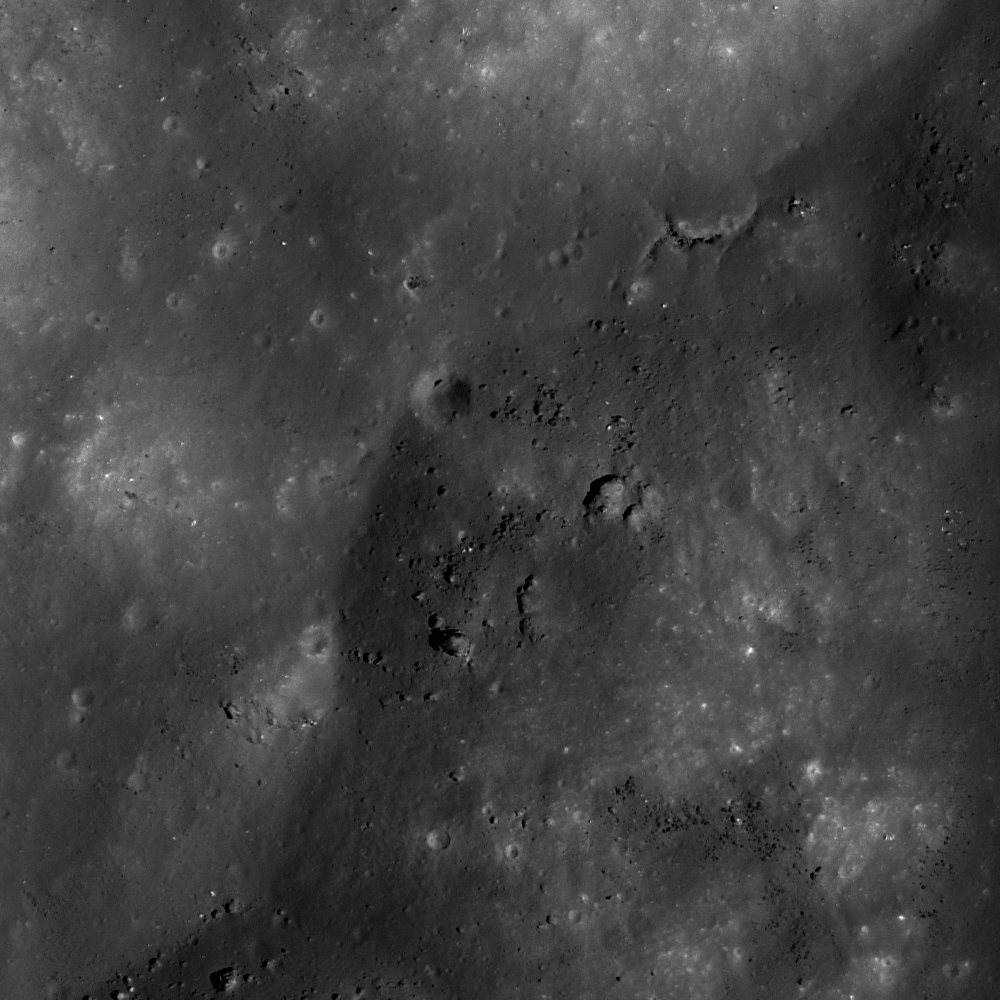
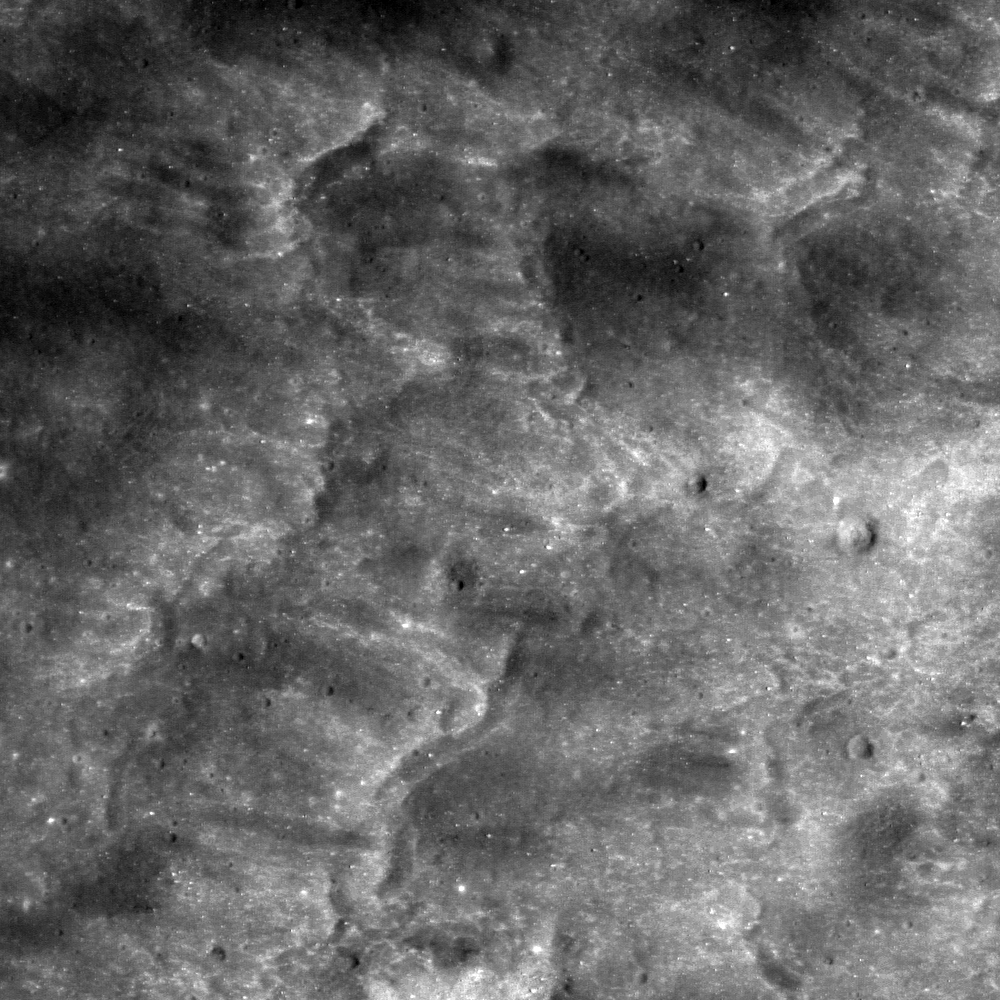
A 960 meter-wide portion of an unnamed young crater's distinctive ejecta deposit pattern, 330 km west-southwest of Kepler in Oceanus Procellarum. LROC Narrow Angle Camera (NAC) observation M188557336R, LRO orbit 12847, April 8, 2012; field of view centered on 3.972°N, 311.942°E, resolution 95 cm per pixel, angle of incidence 21.1° from 114.25 km [NASA/GSFC/Arizona State University].
Hiroyuki Sato
LROC News System

Today's Featured Image highlights a portion of a very fresh ejecta deposit. The source crater is an unnamed crater about 1.2 km in diameter, located within Oceanus Procellarum.

As seen in the NAC context view below, the higher reflectance ejecta spreads radially from the crater, and in some regions may have formed interference patterns that look a bit like fish scales.

The opening image focuses on a typical portion showing this geometric pattern.
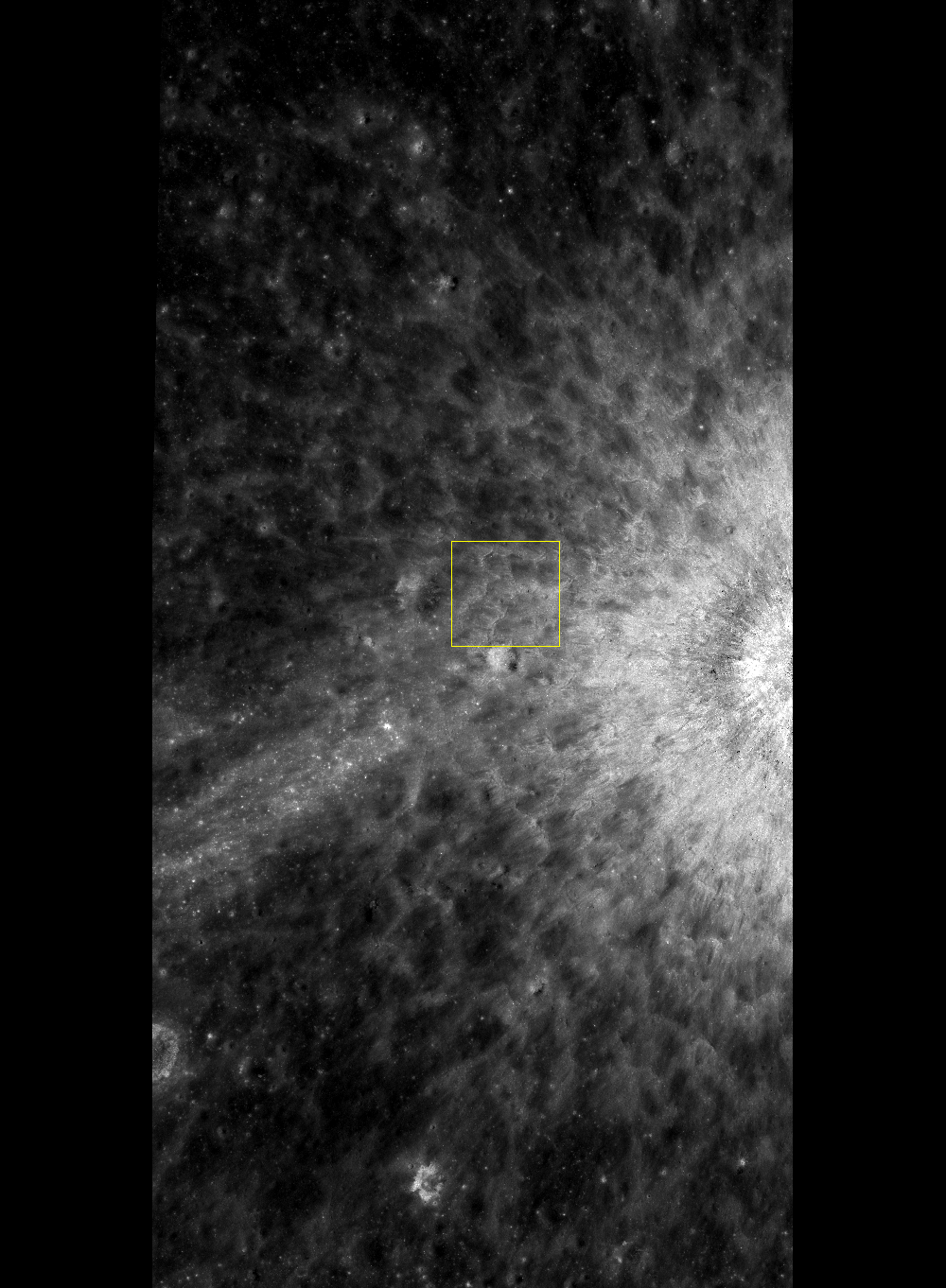
Near the full 5.4 km width of the field of view within the footprint of LROC NAC M188557336R, a context view for the scope of the LROC Featured Image (yellow box) at reduced resolution. [NASA/GSFC/Arizona State University].
In the vacuum of space, the ejected materials experience no atmospheric drag, and thus no fluid dynamic instabilities driven by such an interaction occur. How then was this sparse/dense ejecta pattern formed? The advancing ejecta curtain probably already had internal density contrasts that produced greater or lesser collision frequencies among the admixed rock fragments. Portions having regular density at intervals with portions have irregular density might have formed this odd, scaly pattern.

Context view of the unnamed young crater and vicinity, a LROC WAC monochrome mosaic (100 meters resolution) centered near 3.96°N, 311.94°E. LROC NAC M188557336R footprint represented by a blue rectangle with the location of LROC Featured Image field of view designated with an arrow [NASA/GSFC/Arizona State University].
At full resolution, the area of interest (arrow) is visible in a mosaic of 21 telescopic images stacked on Earth, January 13, 2009. (Note the bright ray from Kepler crossing hundreds of kilometers over and past the vicinity of the unnamed crater, visible from Earth in the midst of the wide middle expanse of Oceanus Procellarum. Field of view is shown context with a reduced view of the complete mosaic below [ASTRONOMINSK].

Explore the exotic patterns of this young crater ejecta in full NAC frame yourself, HERE.

Related Posts:
Lassell D Ejecta
In the Wake of Giordano Bruno
Smooth Ejecta
Polka-dot Ejecta
Brush Strokes of Ejecta
Action Shot
Delicate patterns in Giordano Bruno ejecta
Ejecta sweeps the surface

Wednesday, February 6, 2013

Debris Flows in Kepler Crater

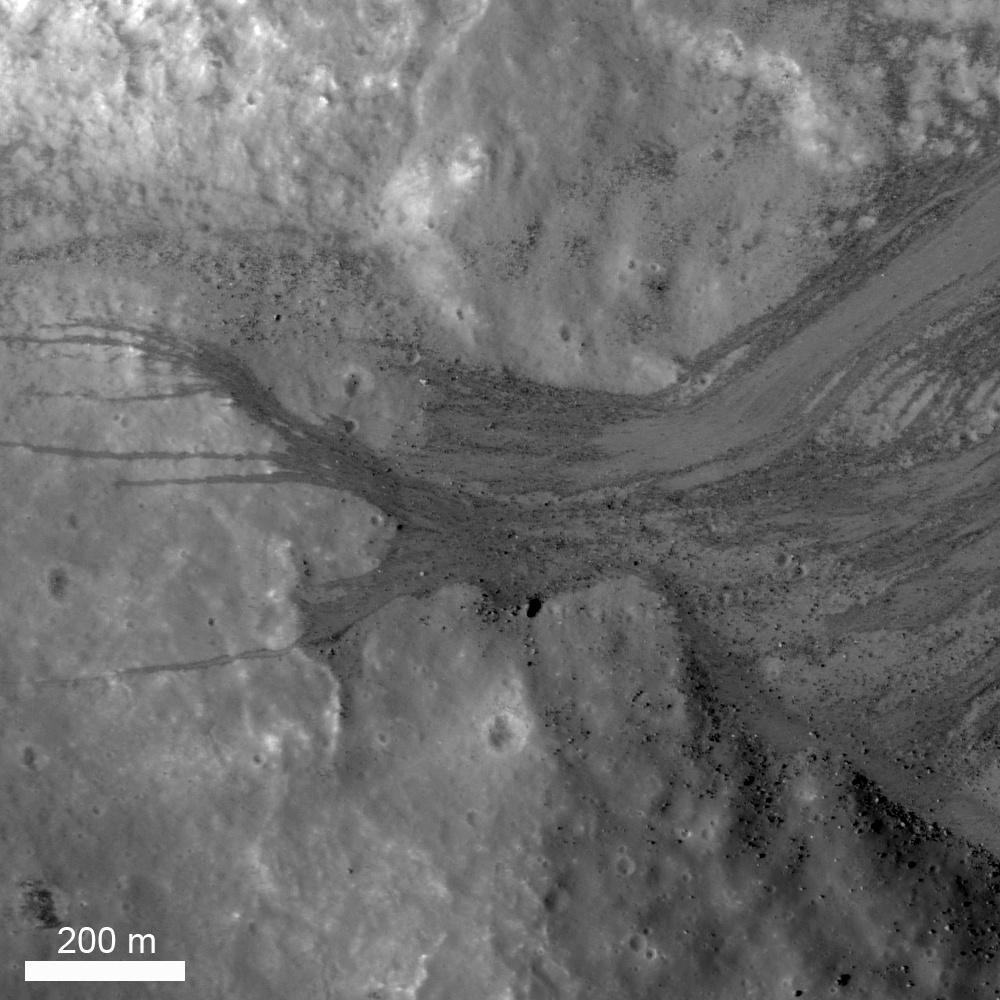
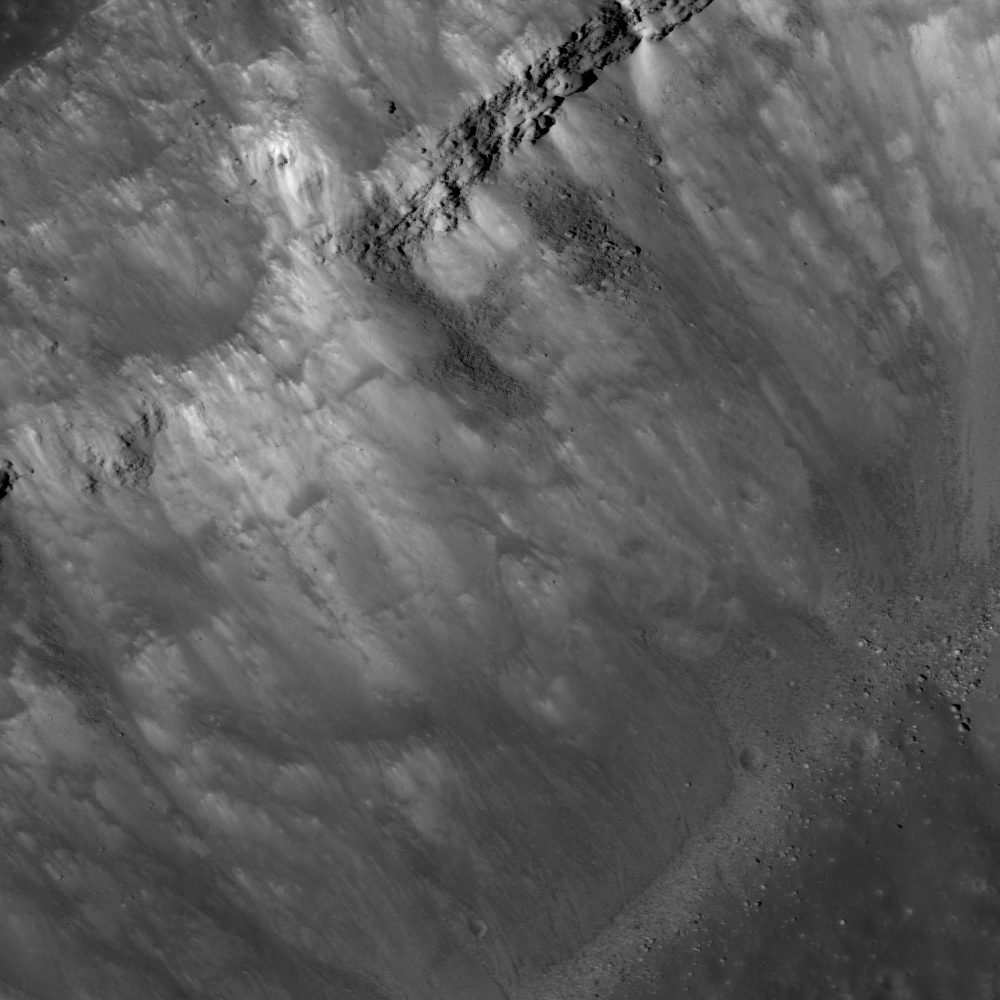
The lower part of the northeast wall of nearside landmark crater Kepler. Loose material is sliding down from near the rim crest (upper right) and ponding on a part of the crater floor. LROC Narrow Angle Camera (NAC) M104755664L, LRO orbit 595, August 12, 2009; resolution 1.27 meters from 119.86 km [NASA/GSFC/Arizona State University].
Jeffrey Plescia
LROC News System

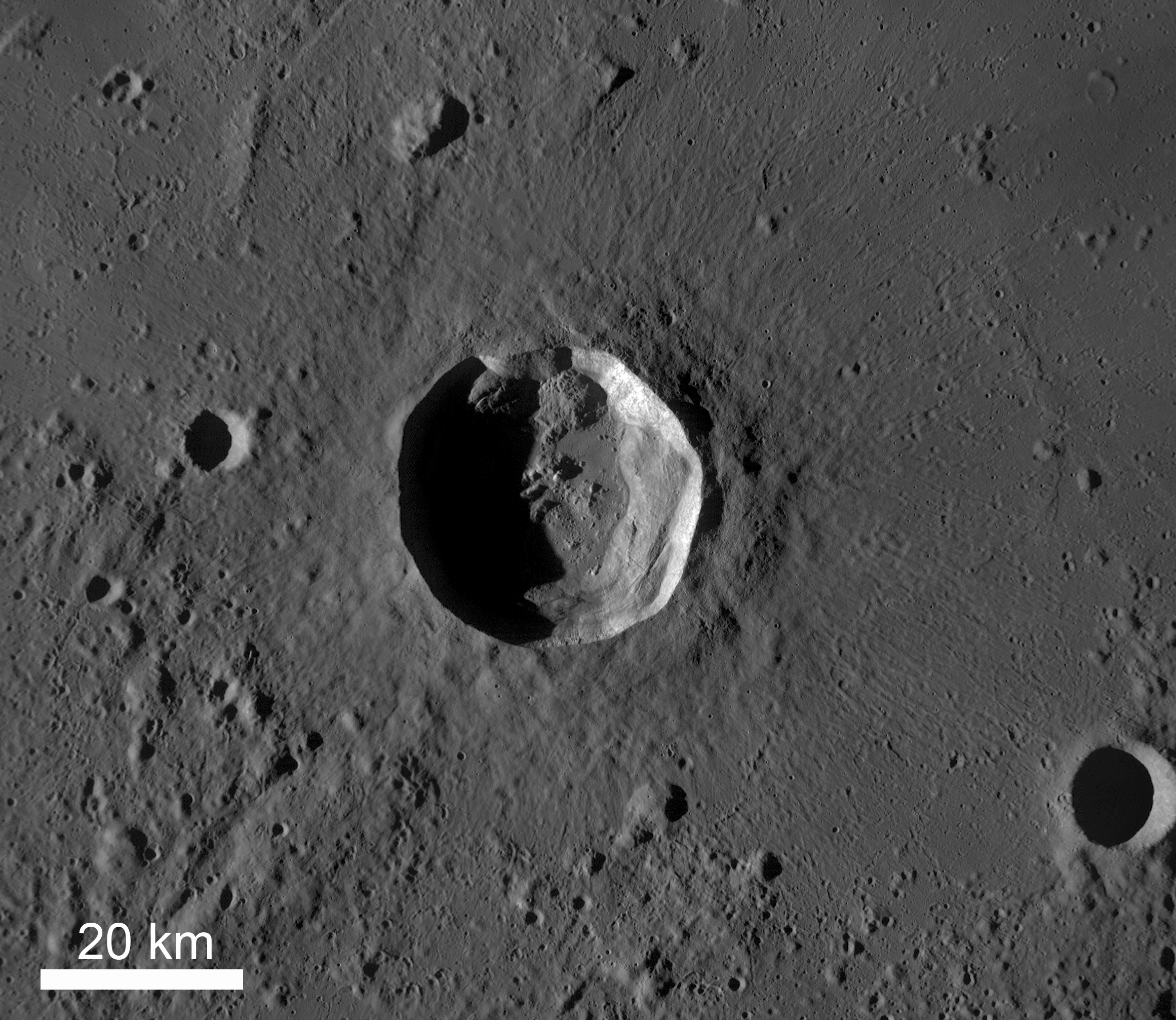
The Featured Image shows the lower slopes of the northeast inner wall of the Kepler impact crater (8.1°N, 322.0°E, diameter 32 km). Loose material often moves down the steep slopes of impact craters, and there are many examples of lunar landslides. The observation that such landslides exist on the Moon were first made during the Apollo program using the images taken from the Command Module while it was in lunar orbit.

This landslide is composed of a range of particle sizes from well below the pixel scale (1.25 m/pixel) to boulders as large as 20 m. Debris slid down the walls and spread out across the crater floor being locally deflected by obstacles on the crater floor. The crater wall has a slope of about 33°.

Another similar pond at the bottom of a long granular debris flow, this one on the southeast wall and floor of Kepler but captured two years later, and at a high resolution opportunity afforded by spacecraft maneuvers in late summer 2011.  LROC NAC M168455361R, LRO orbit 9959, August 20, 2011; 29 cm per pixel, at 36.67° angle of incidence from 22.92 km [NASA/GSFC/Arizona State University].
In the center left of the (top) image, a coarse debris flow was diverted around local topography into several narrow (up to 12 meters wide) flows that extend an additional 400-500 m across the slope and crater floor. Boulders accumulated at the base of the debris flows after rolling all the way down the slope. Debris flows occurred numerous times in this location, as well as many other locations around the crater wall. The material acted as a fluid as it moved downslope flowing around and over obstacles and ponding behind obstructions despite the fact that there was no water present.

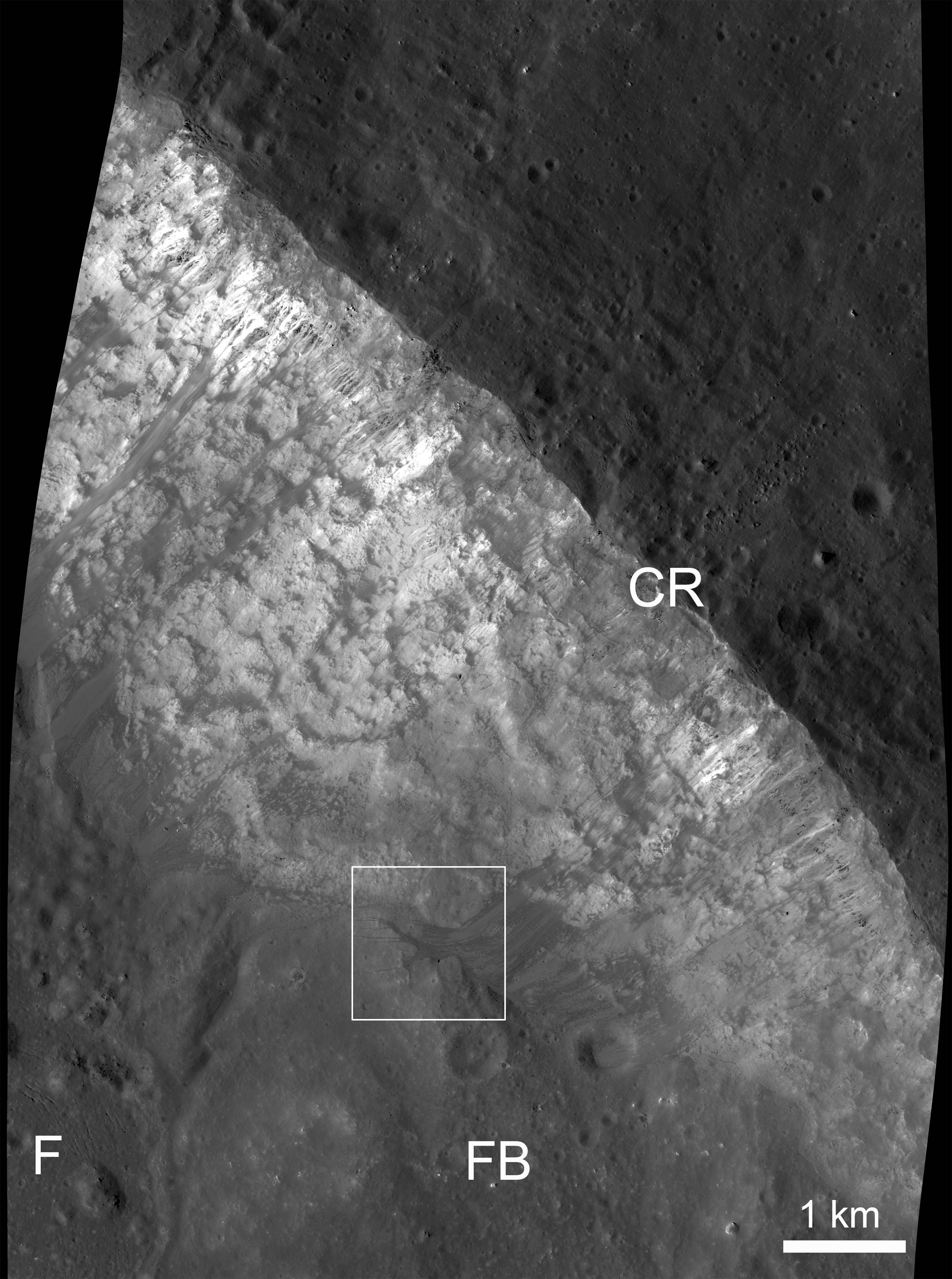
View of the northeast crater wall of Kepler, the field of view in the LROC Featured Image outlined by the white box. Legend: F: crater floor, FB: fault block which has slide down the crater wall, CR: crater rim. LROC NAC M104755664L [NASA/GSFC/Arizona State University].
Above is a reduced resolution version of a larger area around the image shown above (outlined by the white box). Several bright debris flows are observed along the inner crater wall. The area around Kepler crater is illustrated in the wide angle image below.

Kepler Crater (32 km diameter) and surrounding plains, afternoon lighting. LRO Wide Angle Camera (WAC) M117738837M. [NASA/GSFC/Arizona State University].
View the entire LROC NAC frame, HERE.

Oblique view of Kepler from on-board Apollo 12, November 1969; 70mm B/W, AS12-52-5547 [NASA/JSC/LPI].
In the shadow of Copernicus, Kepler's bright, widely distributed ejecta and rays would more easily stand out to the naked eye if the similarly youthful and larger crater to its east did not exist. From one of the incredible telescopic mosaics, this one of a Full Moon, by Yuri Goryachko and ASTRONOMINSK team, March 29, 2010.
 Related Posts:

How Recent?
Granular Flow
Dawes
Debris Channels
Kepler's Rim

Friday, November 12, 2010

The Central Peak of Kepler


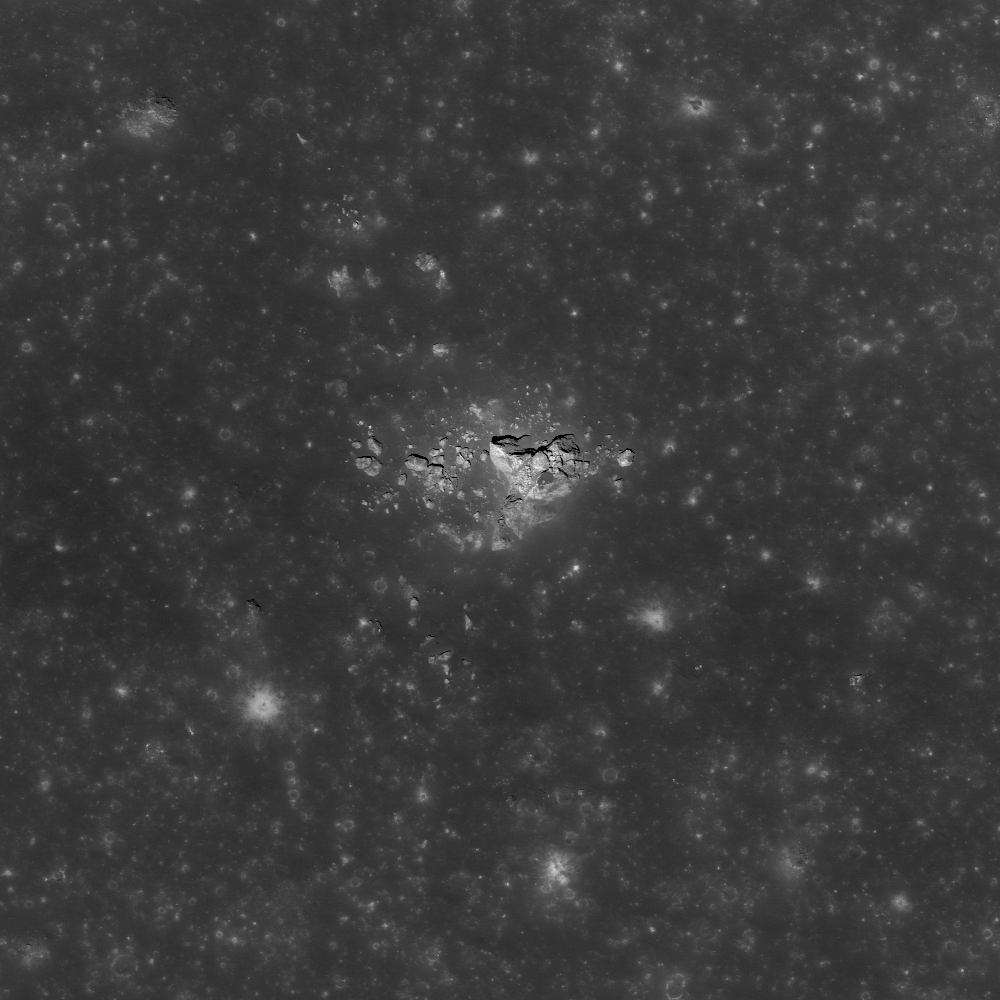
Boulders and simple craters perched on top of Kepler crater's central peak. LROC Narrow Angle Camera (NAC) observation M111843702R, LRO orbit 1616, November 2, 2009; field of view (below and HERE) is 500 meters [NASA/GSFC/Arizona State University].


Drew Enns
LROC News Service

There are two basic types of impact craters: simple and complex. Simple craters form a bowl-like rimmed depression, and complex craters (such as Kepler) display central peaks, terraces, and flat floors. Complex craters occur above a certain diameter crater, the cutoff diameter is dependent on gravity, so it varies from planet to planet (or moon to moon). On the Moon the size cutoff between simple and complex craters is between 10 and 20 km, on the Earth it is between 2 and 5 km.


A full-sized segment of an Apollo 12 orbital shot featured in previous postings from Drew Enns discussing Kepler. From this foreshortened angle (see context below) it's easier to see the minimal central peak does not exceed the crater's rim in elevation [NASA/LPI].


An LROC Wide Angle Camera mosaic of Kepler with an arrow indicating the location of featured NAC image above can be viewed HERE.

Despite the label "central peak," a central peak is not always exactly in the center of a crater, nor is it always symmetrically shaped; Kepler crater is an example. Instead of having a nice central peak, Kepler crater has an irregular off-center peak. This form is most likely due to the crater being close to the boundary diameter between a simple and complex crater. Larger craters, such as King crater, can also display oddly shaped central peaks that are likely the result of an oblique impact.
Link
Browse the whole NAC image of Kepler crater and inspect the landforms associated with its central peak. Can you find evidence of impact melt on the central peak, terraces, and floor?

Related Posts:
Concentric crater
Kepler Crater Ejecta
Kepler's Rim

Wednesday, November 10, 2010

Kepler's Rim


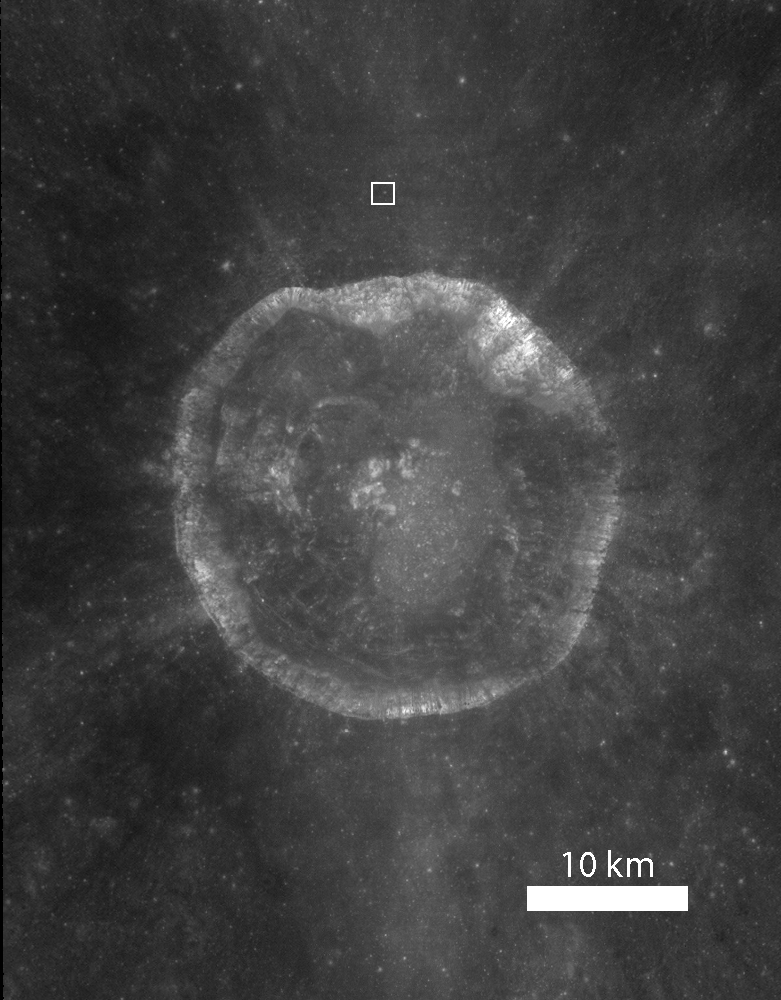
Steep interior wall of Kepler, the crater's northwest rim is to the upper left and interior toward the lower right. Note the exposed layering near the top and boulders collecting at the base of the crater wall. From LROC Narrow Angle Camera observation M107128381R, LRO orbit 926, September 9, 2009; field of view is ~ 800 meters [NASA/GSFC/Arizona State University].

Drew Enns
LROC News System

Landslides are primarily caused by gravity pulling loose material down a slope. Numerous factors contribute to landslides on Earth, including water and vegetation, but these can be ignored for the Moon. However, both bodies are affected by the angle of repose which is related to the cohesiveness of the material making up the slope. Once the angle of repose is exceeded the loose material on the slope slides downhill. Since the exposed bedrock layer near the top of the wall is more cohesive it stays intact while loose rocks and dust slide from underneath. As the wall material continues to slide down, more of the resistant layer will be exposed until it is undermined and is pulled down by gravity. The boulders at the base of the landslides are probably pieces of the bedrock layer.


The range of two LROC NAC observations from early November 2010, from which consecutive Featured Images were derived are seen draped over the Google Earth lunar digital elevation model of Kepler's interior, once again suggesting the vast improvements in resolution since the base albedo map from the Clementine (1994) mission was gathered [NASA/GSFC/Arizona State University].

Explore the rest of Kepler's rim in the NAC image!

Related Posts:
Linné Crater
Kepler Crater Ejecta

Tuesday, November 9, 2010

Kepler Crater Ejecta


Large boulder ejected from Kepler crater, a small depression from the boulder's impact is just visible. LROC Narrow Angle Camera (NAC) observation M140155410L, LRO orbit 5788, September 26, 2010; above field of view is 320 meters, original LROC featured image (here) 800 meters [NASA/GFSC/Arizona State University].

Drew Enns
LROC News System

Kepler is a Copernican aged crater (32 km diameter, 8.1°N, 322.0°E) named for the German Astronomer Johannes Kepler, famous for his three laws of planetary motion. The impact event that created Kepler crater was energetic enough to eject this 100 m boulder out onto its continuous ejecta blanket. Impact events excavate material from great depth (approximately 1/3 the transient crater diameter) and distribute the material around the crater as ejecta. The material at the top of the impacted surface is ejected the furthest, while the deepest material has just enough energy to land on the crater rim. This distance to depth relation creates a natural core sample for astronauts to collect as they explore.


LROC Wide Angle Camera (WAC) context image of Kepler showing the location of the boulder field north of the crater on the downward slope of its ejecta blanket [NASA/GFSC/Arizona State University].


Kepler when the Moon is full, or how the optical immaturity of it's surroundings betray its relative youth in this spectacular photograph by P. Van de Haar of the Netherlands. This is how this familiar near side crater appears through modest telescopes at local "high noon."


In November 1969 the crew of Apollo 12 had a landing transfer orbit with a perilune further west than any other of the Apollo surface expeditions, and as such apparently captured the best images of Kepler prior to LRO, forty years later. The view of Kepler, 557 km northeast of the Apollo 12/Survey 3 landing site, had to have been captured late in the mission [NASA/LPI].


A center slice of a wider wallpaper-sized view of Kepler, looking south from a virtual vantage over the featured boulders, peeking over the north rim across Kepler to the south rim 40 km beyond [NASA/GSFC/Arizona State University/Google Earth].

The lunar mare were formed as old impact basins filled by massive eruptions of very fluid basalt. Its easy to measure the area of these mare basalts, but how thick are they? Are there multiple basalt flows that form the mare? If the mare is thin enough the Kepler impact may have excavated both mare and the underlying highland material. Samples from this boulder, and others like it out to the edge of ejecta could answer these questions. An astronaut would start sampling at the far edge of the ejecta blanket and work towards the rim. During this traverse the intrepid geologist would in effect be traveling down the inside of the crater, without doing all the work of climbing in and out! The last sample on the rim would be from near the bottom of the crater. With this suite of samples the history of the emplacement of the basalts at this spot could be unraveled.

Search for other ejecta boulders in the NAC image!

Related Posts:
Ejecta from Van de Graaf Crater