Showing posts with label Vallis Schröteri. Show all posts

Saturday, August 13, 2011

LOLA: refining impact basin dimensions


Laser altimetry by LOLA, now having traveled nearly 10,000 orbits of the Moon on-board the Lunar Reconnaissance Orbiter, has confirmed the existence of impact basins once believed "questionable" [NASA/GSFC].

GSFC - This image reveals the power LOLA data have in helping scientists refine sizes of impact basins on the Moon. By studying lunar impact basins, scientists refine their understanding of what happened in the earliest stages of the formation of our Solar System, including the size distribution of early impactors.

The Sikorsky-Rittenhouse impact basin, which is estimated to be between 3.9 and 3.5 billion years old, was originally estimated to be 310 km in diameter, and its existence was considered "questionable" in Wilhelms' lunar atlas.


The ghostly Sikorsky-Rittenhouse impact basin, northwest its more-recent doppelganger, the slightly larger and still well-defined Schrodinger basin, is also visible in this LROC Wide-Angle Camera (LROC WAC WMS) global mosaic [NASA/GSFC/Arizona State University].

This initial definition was based on low-resolution images from Lunar Orbiter missions. Later Earth-based radar estimates confirmed Sikorsky-Rittenhouse's status as a basin and placed the basin diameter at 319 km. However, the use of LOLA data have helped scientists to further define the diameter size to 275 km, which represents an 11% decrease in the original diameter estimate. LOLA's high density of measurements across the Moon allows its data to create the most accurate definition of lunar craters ever.

References:
1. Jones, N. and B. Steigerwald, (2010) "NASA's LRO Exposes Moon's Complex, Turbulent Youth," 03 June 2011.
2. Wilhelms, D.E, (1987) The Geologic History of the Moon, USGS Professional Paper 1348
3. Frey, H.V. (2010) Chapter 2, GSA Special Publication Recent Advances and Current Research Issues in Lunar Stratigraphy (in press).
4. Romine, G.C., and H.V. Frey, (2011) "Using LOLA Data to Test the Reality of Candidate Lunar Basins Derived from Older Data," 41st Lunar and Planetary Science Conference, Abstract 1188, March 1-5, The Woodlands, TX.

small | large | high-res [PDF]


Late in its mission, Japan's Kaguya captured this relatively low altitude HDTV view across 98 km-wide Sikorsky (66.1°S, 103.2°E), bisected by 310 km-long Vallis Schrodinger. The northern rim, where the horns of the Valley cross through, is also the broader and essentially invisible rim of the Sikorsky-Rittenhouse impact basin. View the full-sized Kaguya HDTV image HERE [JAXA/NHK/SELENE].

Tuesday, July 5, 2011

Old Man River (of Lava)


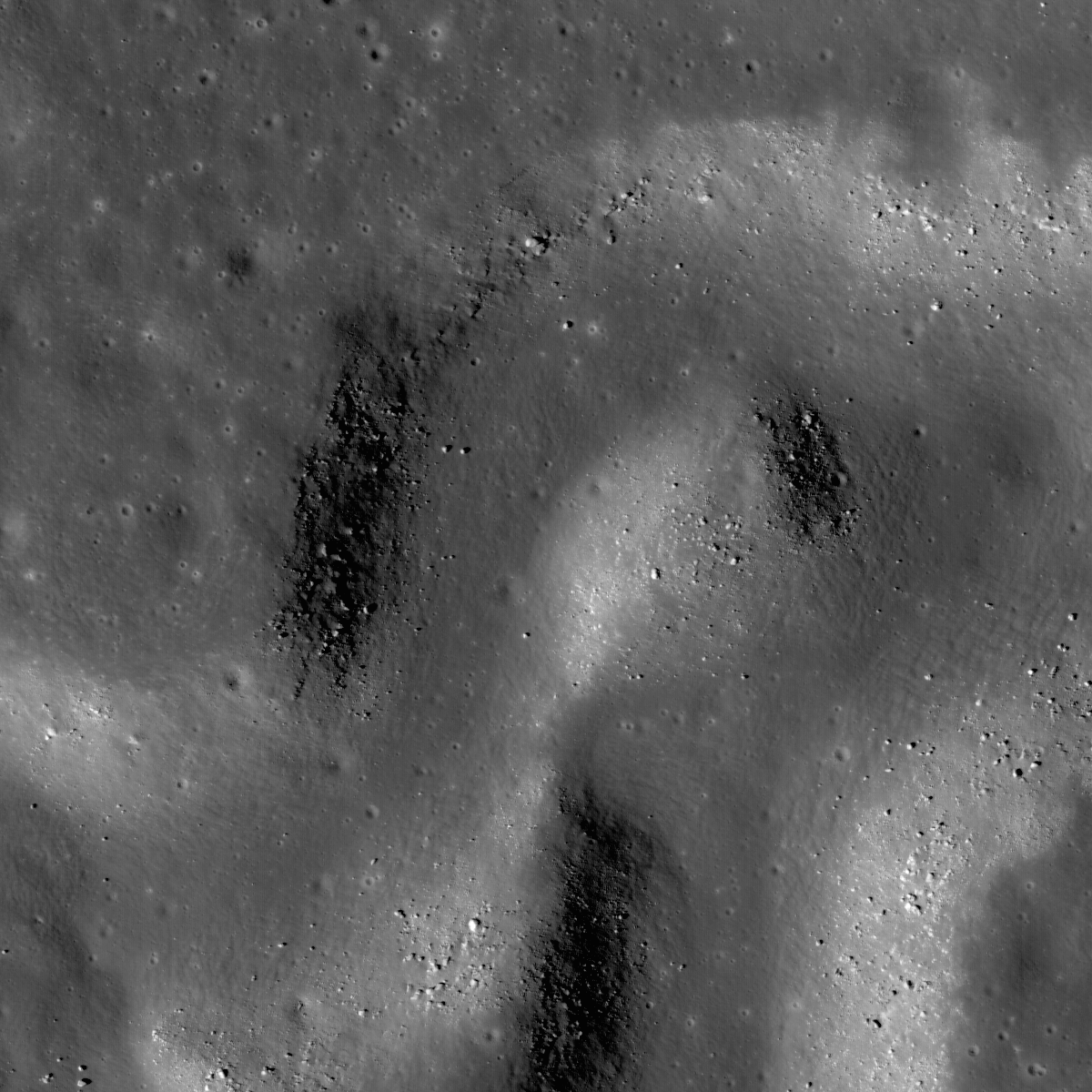
A tight turn in the sinuous rille running through Vallis Schröteri on the Aristarchus Plateau. Could you drive a SUV-sized rover through it? Probably, it's flat on the bottom. Just watch out for those house-sized boulders. A new close-up, LROC Narrow Angle Camera (NAC) observation M157934151L, LRO orbit 8409, April 20, 2011; illumination incidence angle 35°, field of view 1.75 km across. View the spectacular full-sized LROC Featured Image HERE [NASA/GSFC/Arizona State University].

Sarah Braden
LROC News System

This sinuous rille is a small part of Vallis Schröteri, which is the largest rille on the Moon, and actually contains two rilles! The larger rille (155 km long) cuts through the Aristarchus Plateau, and the smaller, curvier inner rille (204 km long) cuts through the floor of the larger rille. These two rilles may have formed during two different volcanic events, or they could represent a change in volume from a single event over time. The larger rille formed when the flow of lava was higher in volume. The inner rille subsequently cut through the floor of the larger rille after the eruption volume waned.

Geologists ask questions such as why did the inner rille flow farther than the larger rille? Did the magma flow faster in the case of the smaller rille? Scientists do not fully understand how rilles formed on the lunar surface, but there are two main theories. In general, rilles form when large volumes of very fluid (low viscosity) magma erupt and flow rapidly. The molten lava may carve a channel into the lunar surface through the erosive power of the flow of magma that then drains away, leaving only the empty lava river behind. An alternative theory proposes that the lava initially forms levees on the edges of the flow, which then confine the flow to just one channel, creating the river-like rille instead of spreading out over a large surface like a mare.


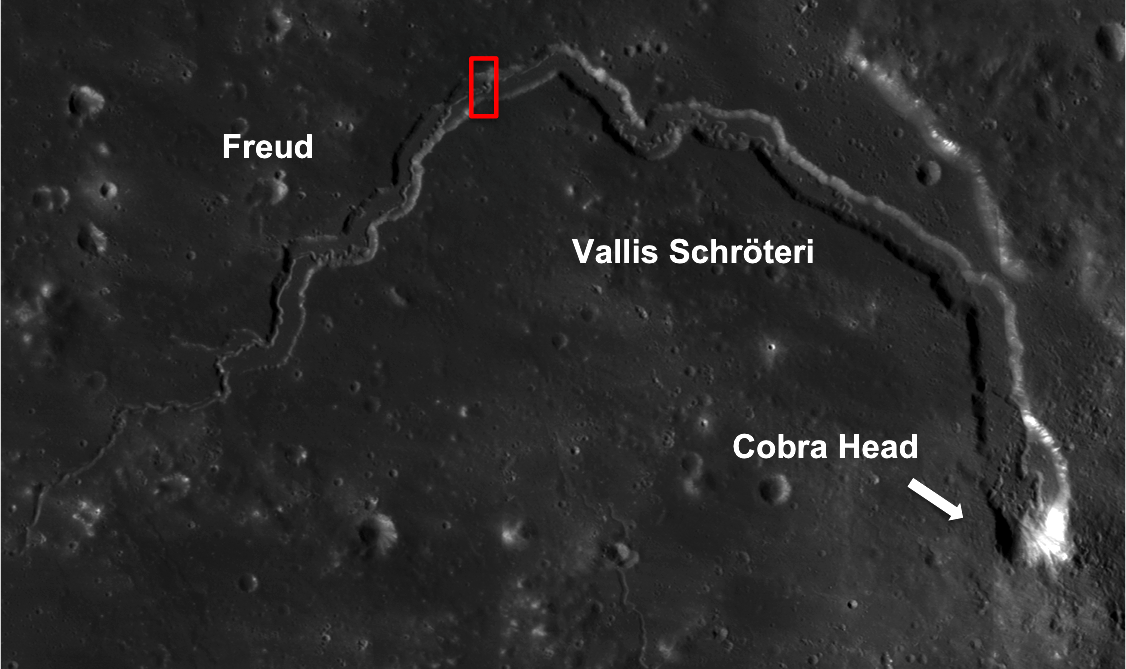
LROC Wide Angle Camera 100m mosaic of Vallis Schröteri, the red box marking the region of the rille seen close-up in the Featured Image, June 28, 2011. View the full-sized, 1140 pixel-wide context image HERE [NASA/GSFC/Arizona State University].

Vallis Schröteri starts at a 6 km diameter crater to the north of Herodotus. Some people call the start of the rille the "Cobra's Head" since it resembles a snake. The rille has a maximum width of about 10 km. For a scale comparison, consider that the Grand Canyon on Earth (formed by water) has a width that ranges from about 6.4 to 29 km.


Look in the full NAC frame for more twists and turns!

Related Posts:
Rille within a rille!
Sinuous Chain of Depressions
Hadley-Apennine: the Apollo 15 Landing Site
Secrets of Vallis Schröteri
The Colorful Moon

From Lunar Pioneer Album 5 -
From one of the varied, excellently detailed full-disk lunar mosaics by Astronominsk, the Aristarchus Plateau shield and Vallis Schröteri as photographed from Earth [Astronominsk].

Saturday, August 22, 2009

"Finally, I write about Lunar Reconnaissance Orbiter Camera photos."


Sinuous rille winding its way across a much larger rille in the heart of the Aristarchus Plateau, From Full Image [NASA/GSFC/Arizona State University].

Emily Lakdawalla, of The Planetary Society Blog, skips the temptation to "ooh and aah over the photos that LROC has shot of Apollo hardware," and takes a look forward to September 15, when NASA's Lunar Reconnaissance Orbiter will enter it's mission-phase orbit.

"I am so sorry it's taken me so long to sit down and write about some of the amazing images being returned from the Moon by Lunar Reconnaissance Orbiter. The Lunar Reconnaissance Orbiter Camera or LROC is the sharpest camera ever sent to lunar orbit -- the only higher-resolution photos to have been returned from the Moon came from the spacecraft (and people!) that landed on it. There really isn't anything that compares to LROC except HiRISE at Mars."

Read her informative posting, HERE.