Showing posts with label Lassell. Show all posts

Friday, May 16, 2014

The complex case at Lassell K

An early morning view looking east-to-west from an altitude of 86 km across the southern portion of the Lassell Massif, an irregularly shaped series of hills and steep-walled depressions. North is to the right in this LROC NAC oblique mosaic M1108311369LR, LRO orbit 15611, November 23, 2012; 71.73° incidence angle, spacecraft and camera slew 56.64° from orbital nadir, resolution above 2 meters from 85.65 km over 14.63°S, 355.69°E [NASA/GSFC/Arizona State University].
J. Stopar
LROC News System

The Lassell Massif is a complex area of rugged terrain located in northeastern Mare Nubium (14.7°S, 351.0°E). This undulating terrain of hills and steep-walled depressions is 45 km across from north to south and 25 km across from east to west.

The southern portion of the massif comprises several prominent elongate depressions (like Lassell K and Lassell G, seen below) that are clustered together.

The Lassell Massif in Mare Nubium; north is to the right. Prominent features of the Lassell Massif region include Lassell C, K, and G [NASA/GSFC/Arizona State University].
The clustering and irregular shape of these negative-relief features is reminiscent of volcanic calderas on Earth and other terrestrial planets, including Mars. Calderas generally form through collapse as magma retreats from the vent area. Overlapping collapse features suggest multiple episodes of magma advance and retreat over time. Lassell K and G may be part of a volcanic caldera!

Lassell K and G could, however, instead represent a series of clustered impact craters, which are relatively common on the Moon.

Remote sensing data displayed in eight diverse views of the 1000 meter-high profile of Lassell massif, collected by four spacecraft (all of them post-Apollo) presented in an overlapping 40.2 km-wide field of view, visible throughout both day and night. The largest crater at center-left is Lassell C (8.74 km; 14.67°S, 350.64°E) [Clementine, LRO, Chandrayaan-1 and Chang'e-2].
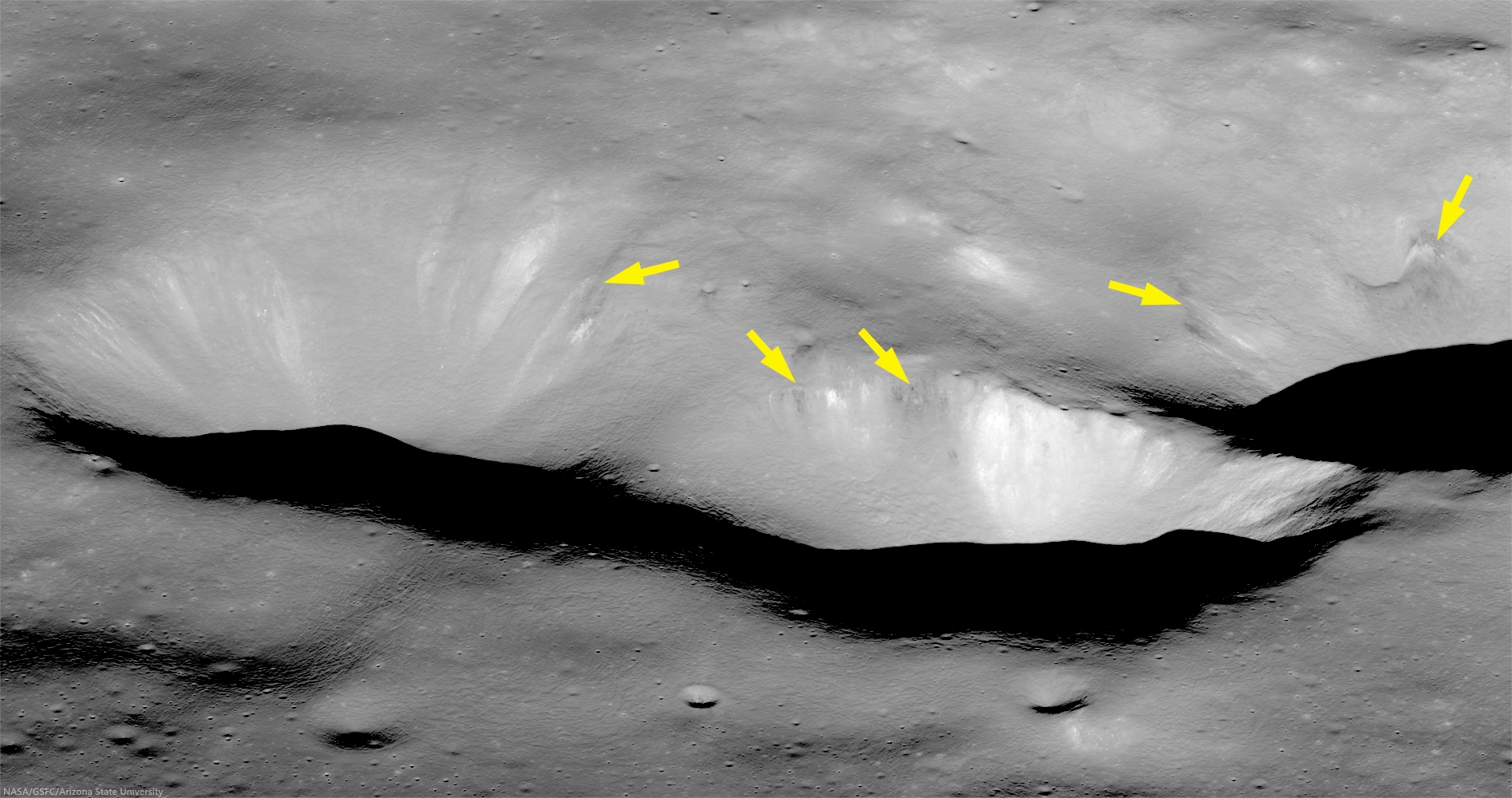
Lassell K (left) and portion of Lassell G (right). The upper walls of these steep-walled depressions have dark, low-reflectance, boulders and downslope streamers (arrows), where a thin layer of dark material, possibly pyroclastic, has eroded out of the wall [NASA/GSFC/Arizona State University].
Looking closely at this region, we see other features that are typical of volcanic eruptions including: dark mantling layers interpreted as possible pyroclastics, a subdued or mantled terrain, and even a possible volcanic cone.

Taken together, these features suggest a complex volcanic history for this region. If the Lassell Massif is constructed from a series of volcanic extrusions, it may represent an unusual type of silicic volcanism on the Moon (perhaps similar in composition to rhyolite).

Read more about the Lassell massif and its unusual style of volcanism in a study presented by members of the Lunar Reconnaissance Orbiter Camera team and colleagues to the 44th Lunar and Planetary Science Conference (2013): "The Lassell Massif, Evidence for Complex Volcanism on the Moon," #2504.

The full oblique image (below) along with other images and compositional data sets may reveal more clues to the timing and nature of volcanism in the Lassell region. However, returning rock samples to Earth and exploring the slopes of this structure from the surface may be the only way to confirm its origins.
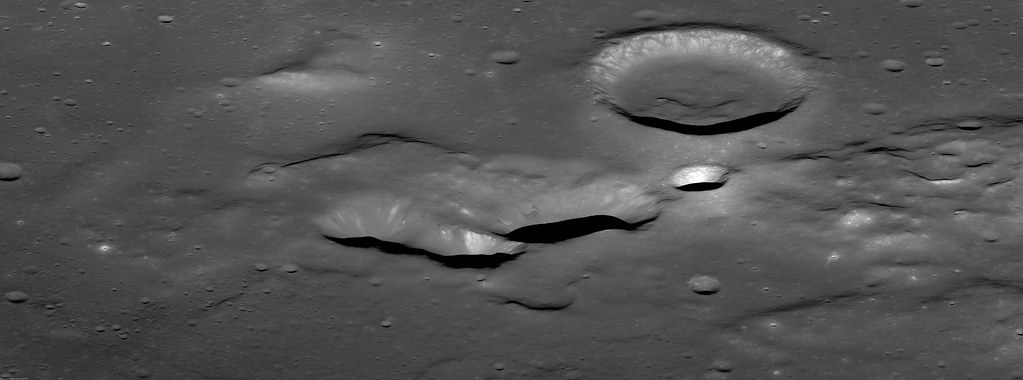
View assorted sizes of an unlabeled sample of a mosaic from the LROC observation above, HERE.
View oblique in full-window, HERE.

Related LROC Featured Images:

Thursday, March 14, 2013

Low reflectance deposits on Lassell Massif

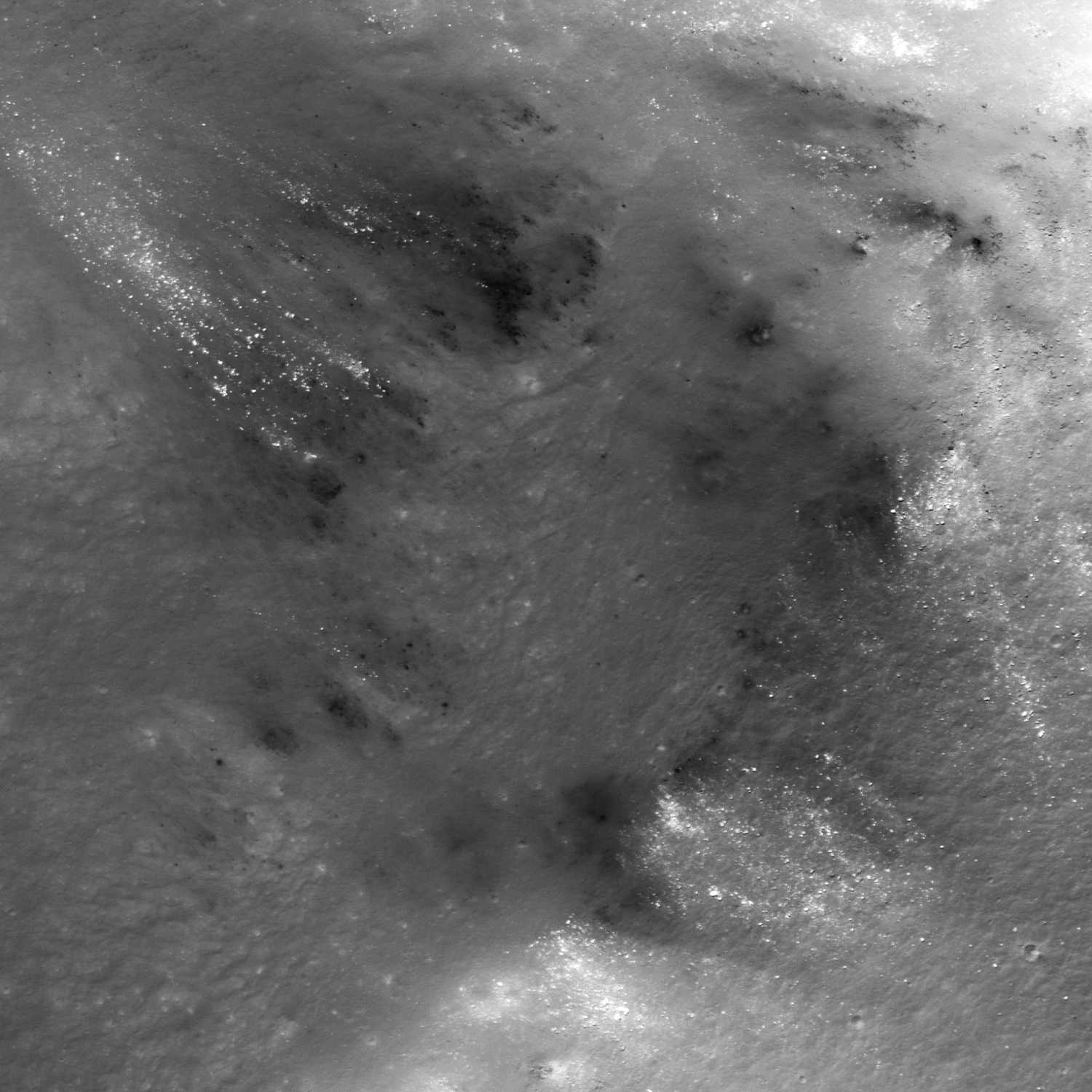
Low reflectance deposits are seen along the margins of the double 'vent-like' depressions Lassell G and Lassell K (14.918°S; 351.065°E) in Mare Nubium. LROC Narrow Angle Camera (NAC) observation M1116585481R, LRO orbit 16774, February 27, 2013; Sun is overhead, north is up, field of view roughly 1.8 km across at 0.88 meters resolution [NASA/GSFC/Arizona State University].
James Ashley
LROC News System

Today's Featured Image follows up on the two previous posts with another look at the Lassell Massif region of Mare Nubium. These prominent low reflectance deposits line the rims of the Lassell G and Lassell K pit features (see context image below). Their occurrence along the pit rims suggest a dark layer may be present just beneath the regolith surface, whose exposure has been encouraged by mass wasting in the pit walls. What caused such steep walled pits, and what are these low reflectance materials?

Our geologic train of thought continues from yesterday's post. We were discussing the geochemical differences between iron-rich, silica-poor (basaltic) and iron-poor, silica-rich (rhyolitic) magmas in the inner Solar System. But why should this matter, and what does it have to do with our images this week? The short answer is that basaltic lavas (and basaltic impact melts) have low viscosity, where rhyolitic lavas have relatively high viscosity. Basaltic extrusions filled mare basins like lakes, cascaded over fault blocks like waterfalls, and flowed like molten rivers on the Moon. On Earth and Mars they form flood basalt deposits and low-topography shield volcanoes. By contrast, rhyolitic lavas can be visualized as having a pasty or sticky consistency. They form steeper slopes, flow more sluggishly, develop high constructs, and can erupt explosively.

Mt. St. Helens and other Cascade volcanoes are good examples for Earth.

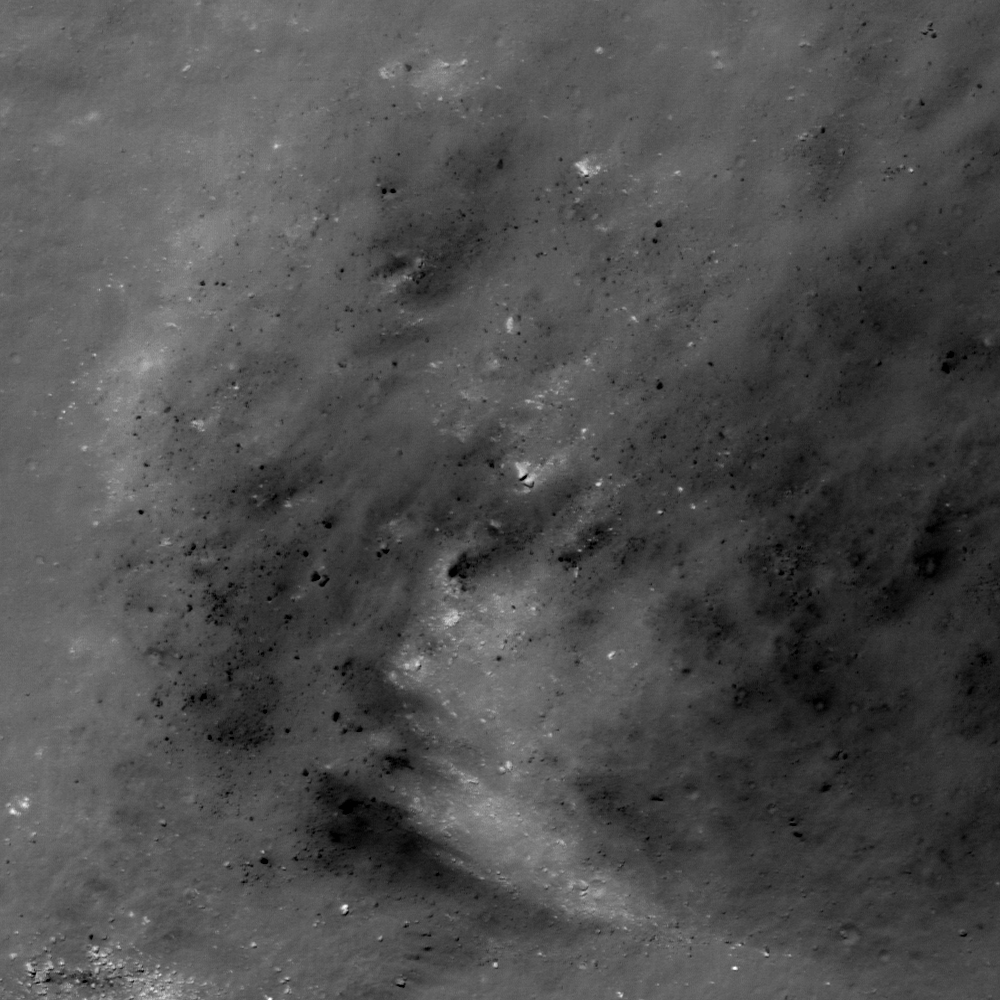
Another portion of NAC frame M1116585481R shows fragmented dark deposits [NASA/GSFC/Arizona State University].
A story of complex volcanism is emerging for the Lassell Massif region. The dark deposits may be pyroclastic in origin, and may have come from the massif source magmas themselves, or from adjacent volcanic fountaining (the floor of Lassell crater out of frame to the lower right of the context image is suspected to contain pyroclastic deposits). Based on LRO Diviner data the massif itself is silica-rich, which accounts for its topography, and suggests that Lassell G and Lassell K may be collapse calderas. They have very steep slopes and V-shaped profiles, in contrast to impact features.

LROC Wide Angle Camera (WAC) mosaic context image, outlining the areas spotlighted in this and two other LROC Featured Images, released the week of March 11, 2013 . The light yellow square encloses the area in today's Featured Image [NASA/GSFC/Arizona State University].
Another look, from another angle, at the south Lassell complex, allowing some perspective of the topography - steep drops on either side of a shared wall - of the area highlighted in the Featured Image - from the newly-released LROC NAC oblique mosaic M1108311369LR, linked HERE [NASA/GSFC/Arizona State University].
Explore the full NAC frame HERE. Other examples of silica-rich, so-called 'intrusive' lunar volcanism may include the Gruithuisen Domes, features in Compton-Belkovich and the Hortensius Domes.