Showing posts with label oblique impact. Show all posts

Wednesday, June 26, 2013

Love U, on the farside of the Moon

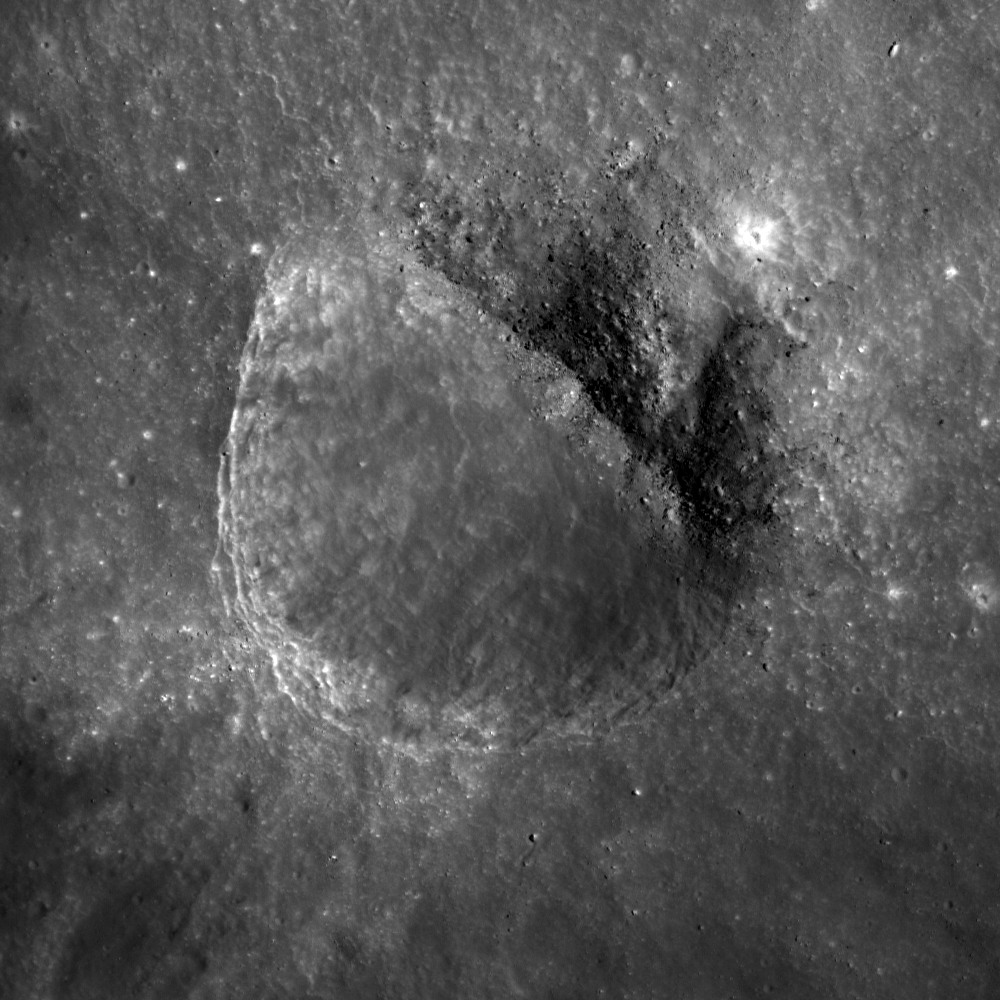
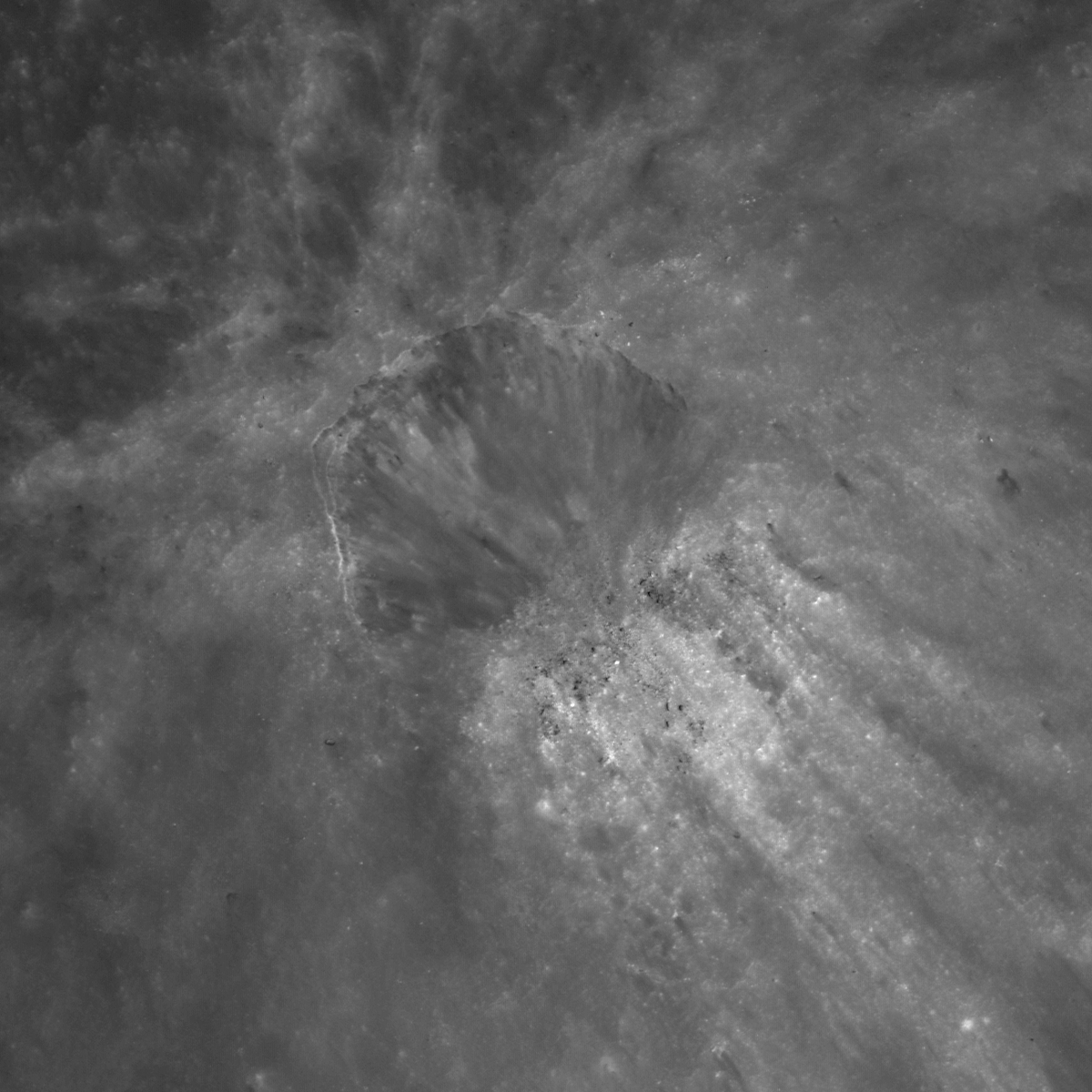
A small crater on the inner rim of the farside highlands crater Love U (5.535°S, 128.024°E). LROC NAC M159114365R, LRO orbit 8582, May 4, 2011; 39.5° angle of incidence image, 61 cm resolution from 59.82 km [NASA/GSFC/Arizona State University].
Sarah Braden
LROC News System

The 320 meter diameter crater in today's Featured Image is located inside the larger Love U crater (12 km, 5.535°S, 128.024°E).

Why does this fresh crater look "squished" on one side? The inner wall of Love U slopes downwards from the lower left to the upper right. The lower left hand portion of the crater rim is crisp and unmodified, because it is the upslope part of the crater.

The upper right hand half of the crater rim is not circular and is very modified by debris that fell downslope.

Asymmetric craters are sometimes due to the trajectory of the impacting bolide being less than 15° from the surface (oblique impact). The ~26° slope of Love U's inner wall dominates the morphology of the crater in the Featured Image. The rays of the crater are also asymmetric; longer rays extend downslope into Love U crater.

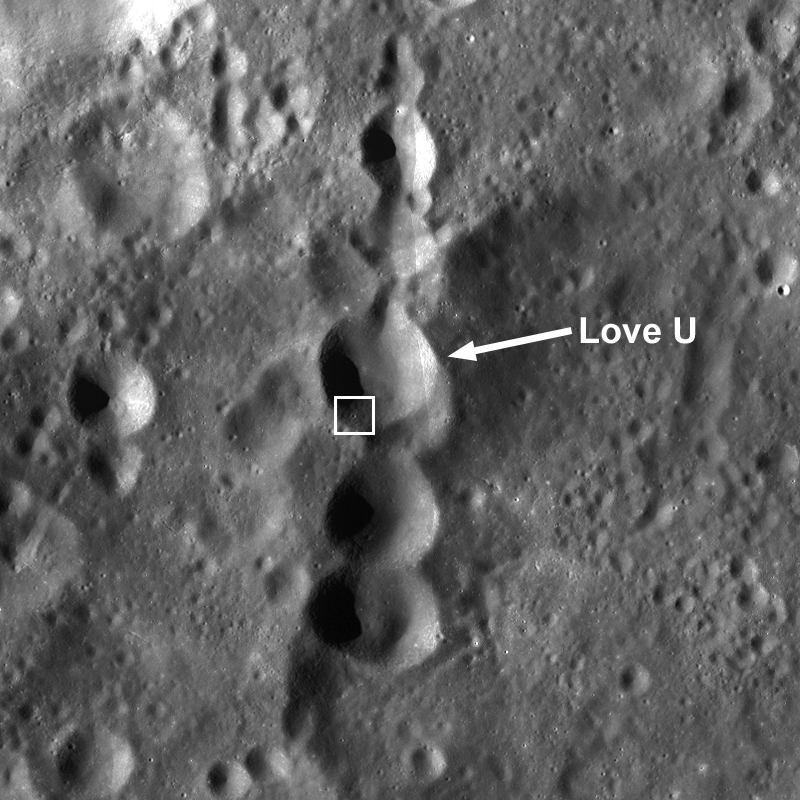
LROC image-derived Digital Terrain Model (DTM) of Love U crater and surroundings, generated on the fly using the latest generation of their versatile Quick Map application. The crater of interest is seen "on edge" (arrow) from this perspective [NASA/DLR/GSFC/Arizona State University].
For more love on the Moon, remember this lunar valentine HERE?

LROC Wide Angle Camera (WAC) context view (with false-color relative elevation) of Love U; white box outlines the field of view shown in detail in the LROC Featured Image [NASA/GSFC/Arizona State University].
The WAC image above shows that Love U is part of a crater chain. Some of the craters in the chain are oval or elongated, which indicates that they are probably secondaries from a large impact. Crater chains can be formed by secondary craters, volcanic collapse in association with graben, or primary impacts from a string of smaller bolides. Planetary scientists use morphologic and contextual clues to determine how a crater chain formed.

Love U is a satellite crater of the main crater Love, a 90 km diameter, highly degraded crater on the far side of the Moon. The namesake of Love crater is Augustus Edward Hough Love, a mathematician who is well known for Love waves and Love numbers.

Explore the entire NAC image, HERE.

Related Images:
Lopsided La Perouse A
Top of the Landslide
Oval Crater

Tuesday, June 11, 2013

Slope Resurfacing

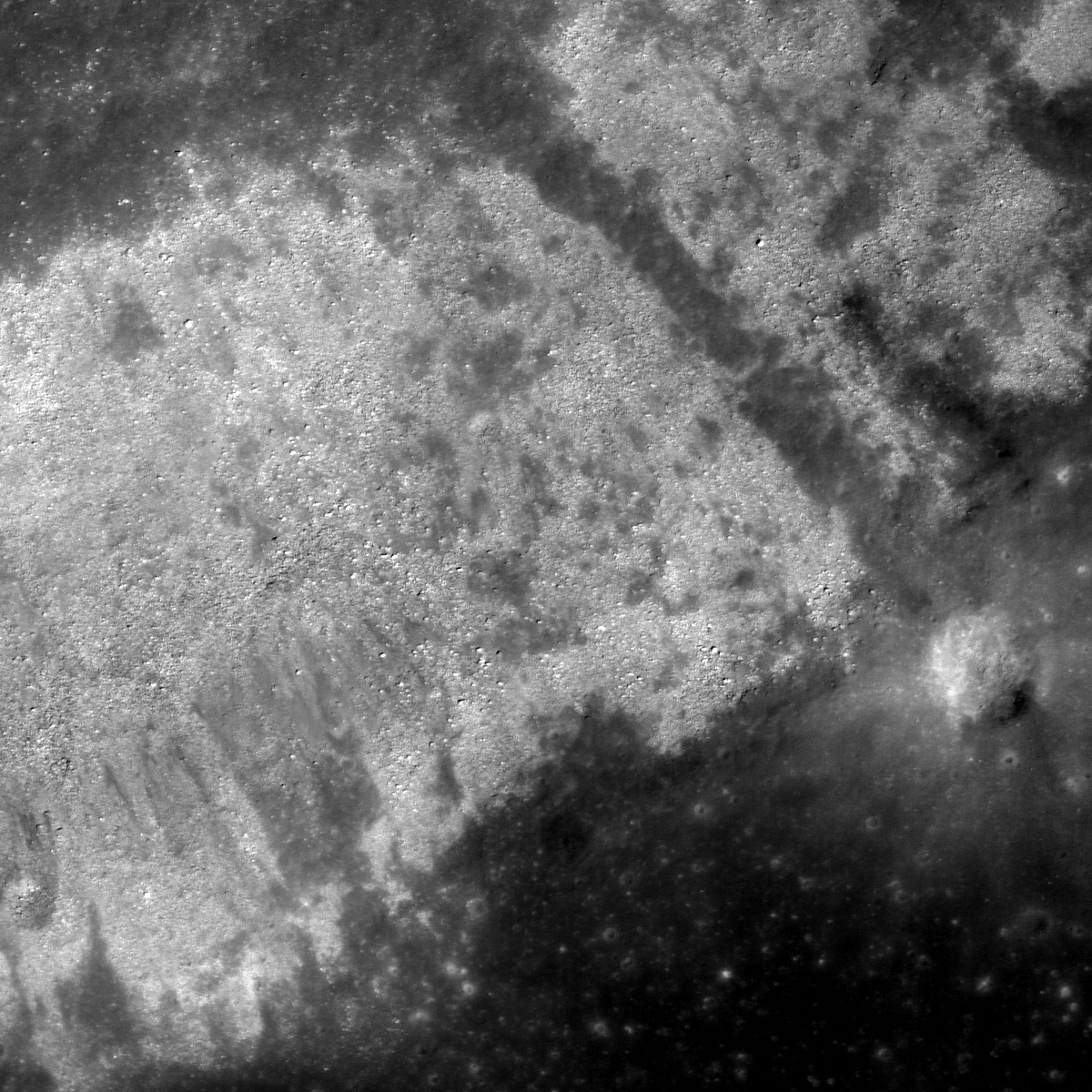
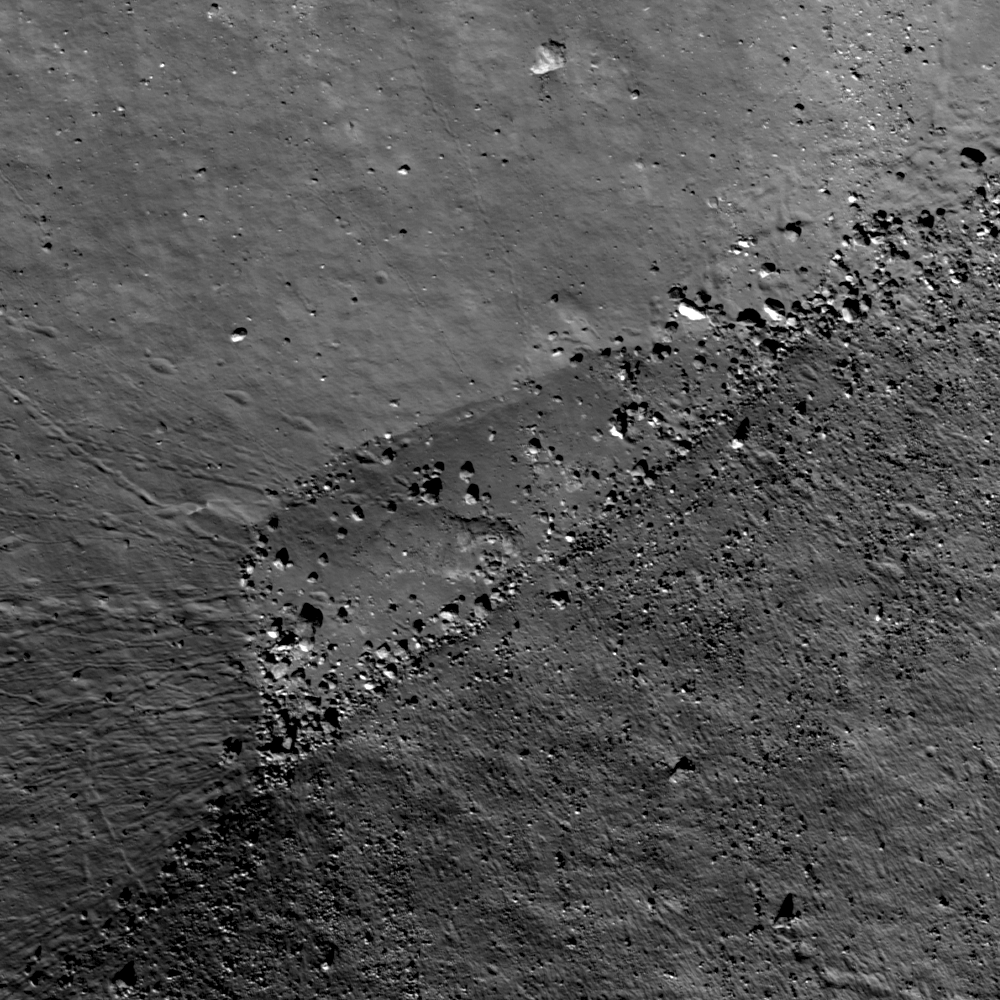
Southeastern wall of Jansen U crater. LROC Narrow Angle Camera (NAC) observation M188028576R, spacecraft orbit 12773 April 2, 2012; 18.45° angle of incidence, resolution 0.98 meters from 120.28 km, 1182.3 meter-wide field of view centered on 11.926°N, 32.306°E (Downslope toward upper left, north at top) [NASA/GSFC/Arizona State University].
Hiroyuki Sato
LROC News Service

Today's Featured Image highlights the wall of Jansen U crater, located at the northeast section of Mare Tranquillitatis. Jansen U is a 3.28 km diameter crater with a teardrop shaped cavity, and likely originated from a low angled oblique impact (see next NAC context image).

The high reflectance area includes many boulders is the crater wall. The low reflectance area in the lower right of the image, which includes a smaller crater (~130 m in diameter), is the rim and shallowly sloping ejecta blanket. The upper left corner of the image, which is covered by low reflectance materials (but not as low as the background surface), corresponds to the crater floor.

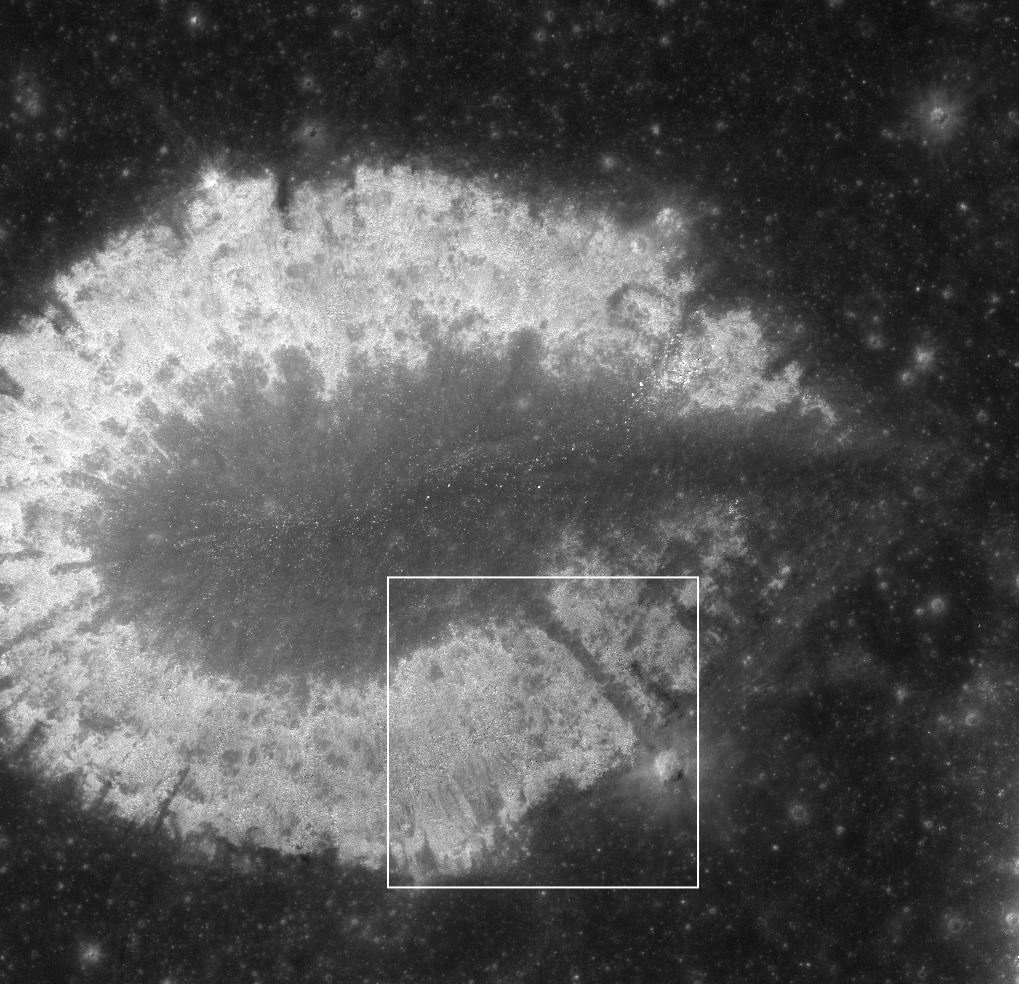
Jansen U crater in NAC context image, center on 11.955°N, 32.304°E, field of view about 4 km. The Featured Image corresponds to the field of view outlined by the white box [NASA/GSFC/Arizona State University].
Jansen U crater has an eye-catching appearance due its ovoid shape and brilliant contrast between the low reflectance floor higher reflectance crater walls. Since no indication of impact melt is seen on the crater floor (e.g. fractures or viscous flow features), the floor is likely covered by post impact in-filling materials. Little by little space weathering produces the mature regolith everywhere on the surface, while the slope failure slumps mature material away continuously. These mass wasting and weathering processes often result in striking albedo patterns. 

Jansen U and surrounding Mare Tranquillitatis in LROC WAC monochrome mosaic (100 m/pix), centered on  6.15°N, 16.17°E. The NAC footprint (blue box) and the location of the field of view in the LROC Featured Image (yellow arrow) are indicated [NASA/GSFC/Arizona State University].
Explore Jansen U crater, contrasting reflectance patterns of the wall and the floor in the full NAC frame, HERE.

Related Posts:
Downhill Creep or Flow?
Leathery vs smooth surface
Slope failure near Aratus crater
Crater Covered With Boulders!
Bright ridge near Mons Hansteen
Multiple Flow Lobes

Tuesday, January 29, 2013

Clam Shell on the wall of Lalande C

An oblique impact crater on the wall of Lalande C crater. LROC Narrow Angle Camera (NAC) M170606751LR, LRO orbit 10276, September 14, 2011; incidence angle 11.82° at 49 cm per pixel resolution revealing a field of view 600 meters across, viewed from 44.83 km [NASA/GSFC/Arizona State University].
Lillian Ostrach
LROC News System

Oblique impact craters can form when the angle of impact is less than 15° from the horizontal or from impact into sloped terrain.

Oblique impact craters typically exhibit specific morphologies: asymmetric ejecta and non-circular (more elliptical) crater shapes. The approximately 220 meter impact crater in today's Featured Image (5.668°S, 353.148°E) formed on the interior crater wall of Lalande C and is a nice example of a small, oblique impact crater that formed due to target slope as opposed to impact angle.

The oblique crater in Lalande C does have an asymmetric ejecta blanket (see the full NAC image) and a poorly defined zone of avoidance. The crater shape is not circular; instead, the irregular crater shape is reminiscent of a clam shell. There is also a blocky jumble of mostly high-reflectance material collected downslope of the crater, where the rim would be. What could explain the presence of this material?

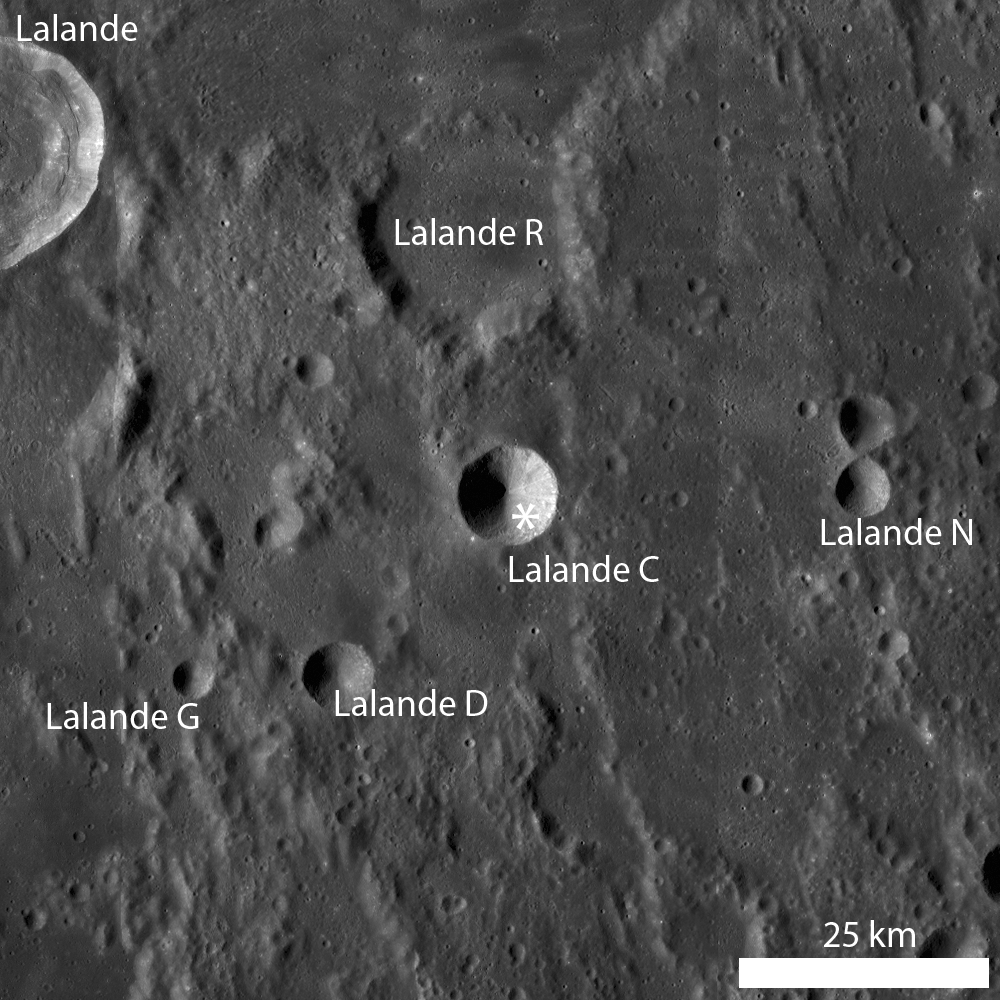
LROC WAC monochrome mosaic centered on Lalande C crater (10.5 km diameter, 5.596°S, 353.041°E), where the asterisk marks the location of the field of view shown at high resolution in the LROC Featured Image released January 29, 2013 [NASA/GSFC/Arizona State University].
Circular, or bowl-shaped, craters form when impact occurs greater than 15° from the horizontal (the most probable angle of impact is 45°), and material from within the crater is ejected ballistically to form an expansive, symmetric ejecta blanket. However, because the bolide impacted into the sloped crater wall, the material ejected from the crater in today's Featured Image did not form a symmetric ejecta blanket. What this means is that the jumble of high-reflectance material is probably excavated material that was ejected at low velocity from the crater during crater formation. LROC NAC images of oblique craters such as this one show similar features and certainly require additional study!

Take a look for yourself in the full LROC NAC image! Can you identify the extent of asymmetric ejecta superposed on the wall of Lalande C?

Related Posts:
Rim on a Rim
Rim Impact
Slice of Mare

Wednesday, June 6, 2012

LROC: Rim Impact

The small pond of impact melt and debris on the floor of Hercules E is not circular. What forces teamed up to result in this small triangular crater floor deposit? LROC Narrow Angle Camera (NAC) observation M170300291R, LRO orbit 10231, September 10, 2011; field of view width is 500 meters at 0.47 meter-per-pixel resolution in the full size LROC Featured Image, from 38.49 kilometers; angle of incidence 49.08° Spacecraft was significantly slewed from nadir (-12.66°). [NASA/GSFC/Arizona State University].
Lillian Ostrach
LROC News System

Simple craters on the Moon, roughly ≤15 - 20 km in diameter, are typically bowl-shaped, but changes in impact conditions influence the final crater shape. When a bolide (asteroid or comet or even spacecraft) impacts the lunar surface, the resulting crater shape is dependent on several factors, and the influence of these factors on crater shape is complicated. Final crater shape is dependent on factors such as angle of impact, speed of impact, slope of the surface, and target material, and often it is difficult (at times, impossible!) to determine which factor dominates the crater formation process. In fact, the bulk of knowledge about impact cratering mechanics is derived from experiments and numerical modeling that attempt to understand the dynamics of impact cratering.

Today's Featured Image is proof that impact crater shape is somehow linked to the factors mentioned above. Hercules E crater (45.783°N, 38.698°E, ~9 km diameter) formed on the southern rim and wall of the much larger Hercules crater (~70 km diameter), nestled between Lacus Mortis and Atlas crater. The shape of "E" (see LROC WAC context image below) is elongated and more elliptical than circular, especially compared to Hercules G and an unnamed crater that impacted into the Hercules rim to the east. In the WAC, just over half of Hercules E is in shadow, so observations of the floor are impossible at this scale. However, the crater interior is visible in the opening NAC image, and the triangular-shaped floor suggests that Hercules E is not a simple bowl-shaped crater after all.

The uncorrected full 2.5 kilometer-wide field of view of LROC NAC frame M170300291R, centered on Hercules E, high on the southwestern rim of Hercules proper [NASA/GSFC/Arizona State University].
An initial interpretation might be that the morphology of the crater interior was largely influenced by formation on the rim and wall of Hercules, but there are two circular craters that also formed on the rim and wall Hercules. The presence of these circular perched craters on the wall of Hercules, as well as circular perched craters elsewhere on the Moon, suggests that other factors (impact velocity, impact angle) likely contributed to the elliptical shape of Hercules E. When the angle of impact is low (<15°), crater shapes change from circular to more elliptical or oblique, so it may be that Hercules E resulted from an oblique impact. However, impact velocity can also affect crater shape and low velocity impacts may produce irregularly-shaped craters.

LROC Wide Angle Camera (WAC) monochrome mosaic centered on Hercules crater (45.783°N, 38.698°E). Hercules E formed on the southern rim; location of the field of view included in the LROC Featured Image released June 6, 2012 is noted by an asterisk [NASA/GSFC/Arizona State University].

Suffice to say, the answer to the question of "What factors primarily control crater shape?" is complicated and is probably dependent on the location of the crater, the size of the crater, and the geology of its surroundings. Perhaps a global survey of crater shapes using LROC WAC and NAC DTMs, paired with hydrocode numerical modeling of crater formation, would be beneficial to assessing this science question.

What do you think? What observations can you make when exploring the full LROC NAC image, HERE?

Related Posts
:
Rim on a Rim
Last Portion of Original Floor
Dark Impact Melt Sheet
Ryder Spectacular!