Showing posts with label Return. Show all posts

Friday, April 12, 2013

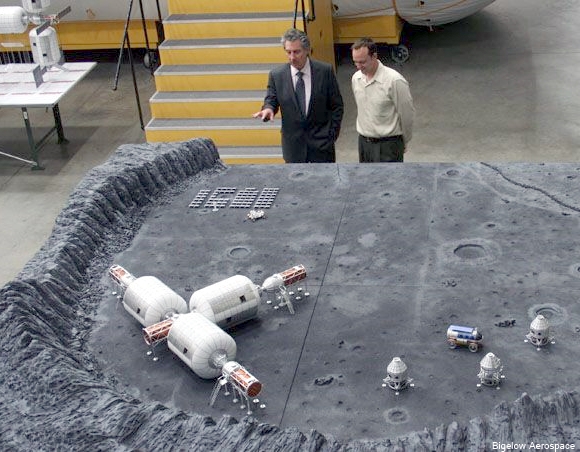
Bigelow, NASA rumored contracted for the Moon

Robert Bigelow explains his moon base concept. Photograph by Bigelow Aerospace. HT: Astronwright ("Chronicles of someone trying to get off this rock.")
George Knapp
Las Vegas City Life

Business deals don’t get much bigger than this one. Have you ever read a contract that gives a governmental green light to a program to “place a base on the surface of the moon?” Ever see an agreement signed by the U.S. government that declares a specific goal “to extend and sustain human activities across the solar system?” Me, either.

Yet that is essence of an adventurous deal already reached between NASA and Las Vegas space entrepreneur Robert Bigelow. An official announcement is still a few days away and will likely happen during a news conference at NASA headquarters. In the meantime, I have a draft copy of what could be an historic contract, one that reads like a Kubrick screenplay or an Arthur C. Clarke story. It is flat-out otherworldly.

Bigelow made his fortune building apartment buildings and weekly-rental hotel rooms in Las Vegas. In 1999, he launched what must have seemed a pipe dream at the time — his own private space program. But within a few short years he stunned the aerospace world by launching two of his own locally built spacecraft, both of which still circle the Earth (and one of which contains my weightless, floating business card). The focus of Bigelow Aerospace is an expandable module, small and light enough to make for less expensive launches but so strong and durable when expanded to full size that it accomplishes what NASA has been unable to do on its own: It puts more space in space, that is, more room for companies and governments to work, live and conduct research.

Back in January, NASA bigwigs came to Bigelow’s main plant to announce a landmark deal that calls for one of Bigelow’s modules to be attached to the International Space Station (ISS) within two years. Bigelow used that occasion to let slip some even bigger news — the fact that he is spending $250 million of his own money to build a private space station, larger than the ISS, and that he plans to have it in low-Earth orbit by 2016. What few knew at the time was that he was secretly negotiating an even bigger deal with NASA, one that represents a fundamental, across-the-board change in our approach to space.

Read the full article HERE.

Bipartisan legislation sets NASA's focus on the Moon

George M. Cecala
Office of Representative Bill Posey
Cannon House Office Bldg.
U.S. House of Representatives

U.S. Representatives Bill Posey (R-FL), Sheila Jackson Lee (D-TX), Chairman Frank Wolf (R-VA), Robert Aderholt (R-AL), John Culberson (R-TX), Steve Stockman (R-TX), Pete Olson (R-TX), Rob Bishop (R-UT) and Ted Poe (R-TX) have once again reintroduced bipartisan legislation directing NASA to develop a plan for returning to the Moon and establishing a human presence there. The RE-asserting American Leadership in Space Act, or REAL Space Act (HR 1641), sets a clear course for NASA toward human space flight while keeping within current budgetary constraints.

“The Moon is our nearest celestial body, taking only a matter of days to reach,” said Rep. Bill Posey, who as a young man worked on the Apollo Program at the Kennedy Space Center. “In order to explore deeper into space—to Mars and beyond—a moon presence offers us the ability to develop and test technologies to cope with the realities of operating on an extraterrestrial surface.”

“Space is the world’s ultimate high ground, returning to the Moon and reinvigorating our human space flight program is a matter of national security. Returning to the moon would allow NASA to continue to develop technologies that have not only enhanced our exploration programs but have been applied across all disciplines of science,” said Rep. Sheila Jackson Lee.

“Last year, the National Research Council committee charged with reviewing NASA’s strategic direction found that there was no support within NASA or from our international partners for the administration’s proposed asteroid mission. However, there is broad support for NASA to lead a return to the Moon. So the U.S. can either lead that effort, or another country will step up and lead that effort in our absence -- which would be very unfortunate,” said Rep. Frank Wolf, Chairman of the House Commerce-Justice-Science Appropriations Subcommittee.

“Moon missions, both human and robotic, offer the United States true international cooperation, while ensuring that we lead from the front. Other nations, private industry, and government experts all regard the Moon as the right place for NASA to direct its resources. The time to reassert the United States as the leader in space is now and the REAL Space Act is the next step,” said Rep. Robert Aderholt.

“Congress should be committed to NASA and to expanding the frontiers of scientific progress. This bill is the correct path forward to get Americans to the Moon and expand human knowledge,” said Rep. Steve Stockman who represents the Johnson Space Center in Houston, Texas. “With a real destination and a realistic timetable, we can achieve our greatest dreams. Without it, we risk seeing our future plans perpetually delayed or cancelled, and only watching as other nations seize the lead in space exploration—and reap the benefits in jobs, inventions, investments, national pride and international respect. I urge my fellow Members of Congress to cosponsor this vital legislation, and I urge space advocates and organizations to join together in support of this bill and in support of the Moon being the stepping stone to Mars.”

Rep. Pete Olson said, “The REAL Space Act clarifies NASA's mission, something it has been lacking in recent years. Human space exploration is critically important to America's global future. President Kennedy understood that the real benefit of exploration to our nation was not landing men on the moon, but what it would take to get there — the technology, the initiative and the will to do it. He knew, as we know, that space exploration is both a scientific and national security priority. This legislation sets clear and achievable goals that will ensure America maintains global preeminence in both space exploration and scientific discovery.”

Rep. Rob Bishop said, “This legislation is not just about landing another human on the Moon. It is about restoring our nation’s now defunct human space flight program and setting clear and achievable goals that will lead to advancements in science and technology. If we are to be leaders in the exploration of the cosmos, to the Moon and beyond, we must have our own innovative resources to get there. It’s going to be next to impossible to maintain our preeminence in the exploration of space if we are having to hitch rides from other countries. Going back to the moon has always been an essential stepping stone for technology development for manned exploration to other parts of the galaxy. This legislation restores and clarifies NASA’s role in human space flight and sets the U.S. back on course to lead exploration of the cosmos.”

Specifically, the REAL Space Act directs NASA to plan to return to the Moon by 2022 and develop a sustained human presence there as a stepping stone for the future exploration of Mars and other destinations within our solar system. The legislation also emphasizes the importance of maintaining the United States’ preeminence in space, and underscores the necessity of preserving America’s independent access to space.

Returning to the Moon presents many scientific, technological and economic benefits for the United States and the world at large. The economic contribution of NASA’s space program is in the tens of billions of dollars. The technologies developed through and transferred from our nation's program have created advancements across all disciplines of science and advances in healthcare in particular have saved and enriched countless lives.

Aside from providing a training ground for space faring enabling technologies, humans still have much to learn from exploring the Moon. To date, twelve Americans have explored a section of our Moon smaller than the National Mall. There are many minerals, isotopes, and other natural resources that can be gleaned from the Moon’s surface such as ice deposits, which can be used to sustain an outpost or produce rocket propellant for deep space exploration.

Setting the Moon as the goal will reengage the public’s interest in the space program and inspire a new generation of American students to study science, technology, engineering, and mathematics (STEM) where they currently lag behind students in competitor nations.

Related:
General Bolden on the Moon (April 10, 2013)

Tuesday, February 2, 2010

Where is Harriman when we need him?


Wayne Hale
NASA Blogs

During my childhood, back in ancient times, science fiction was my reading material of choice. Isaac Asimov, Arthur C. Clark and Robert Heinlein were first among the pantheon of science fiction writers in those days.

One of the best was Robert A. Heinlein's 1949 story "The Man who Sold the Moon". A brilliant American businessman (today we would say entrepreneur, then Heinlien called him a robber baron) devoted his vast wealth to building a moon rocket. Think Elon Musk but with Bill Gate's fortune and Donald Trump's ethics. Of course he succeeded, despite of all the difficulties, including the roadblocks set up by the government. At the end of the story Harriman famously tells his best friend: "I would cheat, lie, steal, beg, bribe -- do anything to accomplish what we have accomplished".

Where is Delos D. Harriman today? We sure could use him. "We" being all those folks who really really really want to humanity off this planet in a significant way. And maybe not depending on the vagaries of politics and politicians.

Read the Post HERE.

The wrong decision for space and America


Editorial cartoon by Paul Conrad published in the Los Angles Times in September 1970 after NASA's decision to ultimately terminate the Apollo program and "cancelling Apollo 15 and 19."

Charles A. "Chuck" Wood
Lunar Picture of the Day

"I've just posted an LPOD that remembers when we turned away from the Moon in 1970 and the present repeat," HERE.

"Comments can be made in the "Discussion" section of the LPOD."

- Chuck Wood
Too old to see a 3rd chance for the Moon

Monday, February 1, 2010

Reach for the Moon

Traveling NASA exhibit allows people to feel a piece of the lunar surface

Alamogordo Daily News

Alamogordoans will have a rare chance to touch a piece of a moon rock this week during NASA's "Driven to Explore" traveling exhibit.

The exhibit will be at the New Mexico Museum of Space History from 9 a.m. to 5 p.m. Monday and Tuesday. The exhibit will be in the parking lot above the IMAX theater.

"Driven to Explore" offers a look at America's program to return people to the moon and travel beyond. This exhibit is free.

The centerpiece of "Driven to Explore" is the opportunity to touch a lunar rock sample that was brought to Earth in 1972 by astronauts on Apollo 17, the United States' last manned mission to the moon.

The almost 4 billion-year-old rock is one of only eight lunar samples in the world made available for the public to touch and feel.

Read the full article HERE.

Wednesday, January 27, 2010

White House won't fund NASA moon program

[Ed. Note: Coming as the following story does, from two Orlando Sentinel writers of note, and good reputation, it leaves little ambiguity as to what will be in the White House budget proposal for federal Fiscal Year 2011, which begins November 1, 2010. It's important to remember, however that "the president," as they say, "proposes, but Congress disposes." NASA is a "creature of Congress." In the end, if heat can continue to be brought to bare Congress is likely to restore some or all of this funding for FY '11, especially as the present fiscal year ends within a week of the mid-term federal election and coming, as it does, with the end of the Shuttle program.

I can and will speculate further, later, on motivations and ideologies, etc. - those of interest groups and such, but I will stop there, as I should, for the moment. In the end this kind of policy decision is up to the American voter. They can be prevailed upon to take up that responsibility if they are made to understand this.
- Joel Raupe for Lunar Pioneer]

Robert Block
and Mark K. Matthews
Los Angeles Times

Reporting from Washington and Cape Canaveral - NASA's plans to return astronauts to the moon are dead. So are the rockets being designed to take them there, if President Obama gets his way.

When the White House releases its budget proposal Monday, there will be no money for the Constellation program that was to return humans to the moon by 2020. The Ares I rocket that was to replace the space shuttle to ferry humans to space will be gone, along with money for the Ares V cargo rocket that was to launch the fuel and supplies needed to return to the moon. There will be no lunar landers, no moon bases.

"We certainly don't need to go back to the moon," one administration official said.

Instead, according to White House insiders, agency officials, industry executives and congressional sources familiar with Obama's plans, NASA will look at developing a "heavy-lift" rocket that one day will take humans and robots to explore beyond low-Earth orbit. That day will be years away.

Read the full story HERE.

Thursday, November 12, 2009

A Sustainable Return to the Moon

On Monday, the Lunar Exploration Analysis Group
begins its annual meeting in Houston.


Paul D. Spudis
Lunar and Planetary Institute
Annual Meeting of LEAG (2009)

Our ultimate goal in space is to be able to go anywhere, at any time with whatever capabilities to accomplish any task or job we choose to undertake. We are light-years away from achieving such a goal, largely because we must drag everything we need in space with us from the bottom of a very deep gravity well – the Earth’s surface. As long as this paradigm prevails, we will remain mass- and power-limited in space and thus, capability-limited as well.

The Vision for Space Exploration, outlined by President Bush in 2004 and endorsed by two Congresses, is the official space policy of the United States. The Vision is designed to serve national scientific, economic and security interests. It calls for extending human missions beyond low Earth orbit by learning how to use the material and energy resources of the Moon to create new capabilities in space. The VSE was envisioned from the beginning to be accomplished under existing and inflation-growth budgetary envelopes. Thus, our challenge is to design a program in which time (rather than money) is the free variable. We want to make steady, constant progress towards our goals. This requires an architecture that uses small, affordable steps (incremental) that occur at frequent intervals (paced program) and build upon each other with time (cumulative) to create new and lasting space faring capability.

The Moon is key to gaining this new capability. It has the material and energy resources needed to operate and live in space. It is over 45% by weight oxygen, extractable through a variety of well-known industrial chemical processes. Hydrogen is also present; at the equator it occurs in concentrations of up to 100 parts per million, extractable through simple solar thermal heating. But the real “pay dirt” on the Moon is at the poles, where concentrations of hydrogen have been confirmed (the current debate is over what form this hydrogen takes). Water ice likely exists in the permanently dark regions of the lunar poles. Moreover, we have documented areas at both poles that are in near-constant sunlight (a consequence of the low obliquity of the Moon’s spin axis). So the Moon’s poles contain both the material (water) and energy (sunlight) resources needed for sustainable human presence there.

An incremental architecture designed to take advantage of these possibilities is possible under current budgetary limitations. The key is to pre-emplace much of the assets we need on the Moon robotically, prior to the arrival of humans. Small robotic landers can survey resources and characterize the terrain for an outpost. Slightly larger landers can deliver equipment; rovers with earth-moving attachments can prepare a habitat site. Large solar arrays can be deployed to generate hundreds of kilowatts of electrical power. Small oxygen production equipment can experiment with different processing techniques, characterizing their yields and efficiencies. All of these robotic devices can be teleoperated from Earth (only a three second time delay); each landing incrementally increases our capability on the Moon and independence from terrestrial logistics. When humans finally arrive on the Moon, they move into a turn-key operation – a pre-emplaced outpost, operating and ready for use.

On the Moon, we will learn the skills needed and develop the technologies required to live and work productively on another world. Our objectives are to arrive, to survive and to thrive. Tasks include building a transportation system, preferably with maximum utility and reusability (arrive), closing the life support loop and extracting consumables from local materials (survive), and producing products for export that create new capability in space, such as rocket propellant (thrive). By establishing a space transportation system that can routinely access the lunar surface and return to low Earth orbit, we have created a system that can also routinely access all other points in cislunar space, where all of our commercial and national security assets – and more than 90% of our scientific assets – reside.

Such a strategy has significant implications for the lunar return architecture. The Orion CEV should be designed in a minimalist, Apollo-scale configuration; its function is only to transport crew to and from Earth’s surface to staging areas in orbit. Staging can be done from the ISS, making that program an asset in our lunar return. Cargo takes solar-electric “slow boat” routes to an Earth-Moon Lagrangian staging point while the crew arrives later using “fast” chemical transport. The Altair lander is more LM than behemoth; a 20-30 mT vehicle, its only job is to transport crew to and from the lunar surface. The crew lives on the lunar surface in habitats pre-emplaced and built through robotic teleoperation. Vehicles are designed to be reused in space and, eventually, re-fueled on the Moon and in cislunar space.

Creation of this new transportation system completely changes the paradigm of space flight; no longer are we limited to what we can bring up from Earth. Space systems become maintainable and extensible. Very large distributedaperture sensor systems can be built and upgraded. We will only launch high-information density payloads from Earth, such as complex machines, sensors and computers, and refuel stages in Earth orbit for placement in higher orbits (e.g., GEO) or into interplanetary space. Creating this cislunar transport infrastructure is analogous to building a “transcontinental railroad” in space – it will open up the space frontier to an ever increasing and varied customer base, not just academic science and government.

The Vision’s purpose was to break the tyranny of the rocket equation by learning how to use what we find in space to create new capability. It was to be undertaken under existing or modestly enhanced budgetary envelopes. We go to the Moon not touch the surface and blast off for Mars but to learn the skills needed to become a space faring civilization. Fulfilling this goal makes space relevant to many different customers, with a wide variety of interests and purposes. The intent of the Vision was to redirect the agency onto a path that creates new wealth, instead of merely consuming it.

Sunday, August 9, 2009

Returning to the Moon:

At The Economist, the debate continues:

"This house believes that NASA should not
send humans back to the moon"

Along with 59 percent of those who had added their vote, the Lunar Pioneers voted (one time) very much AGAINST the resolution of "the House."

We also added the following comment to the on-going discussion:

"Aside from the political questions, questions of NASA's role as "a creature of Congress" and, thus, its concurrent accountability to the national budget and sometimes transient but passionate concerns during the biennial federal election cycle, the weight of science is especially clear.

The astounding technological achievement of the Apollo Era, quite literally, "barely scratched the surface" of Earth's Moon.

There is unfinished business throughout the surface area of this Rosetta Stone, upon which is recorded the long history of the Solar System, and more, the history of the neighborhood in the inner Solar System occupied by Earth.

Far from the desert many hastily concluded that it was forty years ago the Moon has upon it all the materials needed to construct the robust kinds of machinery and equipment needed for exploration beyond the neighborhood, already in Earth orbit, with neither the Gravity Well nor the resistance of atmosphere.

Volatiles, Rail Gun emplacement and materials necessary to both study and overcome the threat of deadly, highly challenging, ionizing interstellar cosmic rays.

The latter threat alone is a compelling reason to put lunar exploration high on the agenda of even a reluctant technological superpower.

(Little discussed is the well-published fact that, using present propulsion technology, a round-trip to Mars, for example, exceeds NASA's individually assessed absolute limit on the probability of Radiation Exposure Induced Death (REID); 4 percent, over any single astronaut's lifetime.)

Finally, there is the history of bombardment, which even the casual observer of the Moon, in long proximity to Earth, shows may not be completely removed to the distant past. Comet Shoemaker-Levy 9, and the similar cometary encounter with Jupiter mere days ago, (demonstrate how) the shuffle of mass, along with the variable radiance of our modest star, right here where we presently spend our lives, is still underway.

If we are to survive, we must reach beyond our dependence on Earth and a deceptive perspective of its constant safety. That way goes through the Moon, our natural deep-water port to the Deeper Sea upon which we depend.

Join the Discussion and Debate HERE.

Saturday, August 8, 2009

Next Step or No Step

The Once and Future Moon
Smithsonian Air & Space
Paul Spudis

The Moon versus Mars controversy has reared its ugly head yet again. For the newcomers, this is the perennial “debate” among space buffs about what the next destination in space should be. I do not mean to suggest that all possibilities are encompassed by these two options; it just seems that most advocates fall into one or the other of these two camps.

In part, this argument has arisen because the Augustine Commission, currently deliberating the future of NASA’s human spaceflight program, has resurrected the debate with an architectural option they call “Mars First” (a.k.a. Mars Direct, Direct to Mars, Apollo to Mars and Mars-in-MY-lifetime), beloved of the Mars Society and ex-astronauts everywhere.

Briefly, this plan calls for sending people to Mars as soon as possible – no Moon, no asteroids, no L-points: do not pass “Go,” do not collect $200.

In such a scenario, all pieces of the Mars mission are launched directly from the Earth; this roughly one-million-pound on-orbit mass includes all the propellant needed for the trip, which makes up about 85% of the mass of the spacecraft.

The Mars First option follows the “Apollo template.”

In 1961, faced by the political necessity to get men to the Moon and back within a decade, Wernher von Braun designed the biggest rocket he could imagine – basically a scaled-up, clustered V-2 – to lift all of the parts he needed into space. This super heavy-lift vehicle was actually a family of rockets (Saturn class), whose ultimate behemoth was the Nova, a vehicle with a lift-off weight exceeding 13 million pounds. Fortunately, the choice of lunar orbit rendezvous for the Apollo mission mode made Nova unnecessary and a self-contained mission was launched by a single, smaller (7 million pound) Saturn V.

The Apollo template makes use of maximum disposability. As the mission proceeds and each flight element is thrown away, unused and unusable, the vehicle gets smaller and lighter. For some items, such as fuel tanks and structural elements, this doesn’t introduce unwarranted penalties, but some parts of the vehicle are high in cost and value. Within the Apollo template, however, their loss is inevitable.

A significant part of the Apollo template is the lack of infrastructure legacy, i.e., the elements brought to a destination that are available for use by the next crew.

We need to develop an architecture that leaves equipment in place for future use and expansion by subsequent visitors. This is one reason why sortie missions are inferior to establishing an outpost or a base; sortie missions spread surface assets over a large area where they cannot mutually support each other.

Much of the support for Mars First comes from the belief of its advocates that we will get “stuck” on the Moon or somewhere else, sort of like we have been “stuck” in low Earth orbit for the last 40 years.

In their minds, Mars is THE destination. To hear the pitch, one might believe Mars has it all – atmosphere, water, a 24 hour day, and possible ancient fossil life. Adventure! Thrills! What else could a space cadet want?

Although the “Mars First” advocates vigorously present their position each and every time the direction of our space policy is debated, they have never won the argument. Why?

Is it some evil conspiracy to keep them from their Mars dream? Is it just the stupidity of policy makers? Some simple facts suggest otherwise.

We do not now have the technology we need to support multi-month, self-sufficient human space travel.

The International Space Station needs nearly constant servicing and re-supply from Earth. In fact, one of the missions of ISS is to learn how to live in space without such service and re-supply, closing the various life-support loops and thereby developing sustained human presence. This is experimental technology and not nearly mature enough upon which to rest the lives of a Mars mission crew. Regardless of claims, a Mars mission is at least one (and possibly two) order(s) of magnitude more costly than any alternative mission.

There isn’t the will in either the Congress or the Executive to significantly increase the amount of money allocated to our national space program. Spectacular claims about “exciting the public” with a human Mars mission, regardless of their veracity (which is doubtful), do not translate into higher budgets for NASA. To go to Mars using existing technology, with an Apollo-style business model, is both unachievable and unaffordable.

The Vision for Space Exploration makes Mars a goal – along with every other space destination – after we go to the Moon to learn how to live and work on another world.

Moreover, the VSE implicitly states that such is to be accomplished under existing budgetary envelopes. In contrast to the Apollo template, time rather than money is to be the free variable.

The Moon can be reached with existing launch assets; although NASA is currently bogged down in a debate about rocket development, the real issues are how you go back to the Moon and what you do there. The Moon offers the material and energy resources to develop the technology and skills necessary for sustained, long duration capability in space.

Mars First advocates worry about getting “stuck on the Moon.” In fact, it is their obsession for Mars that has kept us in low Earth orbit for the last 40 years. By relentlessly pushing for a space goal that is well out of our technical and fiscal reach, they have gotten an undesired (but not unexpected) result: stasis.

There is no choice. You use the Moon or you get nothing. Right now, Mars is a bridge too far – we need the stepping-stone of our Moon to reach it.

Editorial Note: In case there's any doubt, this has been, and remains, the position of the Lunar Pioneers, one to which we've adhered since 1976. The Moon is our manifest destiny.

Like everyone else, we are anxious to hear what alternatives the Review of Human Space Flight Committee has to recommend to the President, hopefully before Labor Day. Certainly, NASA will be holding its breath until the President decides what he will recommend to Congress, upon whom lies both the responsibility and ultimate decision, regardless of what the President recommends.

Regardless, the Lunar Pioneers are prepared with our own plan already, should the President decide to proceed with anything less than the timetable for manned and unmanned exploration of the Moon set forth, after far too long a delay, following the Columbia accident.

Reconciling methane variations on Mars

While we're on the subject, there's that seasonal methane we've detected in the martian atmosphere. Since the days of the Mariner and Viking, to Opportunity and Spirit, we've encountered these ambiguous signs of something...anything... on the edge of life, even if it turns out microscopic or something different altogether, like Archaea, do we want to risk a War of the Worlds scenario?

If it's alive on Mars, chances are its an endangered species.

ESA: Since the discovery of its presence in the Martian atmosphere, methane has remained an intriguing atmospheric component which source (either of biotic or abiotic origin) is not yet fully understood. The recently reported variations in the concentration of atmospheric methane have proven difficult to explain with 3-D numerical models of the atmosphere that include the known chemical and physical processes. In a paper published this week in Nature, Franck Lefevre and Francois Forget present their study to derive the implications of the observed methane concentrations on Mars and their variability. They conclude that there needs to be both an intense localised source of methane and a destruction mechanism that is much more efficient than the known atmospheric processes that break down methane. Further, if this efficient destruction of methane occurs only close to the surface, these findings imply a very harsh environment for organic molecules to survive on the surface of Mars.

More information and videos at ESA

Thursday, July 30, 2009

It's time for mankind to return to the Moon

Joe Culpepper
Editor - Gulf Breeze News

In this week's paper, I share with readers some of my impressions of a recent visit to the Kennedy Space Center that by design coincided with the 40th anniversary of man's first walk on the moon.

The space program always has fascinated me. I was but 10 years old as I sat on the living room floor of my house in Mississippi and watched on television as the Apollo 11 astronauts first reached the moon and hours later set foot on its dusty soil.

When I moved my family to Florida five years ago, one of the promises I made to myself was that we would travel to Cape Canaveral and witness a space shuttle launch. I've since realized that shuttle launches often are postponed, seemingly at the very last minute, due to unforeseen problems. If you want to see a launch in person, you must be prepared to stay a few days.

My visit to Kennedy Space Center on July 20 was a consolation of sorts. My family still was able to see many of the sights you see on TV before, during and after a launch. It baffles my mind that there have been 127 such launches through the years, and sadly there are only seven more scheduled.

Critics say the space program is too costly. Granted, it does cost billions to explore the heavens.

But mankind must continue to be challenged. There are frontiers to explore, much knowledge to be gained. We answered President John Kennedy's challenge by doing what only a few thought possible. Too much time has passed since man last walked on the moon in 1972. It's time to reenergize, return to the moon and reach further into the cosmos.