Showing posts with label Mendeleev. Show all posts

Wednesday, December 7, 2011

On the floor of Green M

High-reflectance boulders interspersed among rubble eroding out from impact melt deposited on Green M crater floor. Illumination from right incidence angle 38.4° on a field of view 570 meters wide; LROC Narrow Angle Camera (NAC) observation M159080552L, orbit 8577, May 3, 2011 - resolution 0.62 meters per pixel from 60.09 kilometers. View the full size LROC Featured Image HERE [NASA/GSFC/Arizona State University].
Lillian Ostrach
LROC News System

Impact craters come in all sizes and morphologies due to different impacting conditions (e.g., impactor velocity, impactor material, angle of impact) and target materials (e.g., rock type, coherent or fragmented material). Green M (0.336°N, 133.117°E, southeast of Mendeleev crater) is a 35 km diameter crater with beautiful wall slumps, several terraces, and ponded impact melt deposits on the crater floor. In the opening image, both impact melt and fractured target material are visible. The two high-reflectance, fractured blocks are approximately 25 m wide and about 40 m in length; about the width of two school buses and the length of three school buses. These blocks are partially covered by a thin layer of impact melt or regolith, so it has been some time since these multiple-schoolbus-sized rocks last moved substantially (probably seconds after impact), unlike the likely more-recent rolling boulders observed elsewhere.

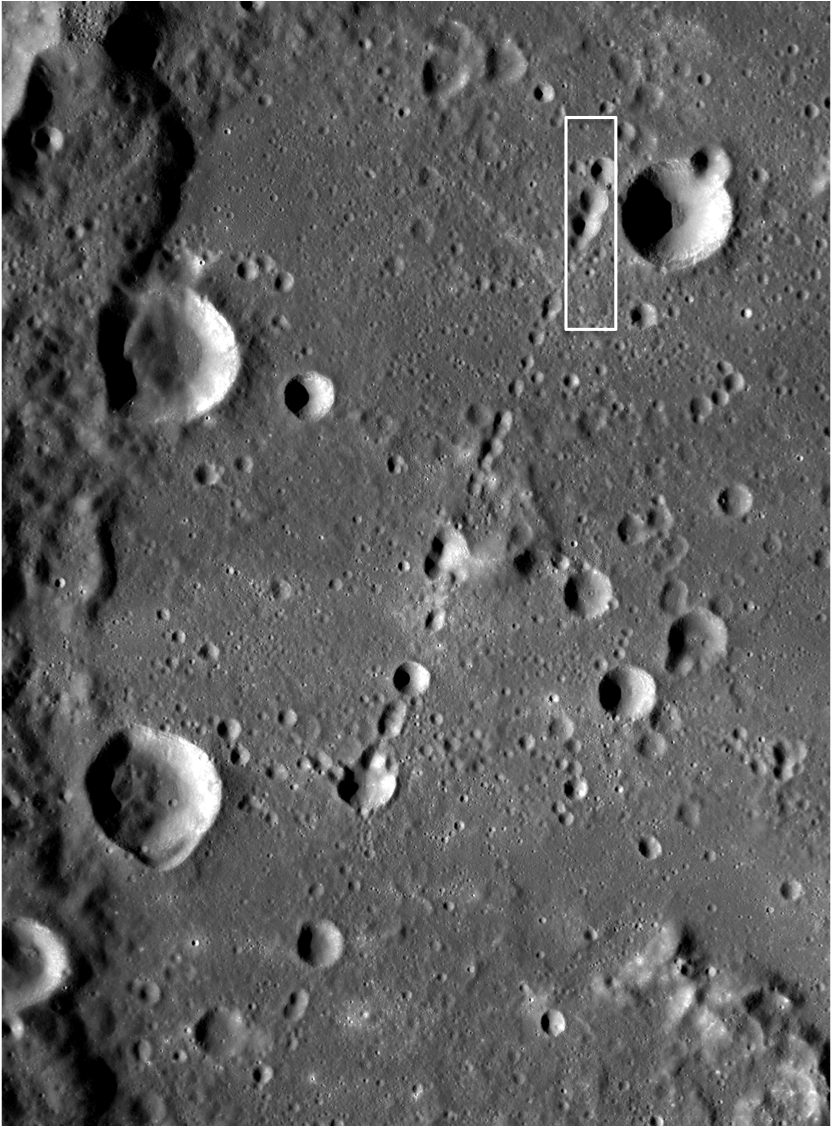
Full 5.8 km width of both left and right frames of LROC NAC M159080552L, reduced one-third from 4 meters per pixel resolution as viewed using LROC QuickMap, HERE. Square shows approximate field of view seen in Featured Image further above[NASA/GSFC/Arizona State University].
Forty kilometer wide view of Green M, with the location of the Featured Image (0.426°N, 133.236°E) indicated by arrow. Range of elevations above global mean derived from LROC QuickMap. Image LROC Wide Angle Camera (WAC) M149648971CE (643 nm); orbit 7187, January 14, 2011. Illumination is from the west at an incidence angle of 72.33° Resolution 79.22 meters per pixel from 58.26 km [NASA/GSFC/Arizona State University].

A thin layer of regolith does not completely obscure the irregular shallow depressions, or negative relief features, surrounding the high-reflectance boulders or the much smaller (<10 m) rocks eroding nearby. These depressions probably represent collapsed pockets in the impact melt sheet, similar to those observed in the King crater impact melt. However, enough time has passed to accumulate a layer of regolith that obscures what was originally a distinct rim, smoothing the surroundings while also enhancing small rock erosion - due to micrometeorite impacts - on the melt sheet over time.

What other interactions between target material and impact melt can you find in the full LROC NAC image? Can you find evidence for additional negative relief features or pits in the impact melt deposit?

Related Posts:
Impact melt in Anaxagoras crater
Ejecta in Tycho crater
The Chicken or the Egg?

Thursday, February 3, 2011

Mendeleev in Full


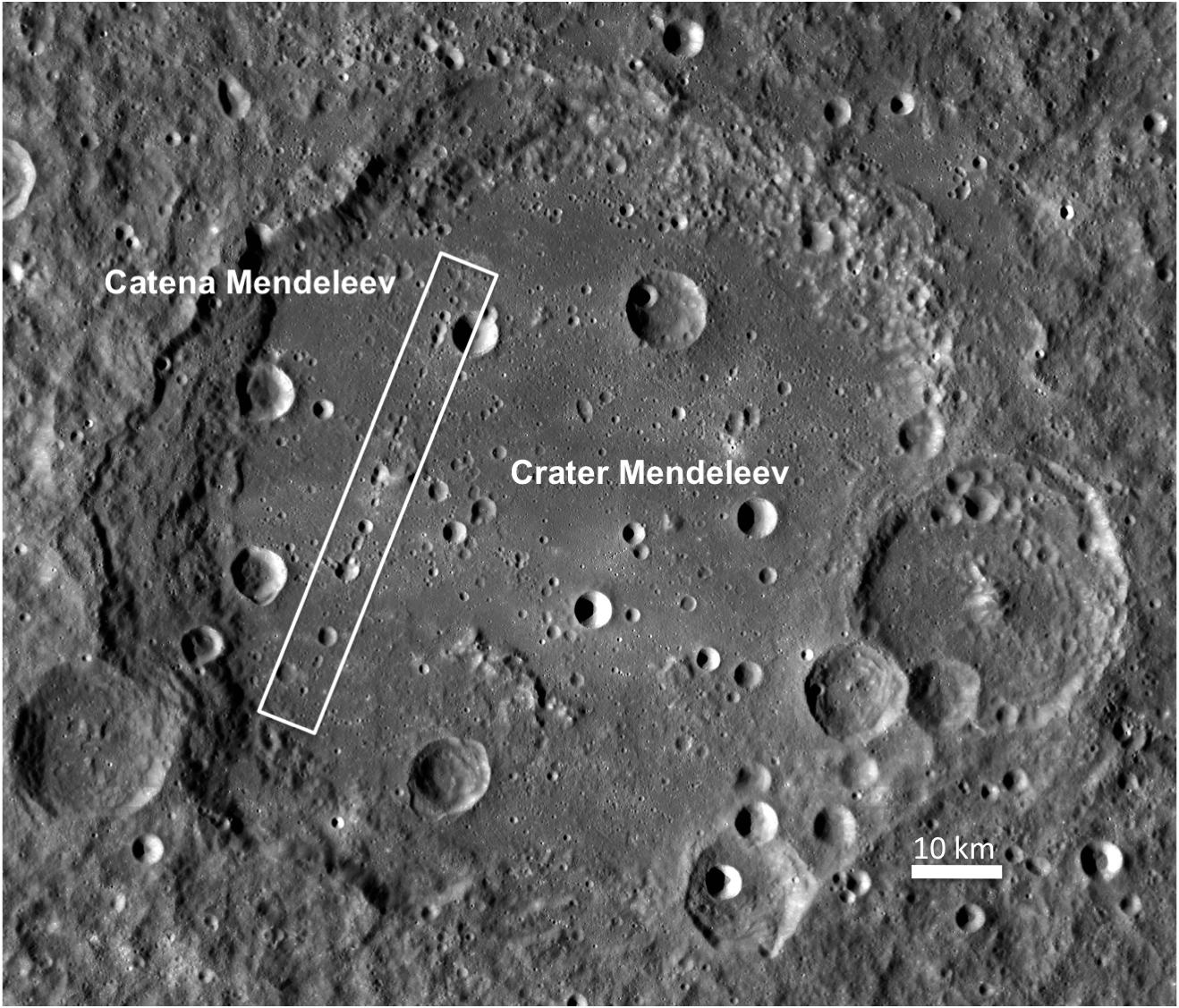
A LROC Wide Angle Camera (WAC) 100 meter/pixel monochrome mosaic released February 3, 2011, shows all of Mendeleev (313 km in diameter) in a full-sized dramatic view available HERE. The white rectangle marks the location of Catena Mendeleev, highlighted in greater detail HERE and below [NASA/GSFC/Arizona State University].

Sarah Braden
LROC News System

Mendeleev crater (named after Dimitri Mendeleev, the inventor of the periodic table of elements) is a very large, Nectarian-age crater on the lunar farside (5.7°N, 140.9°E). Approximately 313 kilometers in diameter, it is almost large enough to be a small basin. The interior contains many younger craters, including Catena Mendeleev, but also features a very smooth floor filled in with a light plains material. In general, this material is characterized by its smooth surface and intermediate albedo (brighter than basaltic mare material, but not as bright as highlands material). Light plains are found elsewhere on the Moon, most notably in the Cayley formation, the Apollo 16 landing site. Light plains are usually thought to be emplaced as large scale grounding flows of ejecta from large basin forming impacts. However details of this formation mechanism are still not well understood.


A fanciful view of the newly-released LROC WAC mosaic, tapered into the lunar digital elevation model available to users of Google Earth (>v.5). In the foreground left Richards crater (7.7°N, 140.1°E) is approximately 9 km in diameter [NASA/GSFC/Arizona State University/USGS/JAXA].

Explore the entire WAC mosaic here!

Related Posts:
Hunting for Ancient Lunar Impact Basins
Mare Frigoris


In 2007, Japan's robust first lunar orbiter SELENE-1 ("Kaguya") took high color High Definition television views from orbit, including this still of Mendeleev from around 100 kilometers above and several hundred to the south, as all of the 313 km crater lingered momentarily on the orbital horizon. Click HERE to see the full-sized image [JAXA/NHK].

Wednesday, February 2, 2011

Inside Catena Mendeleev


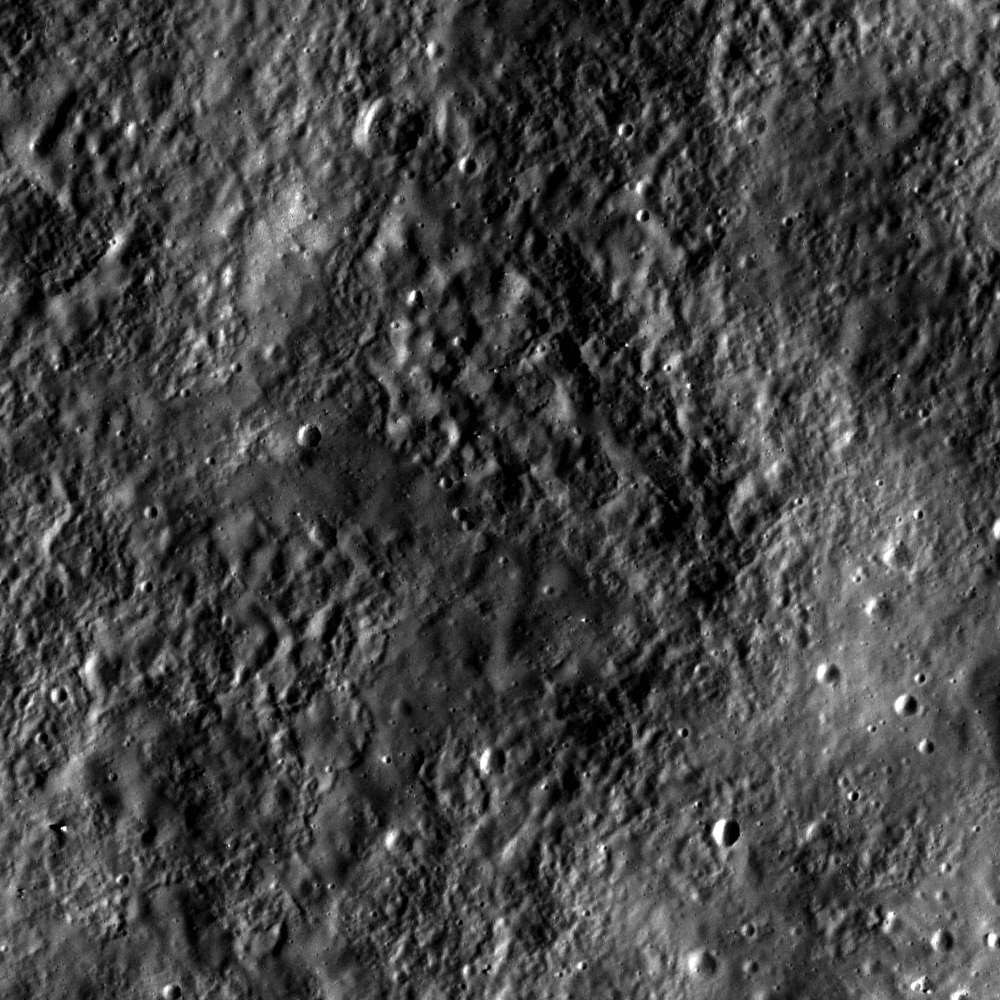
Texture on inside wall of a crater in the Catena Mendeleev, a linear crater chain located inside the 313km Mendeleev crater (5.7°N, 140.9°E), detail from LROC Narrow Angle Camera observation M113038958R, solar illumination incidence angle 46°, image resolution 0.5 m/pixel; LRO orbit 1792, November 16, 2009. View the full-sized original LROC Featured Image, HERE [NASA/GSFC/Arizona State University].

Sarah Braden
LROC News System

Catena Mendeleev is a linear crater chain probably formed by the impact of fragments (called 'secondaries' by planetary scientists) that were ejected by the impact that formed Tsiolkovskiy Crater, 850 kilometers to the southwest of Mendeleev. Crater chains form from secondary impacts ejected radially from their parent impact.

Today's Featured Image shows the rough and smooth textures on the inside of one of these secondary impacts. Secondary craters in a chain are often elongate in shape, with irregular rims. Secondary crater chains tend to occur in a zone immediately surrounding a large primary crater. However, larger impacts can move significant amounts of ejecta, including crater chains, far from the primary crater, as we see here at Catena Mendeleev.


LROC Wide Angle Camera 100 m/pixel monochrome mosaic, annotated with a white box marking the location of LROC NAC observation M113038958 field of view, centered at 7.67°N, 139.62°E, within Mendeleev Crater [NASA/GSFC/Arizona State University].


Backing away further from the field of view above allows for even more context, using the LROC WMS Image Map. The full-extent of the relatively flat interior of 313km-wide Mendeleev in comparison with the rolling highlands typical of the lunar farside comes into view [NASA/GSFC/Arizona State University].

Browse the full NAC frame to explore the craters in Catena Mendeleev!

Related Posts:
Chain of secondary craters in Mare Orientale
Stream of Secondary Craters