|
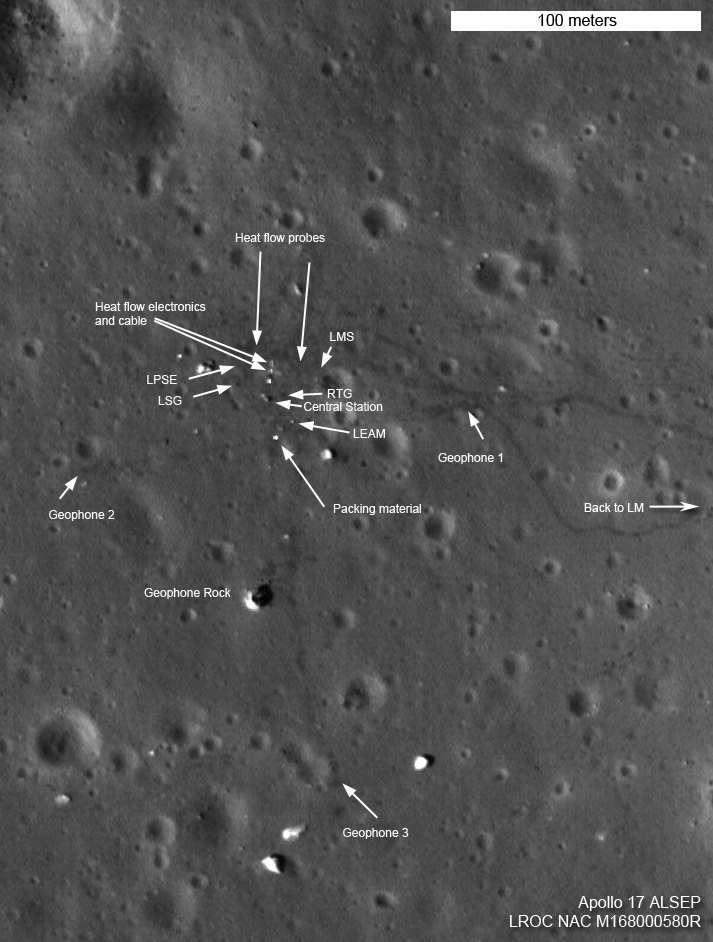
| LACE (Lunar Surface Composition Experiment), a.k.a. "Lunar Mass Spectrometer," deployed as part of the Apollo 17 ALSEP (Apollo Lunar Surface Experiment Package) December 11, 1972 and afterward remotely operated and monitored until shutdown in 1977. The experiment housing has been photographed from lunar orbit by the LROC Narrow Angle Camera [Schmitt/AS17-134-20499]. |
Portions from ScienceDaily July 16, 2012 - The Lunar Atmospheric Composition Experiment (LACE), a spectrometer designed to measure and characterize the thin lunar atmosphere was deployed at Taurus Littrow by Gene Cernan and Harrison Schmitt of Apollo 17. Forty years later, researchers using the Lyman Alpha Mapping Project (LAMP) far ultraviolet spectrograph, on-board LRO have added to those initial measurements to provide the first remotely-sensed measurement of the Moon's gaseous environment at the surface from lunar orbit, specifically the atmospheric concentration of helium.
Aiming LAMP sensors toward the lunar limb, and comparing their readings with measurements of the interstellar background, the authors of work published in Geophysical Research Letters have estimated the helium concentration of the near-surface lunar environment.
Aiming LAMP sensors toward the lunar limb, and comparing their readings with measurements of the interstellar background, the authors of work published in Geophysical Research Letters have estimated the helium concentration of the near-surface lunar environment.
They calculate a density of 7,000 atoms per cubic centimeter at 120° K (-244° F) The earlier LACE observations ranged between 10,000 -- 20,000 and 50,000 atoms per cubic centimeter, depending on the time of day, increasing through the lunar night and decreasing during daylight. The nighttime decrease occurs because the atmosphere cools and contracts, yielding an increased density.
The authors suggest the next steps should involve looking for spatial or temporal variations in lunar atmospheric helium. Such observations could help to determine whether the helium detected is produced locally, by radioactive decay, or if it is formed from trapped and neutralized solar wind.
The authors suggest the next steps should involve looking for spatial or temporal variations in lunar atmospheric helium. Such observations could help to determine whether the helium detected is produced locally, by radioactive decay, or if it is formed from trapped and neutralized solar wind.
 |
| Apollo 17 ALSEP area (north is up). The LACE instrument is labeled "LMS," for Lunar Mass Spectrometer. Detail from a wider field of view HERE. (See Skimming the Moon, September 8, 2011) [NASA/GSFC/Arizona State University]. |