|
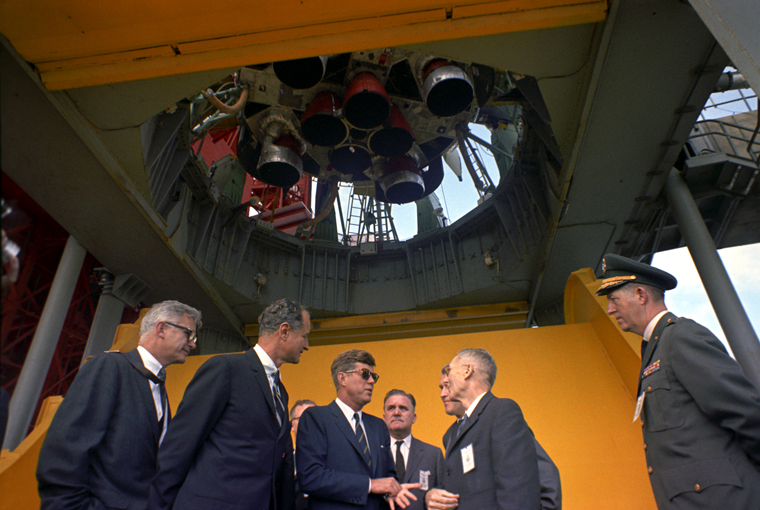
| Dr. Wernher Von Braun with President John Kennedy at the U.S. Army Redstone Arsenal in 1963, "feigning interest?" |
Paul D. Spudis
The Once and Future Moon
Smithsonian Air & Space
The 50th anniversary of the tragic death of President John F. Kennedy has prompted examination of his presidential legacies and in particular, the role he played in our race to the Moon. In an op-ed, Rand Simberg opines on how space buffs magnify and distort Kennedy’s space legacy – that in fact, JFK really didn’t care one whit for spaceflight and only challenged the Soviets to a Moon race for near-term, earthly political purposes.
No one conversant with the history of the Apollo program could seriously doubt that the impetus for setting the goal of a lunar landing within a decade was driven primarily by geopolitical considerations, rather than by a romantic notion of colonizing the Solar System. But there’s a bit more to the story. Simberg’s piece fails to recognize that close, hands-on experience with the unfamiliar often changes attitudes and that prejudices evolve over time.
Upon taking office, Kennedy had little interest in the space program but like Eisenhower with Sputnik, intervening events abruptly forced a change in his outlook. In April 1961 Yuri Gagarin orbited the Earth – the first flight of a human in space – engulfing Kennedy in a press feeding frenzy as a triumphant Soviet Union laid claim to one of the most important laurels of the space age. With recriminations still echoing throughout Washington, a second national security disaster emerged – the Bay of Pigs fiasco, a failed invasion of Cuba by American-sponsored anti-Castro exiles. The new administration appeared both inept and indecisive. The Gagarin space flight and the U.S.-backed invasion of Cuba occurred during the build-up of a devastating nuclear arsenal by the Soviet Union, amid bellicose pronouncements from its bombastic leader, Nikita Sergeivich Khrushchev – “We will bury you!”
Against this high-temperature political background, Kennedy looked for a significant technical project with which to challenge the Soviets. Kennedy thought that the large-scale desalination of seawater would help win the hearts of emerging “Third World” nations. A key consideration was choosing an effort that the Soviets could not win in the next few years. True enough, space was not his original choice but in order to give the United States enough time to build up and use its industrial and technical might (as well as provide payback on politically realistic timescales), Kennedy needed a challenging long-term national goal.
By assigning his Vice-President Lyndon Baines Johnson to look into possible space projects and report back to him, Kennedy had placed the decision in the hands of someone already committed to an accelerated and vigorous space effort. As Senate Majority Leader, Johnson – a vocal advocate for large-scale space projects – had previously helped shepherd the 1958 Space Act (that created NASA) though the Congress. It was Johnson who asked NASA’s James Webb and Hugh Dryden for options.
In a memo to Johnson, Kennedy specifically asked, “Is there a space program we can undertake and win?” With Johnson’s committee working closely with Wernher von Braun on what was technically possible in the near- and far-terms, it became apparent that the Soviets had a clear advantage in rocket boosters, making any attempt to match Soviet space accomplishments in low Earth orbit within the next few years likely to fail. On the other hand, if the U.S. were to pick a goal which neither country could achieve in the near-term, America’s edge in technology and resources might give them enough of an advantage to win in the long run – making it a real race.
A manned mission to the Moon emerged as the logical goal and was duly reported to the President. Kennedy was willing but hesitant – initial cost estimates for Apollo were on the order of $40 billion (this was in a saner fiscal era, when a billion dollars meant real money). Committing to spend that much, while not unprecedented, would give politicians of any stripe pause. Nonetheless, Kennedy moved forward with the Moon landing challenge, announcing his initiative in a special Joint Session of Congress on May 25, 1961.
So we now have a picture of a U.S. President, due to political circumstances, forced into and agreeing to a program he was reluctant to undertake. According to Simberg’s piece, this is the meaning of Apollo. What’s missing is that (as they like to say in Washington) Kennedy “evolved” in his beliefs. While initially willing (but cool) to the space program, his continued attention to “the race” over the remainder of his presidency suggests that he became more keenly interested over time. Kennedy, often guided by von Braun who would brief him on technical details, made multiple visits to the new NASA field centers. Kennedy became a “buff” – just like so many of us in the 1960s, drawn up in the excitement of the new space effort. Enthralled by events like a static firing test of Saturn engines at the Marshall Space Flight Center in May of 1963, he began soaking up space knowledge. He was hooked and in it to win it.
Kennedy’s speech at Rice University on September 12, 1962 has become inextricably tied to the American can-do spirit and cited whenever someone wants to capture the inherent romanticism and steely determination of the American effort. Apollo was not some tiresome political task or a pork-shoveling boondoggle to JFK. It was about winning a battle in a very real Cold War. It is in this context that President Kennedy’s September 1963 offer to go to the Moon jointly with the Russians must be understood. Yet, part of a speech given at the United Nations, has been interpreted to show that Kennedy was ambivalent toward space and was attempting to dodge the heavy political and fiscal costs of building the Apollo system. This notion has led some to surmise that had he lived, Kennedy would not have been as ardent a supporter of the space program as we space cadets believe that he was.
John Kennedy's seminal remarks at Rice University, Houston, Texas, September 12, 1962. It was this speech where, many believe, the 35th President succeeded in placing manned spaceflight in historic and definitively American context. "We choose to go to the Moon," he said, "and do the other things, not because they are easy, but because they are hard. Because that goal will serve to organize and measure the best of our energies and skills. Because that challenge is one we are willing to accept, one we are unwilling to postpone, and one we intend to win."
Words were effective weapons during the Cold War. At every opportunity, Kennedy contrasted the open, non-military nature of the American space program with the secretive and presumably bellicose nature of the Soviet one.
This contrast was made explicit in Kennedy’s initial rationale for the lunar effort when he said, “Whatever mankind must undertake, free men must fully share” (emphasis added). By 1963, Kennedy knew Khrushchev’s mind-set as well as any foreign leader. He knew that Khrushchev and the rest of the Soviet Presidium would never accept a proposal for a joint lunar mission – they were suspicious, paranoid triumphalists, as their never-ending blitz of space propaganda illustrated. Moreover, at this stage of the space race, the Soviets were clearly ahead, having racked up a number of headline-grabbing “firsts” including simultaneous multiple crews and spacecraft, four-day long missions, and orbiting the first woman in space, Valentina Tereshkova.
By making an offer for a joint American-Soviet lunar mission, Kennedy appeared reasonable and forthcoming. “See? America has nothing but peaceful intentions for space. If our Soviet colleagues have similar intentions, as they claim, why do they not join us when we ask them to?” Jack Kennedy, a decorated World War II veteran and the consummate Cold Warrior, knew how to play the propaganda card. His offer did not represent a desire to back away from his U.S. commitment to space. It was a calculated move by the United States in the ongoing war of words, threats and confrontations that constituted the Cold War.
It’s tempting to retrospectively apply today’s intellectual template to past events, but by doing so it distorts the historical record. A look at Kennedy’s approach to the Soviet Union shows that his inclination was to confront them when necessary. The Bay of Pigs fiasco early in his presidency followed by the Berlin crisis led Kennedy to believe that Khrushchev and the Soviets must be opposed on the world stage, up to and including space. Initially cool to the very idea of human spaceflight, Kennedy took the concept to new heights of accomplishment by setting – and ultimately achieving – a goal that captured the imaginations of war-weary people around the world.
Originally published November 24, 2013 at his Smithsonian Air & Space blog The Once and Future Moon, Dr. Spudis is a senior staff scientist at the Lunar and Planetary Institute. The opinions expressed are those of the author but are better informed than average.
Related:
John Kennedy's Final Address, Texas Hotel
Fort Worth, Texas, November 22, 1963
The Once and Future Moon
Smithsonian Air & Space
The 50th anniversary of the tragic death of President John F. Kennedy has prompted examination of his presidential legacies and in particular, the role he played in our race to the Moon. In an op-ed, Rand Simberg opines on how space buffs magnify and distort Kennedy’s space legacy – that in fact, JFK really didn’t care one whit for spaceflight and only challenged the Soviets to a Moon race for near-term, earthly political purposes.
No one conversant with the history of the Apollo program could seriously doubt that the impetus for setting the goal of a lunar landing within a decade was driven primarily by geopolitical considerations, rather than by a romantic notion of colonizing the Solar System. But there’s a bit more to the story. Simberg’s piece fails to recognize that close, hands-on experience with the unfamiliar often changes attitudes and that prejudices evolve over time.
Upon taking office, Kennedy had little interest in the space program but like Eisenhower with Sputnik, intervening events abruptly forced a change in his outlook. In April 1961 Yuri Gagarin orbited the Earth – the first flight of a human in space – engulfing Kennedy in a press feeding frenzy as a triumphant Soviet Union laid claim to one of the most important laurels of the space age. With recriminations still echoing throughout Washington, a second national security disaster emerged – the Bay of Pigs fiasco, a failed invasion of Cuba by American-sponsored anti-Castro exiles. The new administration appeared both inept and indecisive. The Gagarin space flight and the U.S.-backed invasion of Cuba occurred during the build-up of a devastating nuclear arsenal by the Soviet Union, amid bellicose pronouncements from its bombastic leader, Nikita Sergeivich Khrushchev – “We will bury you!”
 |
| June 3, 1961 - only two months following the Gagarin's pioneering orbital flight, and less than a month after Alan Shepard's 15 minute suborbital ride, President John Kennedy meets with Soviet Chairman Nikita Khrushchev at the U. S. Embassy residence, Vienna, Austria [Deptartment of State/John Fitzgerald Kennedy Library, Boston]. |
By assigning his Vice-President Lyndon Baines Johnson to look into possible space projects and report back to him, Kennedy had placed the decision in the hands of someone already committed to an accelerated and vigorous space effort. As Senate Majority Leader, Johnson – a vocal advocate for large-scale space projects – had previously helped shepherd the 1958 Space Act (that created NASA) though the Congress. It was Johnson who asked NASA’s James Webb and Hugh Dryden for options.
In a memo to Johnson, Kennedy specifically asked, “Is there a space program we can undertake and win?” With Johnson’s committee working closely with Wernher von Braun on what was technically possible in the near- and far-terms, it became apparent that the Soviets had a clear advantage in rocket boosters, making any attempt to match Soviet space accomplishments in low Earth orbit within the next few years likely to fail. On the other hand, if the U.S. were to pick a goal which neither country could achieve in the near-term, America’s edge in technology and resources might give them enough of an advantage to win in the long run – making it a real race.
A manned mission to the Moon emerged as the logical goal and was duly reported to the President. Kennedy was willing but hesitant – initial cost estimates for Apollo were on the order of $40 billion (this was in a saner fiscal era, when a billion dollars meant real money). Committing to spend that much, while not unprecedented, would give politicians of any stripe pause. Nonetheless, Kennedy moved forward with the Moon landing challenge, announcing his initiative in a special Joint Session of Congress on May 25, 1961.
So we now have a picture of a U.S. President, due to political circumstances, forced into and agreeing to a program he was reluctant to undertake. According to Simberg’s piece, this is the meaning of Apollo. What’s missing is that (as they like to say in Washington) Kennedy “evolved” in his beliefs. While initially willing (but cool) to the space program, his continued attention to “the race” over the remainder of his presidency suggests that he became more keenly interested over time. Kennedy, often guided by von Braun who would brief him on technical details, made multiple visits to the new NASA field centers. Kennedy became a “buff” – just like so many of us in the 1960s, drawn up in the excitement of the new space effort. Enthralled by events like a static firing test of Saturn engines at the Marshall Space Flight Center in May of 1963, he began soaking up space knowledge. He was hooked and in it to win it.
Kennedy’s speech at Rice University on September 12, 1962 has become inextricably tied to the American can-do spirit and cited whenever someone wants to capture the inherent romanticism and steely determination of the American effort. Apollo was not some tiresome political task or a pork-shoveling boondoggle to JFK. It was about winning a battle in a very real Cold War. It is in this context that President Kennedy’s September 1963 offer to go to the Moon jointly with the Russians must be understood. Yet, part of a speech given at the United Nations, has been interpreted to show that Kennedy was ambivalent toward space and was attempting to dodge the heavy political and fiscal costs of building the Apollo system. This notion has led some to surmise that had he lived, Kennedy would not have been as ardent a supporter of the space program as we space cadets believe that he was.
John Kennedy's seminal remarks at Rice University, Houston, Texas, September 12, 1962. It was this speech where, many believe, the 35th President succeeded in placing manned spaceflight in historic and definitively American context. "We choose to go to the Moon," he said, "and do the other things, not because they are easy, but because they are hard. Because that goal will serve to organize and measure the best of our energies and skills. Because that challenge is one we are willing to accept, one we are unwilling to postpone, and one we intend to win."
This contrast was made explicit in Kennedy’s initial rationale for the lunar effort when he said, “Whatever mankind must undertake, free men must fully share” (emphasis added). By 1963, Kennedy knew Khrushchev’s mind-set as well as any foreign leader. He knew that Khrushchev and the rest of the Soviet Presidium would never accept a proposal for a joint lunar mission – they were suspicious, paranoid triumphalists, as their never-ending blitz of space propaganda illustrated. Moreover, at this stage of the space race, the Soviets were clearly ahead, having racked up a number of headline-grabbing “firsts” including simultaneous multiple crews and spacecraft, four-day long missions, and orbiting the first woman in space, Valentina Tereshkova.
By making an offer for a joint American-Soviet lunar mission, Kennedy appeared reasonable and forthcoming. “See? America has nothing but peaceful intentions for space. If our Soviet colleagues have similar intentions, as they claim, why do they not join us when we ask them to?” Jack Kennedy, a decorated World War II veteran and the consummate Cold Warrior, knew how to play the propaganda card. His offer did not represent a desire to back away from his U.S. commitment to space. It was a calculated move by the United States in the ongoing war of words, threats and confrontations that constituted the Cold War.
It’s tempting to retrospectively apply today’s intellectual template to past events, but by doing so it distorts the historical record. A look at Kennedy’s approach to the Soviet Union shows that his inclination was to confront them when necessary. The Bay of Pigs fiasco early in his presidency followed by the Berlin crisis led Kennedy to believe that Khrushchev and the Soviets must be opposed on the world stage, up to and including space. Initially cool to the very idea of human spaceflight, Kennedy took the concept to new heights of accomplishment by setting – and ultimately achieving – a goal that captured the imaginations of war-weary people around the world.
Originally published November 24, 2013 at his Smithsonian Air & Space blog The Once and Future Moon, Dr. Spudis is a senior staff scientist at the Lunar and Planetary Institute. The opinions expressed are those of the author but are better informed than average.
Related:
John Kennedy's Final Address, Texas Hotel
Fort Worth, Texas, November 22, 1963
 |
| Former President and Mrs. Lyndon Johnson witness the launch of Apollo 11 from the VIP stands at Kennedy Space Center, July 16, 1969 [NASA]. |