
 |
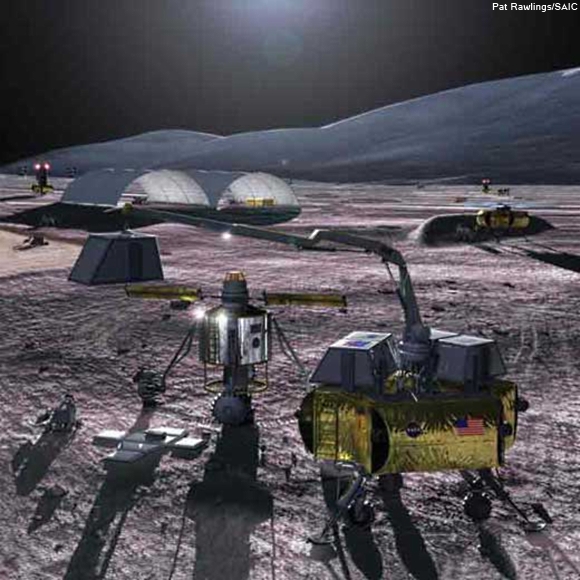
| Of necessity, much of the actual work of harvesting resources for true in situ resource utilization (ISRU) will have to be done robotically [Pat Rawlings/SAIC]. |
Ian Crawford
Birkbeck, University of London
To date, all human economic activity has depended on the material and energy resources of a single planet; understandably, perhaps. It is conceivable though that future advances in space exploration could change this by opening our closed planetary economy to essentially unlimited external resources of energy and raw materials.
Look up at the Moon this evening, and you might be gazing at a solution. The Earth’s closest celestial neighbour seems likely to play a major role and already a number of private companies have been created to explore the possibilities.
It is important to stress that even now, 40 years after the Apollo missions, we still don’t have a complete picture of the Moon’s economic potential, and obtaining one will require a more rigorous programme of lunar exploration than has been undertaken to-date. In part, this is why proposed future lunar exploration missions (such as the recently announced Lunar Mission One) are so important.
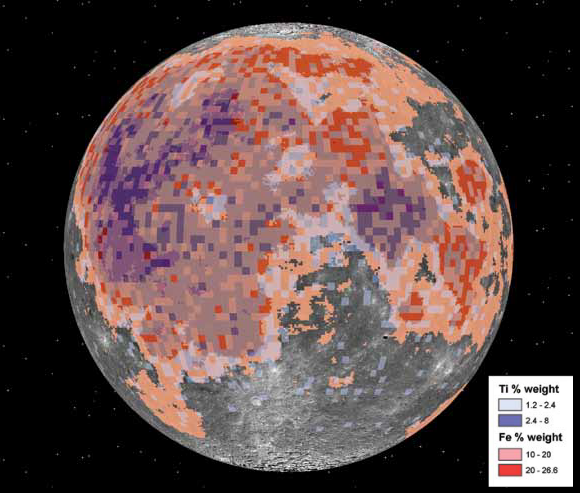 |
| "In addition, lunar surface rocks and soils are rich in potentially useful, but heavy (and thus expensive to launch from Earth) raw materials such as magnesium, aluminium, silicon, iron and titanium." - Relative abundances of titanium and iron, as a percentage of weight, plotted against the nearside hemisphere. Note the heaviest incidences appear in the Ocean of Storms and Sea of Tranquility. |
Nevertheless, as a result of work over the past four decades, we do now know enough to make a first-order assessment of lunar resource potential. In doing so it is useful to distinguish between three possible future applications of such resources.
Read the full article published at The Conversation, HERE.
NOTE from Mr. Crawford: "This essay is based on a much more detailed review article which will be published next year, and in which references to sources and more extensive discussion will be found here: arXiv.org/abs/1410.6865."


