Showing posts with label lunar core. Show all posts

Tuesday, February 21, 2012

ESRF X-rays illuminate lunar interior

Image of artificial moon rock sample, measuring about half
millimeter across, made with an electron microprobe at ambient
temperature after the experiment with X-rays. The fragmenta-
tion of the sample occurred when it was extracted from the
small diamond cylinder in which it had been melted under high
pressure and temperature [ESRF/Nature].
Does the Moon still have even a small, warm liquid core? The answer can only be apparent indirectly, behind its dance movements and the combined angular momentum of it juggled components; the Moon’s anisotropy. If, as investigators now claim, the Moon’s outer surface is still shrinking or, in some cases, stretching, other outward evidence of even a small warm and liquid core can only be discovered indirectly. Why, for example, is any evidence of volcanism on the Moon’s surface at least a billion years old?

A science team in the Netherlands claims to have discovered one answer, the natural buoyancy of molten but poorly mixed constituent materials closer to the Moon’s core. The world’s press is reporting their more subtle investigation, using X-rays, with headlines about future lunar volcanism, which contrasts with their own press release and it's secondary headline:

Deep lunar magma is too heavy to produce active volcanoes

"Scientists have now identified a likely reason for this peaceful surface life: the hot, molten rock in the Moon's deep interior could be so dense that it is simply too heavy to rise to the surface like a bubble in water. For their experiments, the scientists produced microscopic copies of moon rock collected by the Apollo missions and melted them at the extremely high pressures and temperatures found inside the Moon. They then measured their densities with powerful X-rays. The results are published in the Journal Nature Geosciences on 19 February 2012.

"The team was led by Mirjam van Kan Parker and Wim van Westrenen from VU University Amsterdam and comprised of scientists from the Universities of Paris 6/CNRS, Lyon 1/CNRS, Edinburgh, and the European Synchrotron Radiation Facility (ESRF) in Grenoble.

Exploded schematic of the high-pressure cell
assembly for the ESRF synchrotron  X-ray
experiment. The artificial moon rock samples
(orange) were placed inside the ring-shaped, natural
diamond sample holder (grey), and surrounded by
a large disk-shaped container (red) [ESRF/Nature].
"The driving force for vertical movement of magma is the density difference between the magma and the surrounding solid material, making the liquid magma move slowly upwards like a bubble. The lighter the liquid magma is, the more violent the upward movement will be.

"To determine the density of lunar magma, Wim van Westrenen and his colleagues synthesised moon rock in their laboratory in Amsterdam, using the composition derived from Apollo samples as their “recipe”. The pressures and temperatures close to the core of the Moon are more than 45,000 bar and about 1500 degrees. It is possible to generate these extreme conditions with small samples, heating them with a high electric current while squashing them in a press. By measuring the attenuation of a powerful synchrotron X-ray beam at the (European Synchrotron Radiation Facility) in Grenoble, traversing the sample both solid and molten, the density at high pressure and high temperature could be measured.

 “We had to use the most brilliant X-ray beam in the world for this experiment because the magma sample is so tiny and confined in a massive, highly absorbing container. Without a bright beam of X-rays, you cannot measure these density variations”, says Mohamed Mezouar from the ESRF.

"The measurements at the ESRF were combined with computer simulations to calculate the magma density at any location in the Moon.

"Nearly all the lunar magmas were found to be less dense than their solid surroundings, similar to the situation on Earth. There is one important exception: small droplets of titanium-rich glass first found in Apollo 14 mission samples produce liquid magma as dense as the rocks found in the deepest parts of the lunar mantle today. This magma would not move towards the surface.

"Such titanium-rich magma can only be formed by melting titanium rich solid rocks. Previous experiments have shown that such rocks were formed soon after the formation of the Moon at shallow levels, close to the surface. How did they get deep into the mantle? The scientists conclude that large vertical movements must have occurred early in the history of the Moon, during which titanium-rich rocks descended from near the surface all the way to the core-mantle boundary. “After descending, magma formed from these near-surface rocks, very rich in titanium, and accumulated at the bottom of the mantle – a bit like an upside-down volcano. Today, the Moon is still cooling down, as are the melts in its interior. In the distant future, the cooler and therefore solidifying melt will change in composition, likely making it less dense than its surroundings. This lighter magma could make its way again up to the surface forming an active volcano on the Moon – what a sight that would be! – but for the time being, this is just a hypothesis to stimulate more experiments”, concludes Wim van Westrenen."

Reference: Mirjam van Kan Parker, et al., Neutral buoyancy of titanium-rich melts in the deep lunar interior, Nature Geoscience advanced online publication, 19 February 2012

Friday, January 27, 2012

Remnant magnetism hints at once-active lunar core

A piece of lunar sample 10020, a rock that appears to carry
the signature of a past magnetic field on the moon [NASA].
John Matson
Scientific American

The moon of today is a static orb with little to no internal activity; for all intents and purposes it appears to be a dead, dusty pebble of a world. But billions of years ago the moon may have been a place of far more dynamism—literally.

A new study of a lunar rock scooped up by Neil Armstrong and Buzz Aldrin during their Apollo 11 mission indicates that the ancient moon long sustained a dynamo—a convecting fluid core, much like Earth's, that produces a global magnetic field. The age of the rock implies that the lunar dynamo was still going some 3.7 billion years ago, about 800 million years after the moon's formation.

That is longer than would be expected if the lunar dynamo were powered primarily by the natural churning of a cooling molten interior, as is the case on Earth. The moon's small core should have cooled off rather quickly and put an end to any dynamo-generated magnetic field within a few hundred million years. So researchers may have to explore alternate explanations for how a dynamo could be sustained—explanations that depart from thinking of the lunar interior in terms of Earthly geophysics.

A standard-issue, Earth-like dynamo "would have died out on the moon much, much before 3.7 billion years ago," says Erin Shea, a graduate student in geology at the Massachusetts Institute of Technology and lead author on a study in the January 27 issue of Science. "We have to start thinking outside the box about what generates a lunar dynamo."
A lunar sample collected by Apollo astronauts suggests that other-Earthly geophysics drove the moon's churning interior
Using a high-resolution magnetometer, the researchers found that the lunar sample indeed formed in the presence of a magnetic field, perhaps even one as strong as Earth's magnetic field today. "What this sample tells us is that at some point the moon did have a dynamo," Shea says. "This magnetic field lasted much longer than we had considered before."

A similar paleomagnetic study in 2009 by some of Shea's co-authors demonstrated the presence of a lunar dynamo some 4.2 billion years ago. That is just at the cusp of what would be possible with an Earth-like dynamo driven by a cooling interior alone. "Even then it's not trivial," says Ian Garrick-Bethell, a planetary scientist at the University of California, Santa Cruz (U.C.S.C.), who was the lead author of the 2009 study.
Read the full online article HERE.

Friday, February 4, 2011

Journey to the Center of the Moon


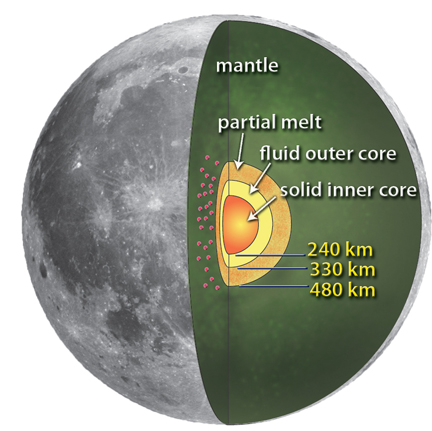
New interpretation of the lunar interior (from Weber et al., 2011, Science 331, 309-312)

Paul D. Spudis
The Once & Future Moon
Smithsonian Air & Space

A recently published science paper presented results of a re-analysis of seismic (moonquake) data sent to the Earth from a network emplaced by the Apollo astronauts 40 years ago. The scientists processing the old data found that the Moon may have more than a simple core – it may have a layered, partly liquid metallic core.

Why is this important? Scientists have known for many years that the Earth has a layered interior structure. The outermost layer, called the crust, is the only part of the Earth directly accessible to us for study. The crust varies in thickness, ranging from a few kilometers in the ocean basins to over 20 km in continental areas. The next zone down is called the mantle. The mantle is very thick – almost 3000 km. It is made up of a dense, iron- and magnesium-rich rock type called peridotite. Partial melting in the mantle is the source of basaltic magma that erupts to make up the floors of ocean basins worldwide. The innermost part of the Earth is the core, comprised mostly of metallic iron and nickel, and over 3000 km in radius. The outer layer of the core is liquid, but the enormous pressure that contains the inner core keeps it solid.

The Earth’s core is electrically conducting as the rotation of the Earth induces currents within it. It is thought that these electrical currents are responsible for the dynamo that generates the magnetic field of the Earth. Because most of the Earth’s iron is contained in the core, we know that in bulk composition, the Earth is made from chondrites, the same stony material found as primitive meteorites in space. Thus, understanding the core is relevant to the origin of its magnetic field and the internal structure and bulk composition of the Earth.

For these reasons, we are interested in the possibility of a core within the Moon. Even before we went to the Moon, we understood that an internal structure similar to Earth was not likely. A property called moment of inertia told us in broad terms that, unlike the layered structure of Earth, the Moon was more or less homogeneous inside. The moment of inertia indicated that any core inside the Moon must be smaller than a couple of hundred kilometers at most (the Moon’s radius is 1740 km).


The Apollo 12 Apollo Lunar Surface Experiment Package (ALSEP) after its deployment in Oceanus Procellarum, November 19, 1969. Among the instruments set up by Conrad & Bean was the Passive Seismic Experiment (PSE). The Apollo ALSEP assets were kept powered by radioisotope thermoelectric generators and data continued to be collected until the project was defunded in 1977, leaving only three laser range reflector arrays as the only remaining Apollo assets contributing new science until the arrival in orbit of LRO in July 2009 [AS12-67-6817-Conrad/Apollo 12].

Seismometers, deployed on the Moon as part of a surface network during the Apollo missions, operated for over seven years collecting data on tremors within the Moon. Because certain rocks have known physical properties (e.g., density), we use the velocity of seismic waves in an indirect way to infer the presence of these rock types and physical structure. From our initial analyses of these data, we determined that the Moon had a fairly thick crust (from 50-80 km, more than twice the thickness of Earth’s crust) and a very thick mantle, almost the remainder of the lunar radius.

The question of the existence of a lunar core remained uncertain. One moonquake resulting from a fairly large impact on the far side of the Moon a couple of years after the Apollo missions had ended produced a signal that suggested the presence of a small core (less than 400 km radius). Moreover, because seismic waves come in two varieties – P-waves, or compression (or sound) waves and S-waves (shear waves, which cannot propagate through liquids) – the partial suppression of S-waves through the center of the Moon during this event suggested that the lunar core might be partly liquid.


The Apollo 14 S-IVB booster (S-IVB-509) was 17.8 meters tall, 6.6 meters wide and weighed about 14,000 kg. It was launched January 31, 1971, and after extraction of the Lunar Module Antares, the S-IVB was directed to dump its remaining fuel directed toward an impact the Moon February 4, 1971. (From "Apollo 14 S-IVB Impact Crater," Mark Robinson, October 8, 2009) "The Apollo impact velocity was 2.54 km/sec at an angle of 69° from the horizontal along a heading of 103° (west to east). The S-IVB had a mass of 14,016 kg at the time of impact and impact energy was 5.54 x 10\10 Joules (equivalent to just over 10 tons of TNT). The signal from the impact was recorded on the Apollo 12 seismometer (PSE) and rebounded throughout the Moon for 3 hours." [NASA/ARC/NLSI].

But this result was so uncertain that few lunar scientists actually believed it. They proceeded to try and constrain the dimensions and composition of a lunar core through other means. A core may be important in the generation of an early global magnetic field that some of the lunar samples seems to indicate (the current Moon has no global field). By carefully measuring the ways in which the magnetic field of the Sun and Earth is modified when the Moon passes through it (as it does during its orbit around the Earth), it was thought that it might be possible to “sense” the presence of a lunar core by measuring these deviations. Results indicated that the core of the Moon had to be small (less than 400 km in radius) and probably made of iron sulfide (FeS).

After seven years of operation, the Apollo seismic net was turned off to save money. Up until it was turned off, we had received a large amount of data but processing it was extremely difficult. The Apollo instruments, although sensitive, were very noisy and not well coupled to bedrock as are seismometers on Earth. Fortunately, faster and more capable computers, along with new techniques to process and analyze noisy data, were developed. And a new generation of scientists came forward to re-examine the old seismic data to see if anything could be discerned from it.

The new results are surprisingly detailed. Not only do these researchers think they have detected a core inside the Moon, but a core with three separate layers – an inner solid core and outer core, very similar in structure to that of the Earth, but with the added wrinkle of a partly molten outermost layer. The entire core is almost 500 km in radius, slightly larger than the diameter inferred from deep magnetic sounding.


LROC Observation M111762553R, LRO orbit 1604, November 2, 2009, from 43.5 km, resolution 49cm/p, solar incidence 31.3° Apollo 14 S-IVB impact at 8.179°S, 333.969°E (from from "LROC Coordinates of Robotic Spacecraft," Samuel Lawrence, April 5, 2010) [NASA/GSFC/Arizona State University].

The presence of currently molten core inside the Moon is rather startling; even the earlier idea about a partly molten zone was viewed askance by most lunar students. But this new idea has revived concepts about a magnetic core dynamo inside the Moon, generating a global field early in lunar history. Such a dynamo might explain a lot about the remnant magnetic fields measured in some of the returned lunar rocks. But there is no obvious reason why such a field would suddenly stop being generated.

Even though the old Apollo network data may still be mined for information, to fully understand lunar structure and history we must emplace a long-lived, global network of new instruments to fully characterize the interior of the Moon. Although studies are underway to determine how this might be accomplished, deployment of such a network is difficult to achieve by robotic spacecraft alone and long life on the Moon may require a nuclear power supply. Each and every time we start believing that we understand our Moon, a new discovery raises even more questions.