Showing posts with label impact model. Show all posts

Thursday, May 2, 2013

Dating Impacts

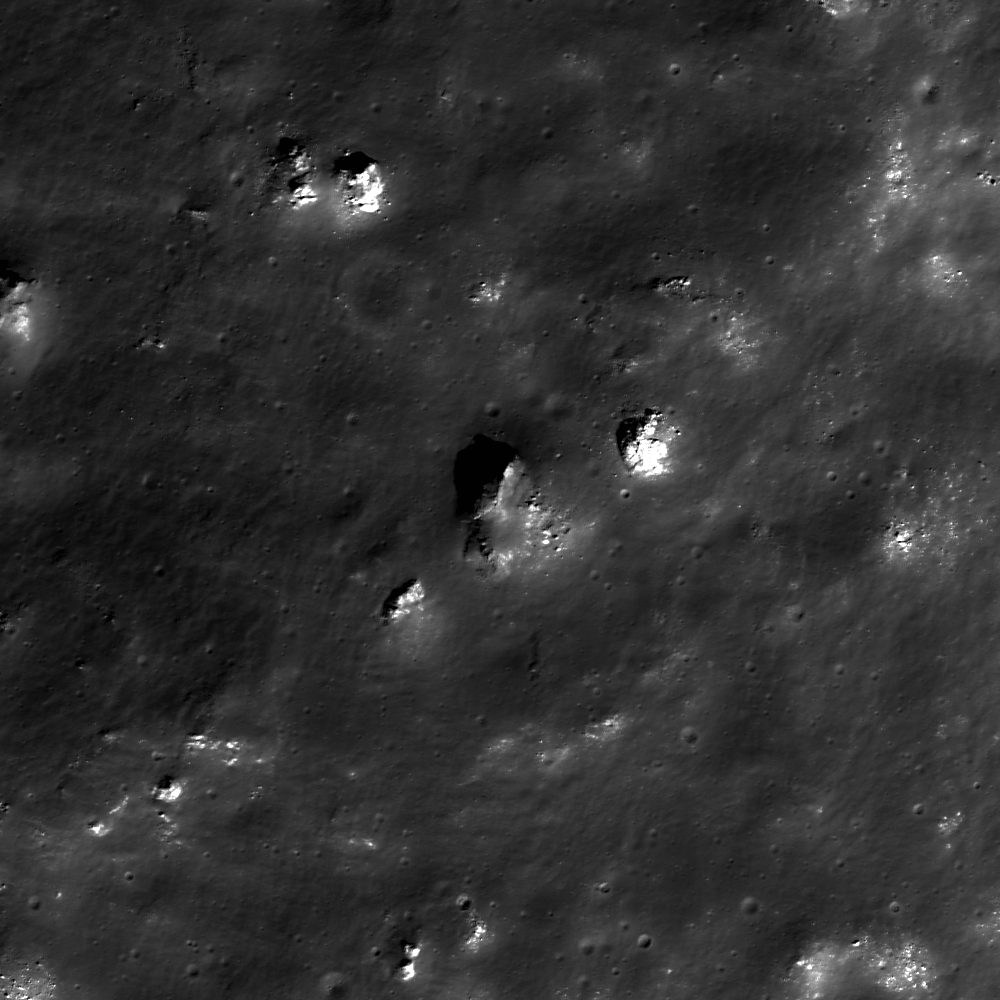
Some boulders are exposed in an impact melt sheet. How can these boulders help geologists understand more about the timing of impacts? LROC Narrow Angle Camera (NAC) observation M1120322807L, LRO orbit 17301, April 11, 2013; field of view 1600 meters across [NASA/GSFC/Arizona State University].
Drew Enns
LROC News System

The impact process produces unimaginable amounts of energy! Some of this energy goes into melting rock, resulting is spectacular landforms. But not all of the rocks melt, and some are just heated up! Such is probably the case for the boulders we see in today's Featured Image. But how can these rocks be of use for geologists? On Earth, some enterprising geologists use boulders like these to date impact structures!

Geochronologists are a brand of geologists who study the ages of rocks. One way to get at a rock's absolute age is to measure its gas content. This method is particularly useful for igneous (and impact) settings. Rocks will accumulate gas over time as a result of radioactive decay of different elements, but these gases don't want to be there. If a rock is later warmed up past a specific temperature (which we term the closure temperature) the gases will start to escape. So if an impact event has heated some material above the closure temperature, the gas content of the rock will be 'reset.'

Closer look at the 'double' outcrop, at 0.65 meters per pixel, cropped from LROC NAC frame M154311644R, spacecraft orbit 7875, March 9, 2011; angle of incidence 45.27° - from 62.06 km [NASA/GSFC/Arizona State University].
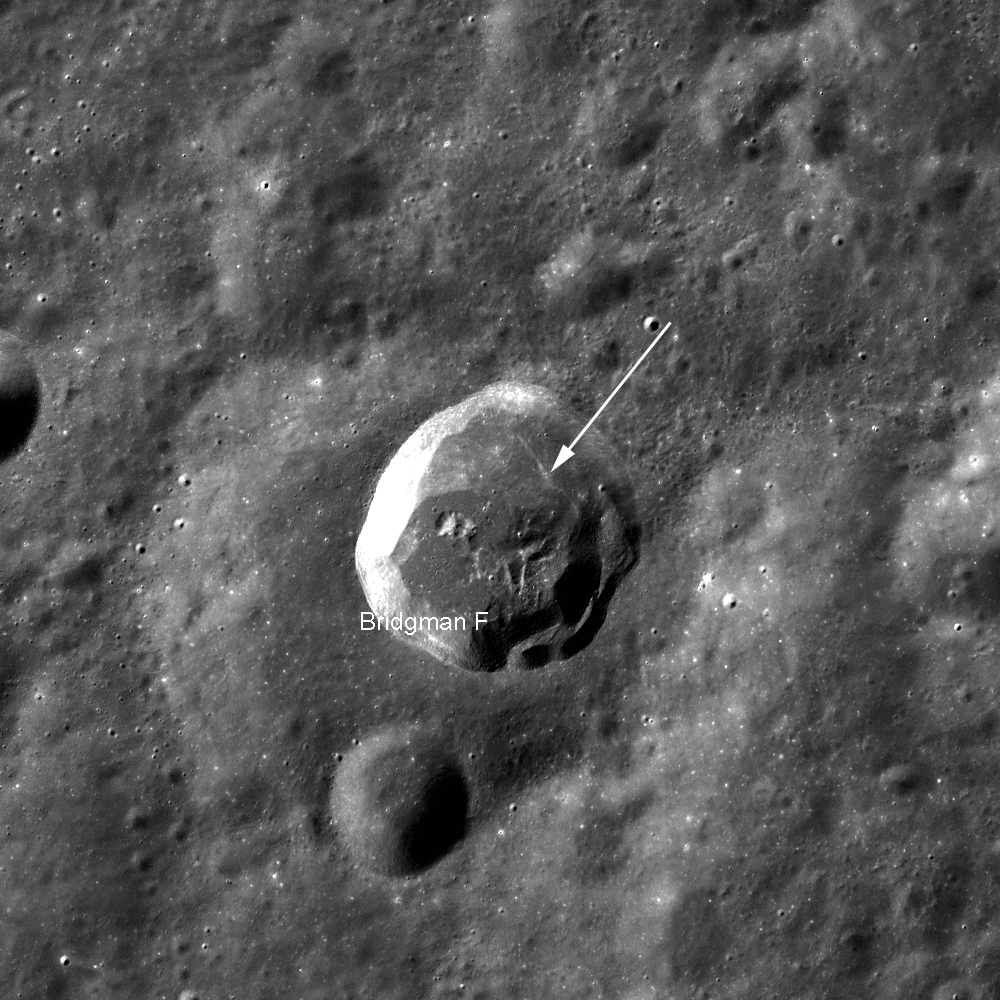
Context image of the LROC Featured Image, May 2, 2013 - for boulders located on a terrace within Bridgman F (44.053° E, 141.825° E). Image width is 100 km [NASA/GSFC/Arizona State University].
Several gas systems are currently in use to obtain absolute dates for rocks, but there are two important ones for impact cratering. One measures the ratio of Argon 40 to Argon 39 (40Ar/39Ar dating). The other uses the Uranium, Thorium, Helium system ((U-Th)/He)). However, both utilize separate materials. 40Ar/39Ar dating benefits from having impact melt to sample. This is one of the methods used in the 1970's that dated Apollo samples and helped scientists understand lunar geologic time. But what if you have no impact melt? On Earth that might be more of a concern since impact melt might not last as long as boulders, and the (U-Th)/He might be the answer.

ASU graduate student Kelsey Young stands next to a boulder in Mistastin crater in Newfoundland. The red box outlines an impact melt zone between two boulders, which we can imagine are contextually very similar to the boulders in our Featured Image [Image credit Kelsey Young].
So Kelsey Young (and her colleagues) at ASU have come up with a new way to date a crater. They date boulders at impact sites using the (U-Th)/He method because the system has a lower closure temperature. This method has a few advantages. One is that boulders are easier to find than melt on Earth's surface. The other is that the system's lower closure temperature means that it is easier to reset the ages of these boulders.

The canonical age for Mistastin crater is 36 +/- 4 Ma, and the (U-Th)/He system came up with 32.7 +/- 1.2 which is within the error of previous estimates. So far this technique shows promise in matching the dates found using 40Ar/39Ar and adds another tool to those of us trying to understand impact cratering!
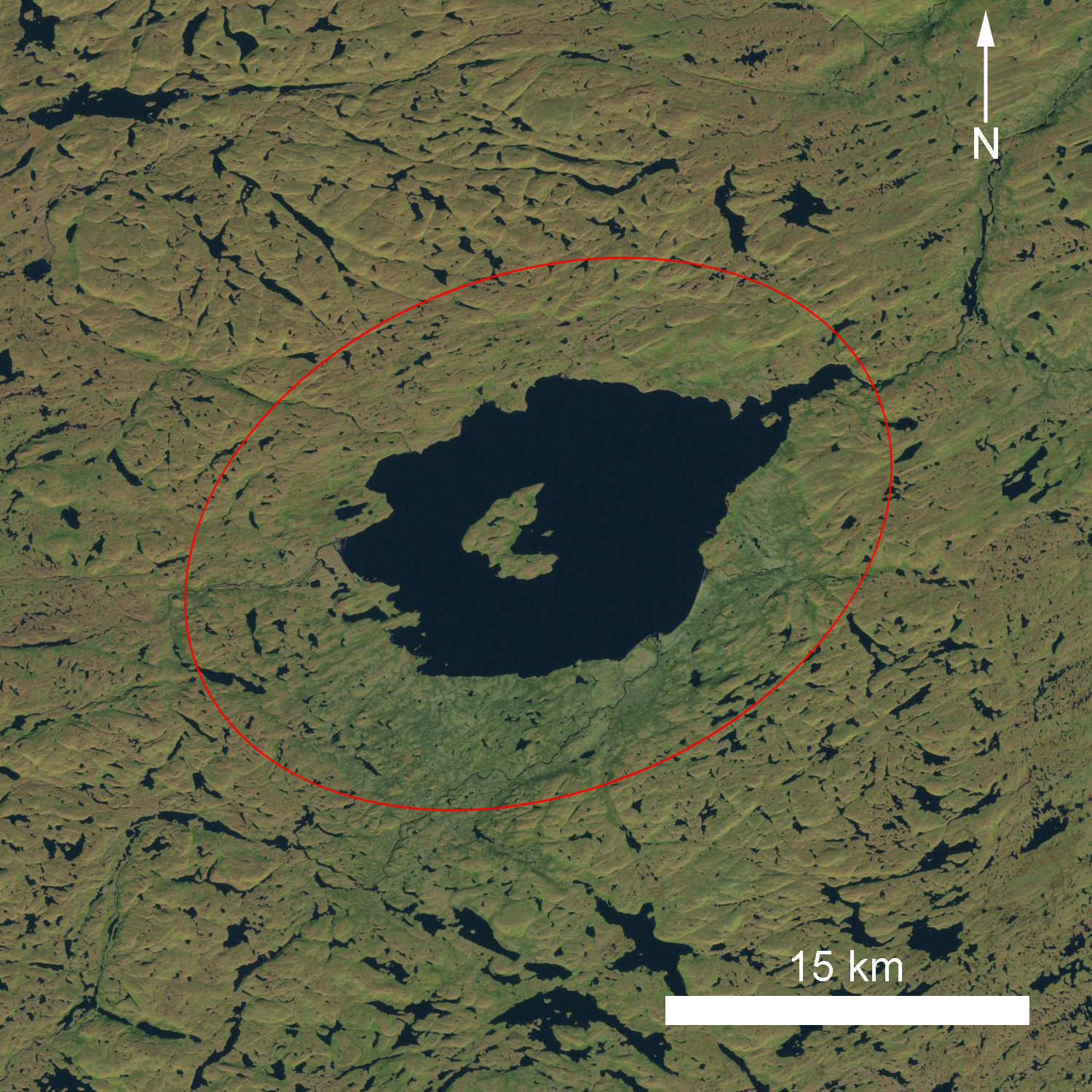
Landsat image of Mistastin crater in Canada (55.83° N, 66.3° W). The impact structure is about 28 km wide, shown here by the red ellipse [NASA/USGS].
Now that we have a better idea of how best to date impact craters, how might you find the absolute age of Bridgeman E crater in today's Featured Image? Of course, you'll have to get there first!

Look for more boulders and melt in the full LROC NAC, HERE.

Related Posts:
River of Rock
Absolute Time
Schiaparelli E

Thursday, October 25, 2012

Making the Moon: Two New Models

Simulation of a Moon-forming impact [Harvard University].
"A common origin for the Moon and Earth is required by their identical isotopic composition. However, simulations of the current giant impact hypothesis for Moon formation find that most lunar material originated from the impactor, which should have had a different isotopic signature. Previous Moon-formation studies assumed that the angular momentum after the impact was similar to the present day; however, Earth-mass planets are expected to have higher spin rates at the end of accretion. Here, we show that typical last giant impacts onto a fast-spinning proto-Earth can produce a Moon-forming disk derived primarily from Earth's mantle. Furthermore, we find that a faster-spinning early Earth-Moon system can lose angular momentum and reach the present state through an orbital resonance between the Sun and Moon."

- Matija Ćuk & Sarah T. Stewart-Mukhopadhyay, "Making the Moon from a Fast-Spinning Earth: A Giant Impact Followed by Resonant Spinning," Science DOI: 10.1126/science.1225542 (Online October 17, 2012)

Scientists have long believed the Moon formed as a result of a collision between the early Earth and a smaller planet, but computer models of the giant impact have always predicted the wrong composition for the Moon. Now researchers at Harvard University and the SETI Institute are proposing a new spin on the giant impact model to match the observed composition of the Moon. Understanding how the Moon formed is important for astrobiologists who are studying how the Earth became habitable for life as we know it.

The previous giant impact models have held that the small planet, Theia, hit the Earth, sending a cloud of debris from Theia into orbit that formed the Moon. But the chemistry of the Moon matches the Earth. Now Sarah T. Stewart-Mukhopadhyay, a professor in Harvard's Department of Earth and Planetary Sciences, and her SETI colleague Matija Ćuk propose a new giant impact model that resulted in pieces of the Earth breaking off and forming the Moon.

The researchers present a dynamic model of their theory, motivated by the results of chemical analyzes of isotopes from the Earth and Moon, in a paper published online today in Science. The results were also presented at the 44th meeting of the AAS Division for Planetary Sciences in Reno, NV.

Additionally, Stewart and Ćuk propose that prior to the collision and creation of the Moon, the Earth was spinning much faster than it does now, and had a day that was only two to three hours long.

Many scientists believe that Earth itself emerged from a series of giant impacts. These impacts made the early Earth spin near its stability limit of about 2 hours per revolution. The last giant impact, they believe, formed a Moon that is a twin of the Earth. Stewart and Ćuk posit that when the giant impact occurred between Theia and the fast-spinning Earth, the high speed of the Earth's spin caused the ejection of material from Earth into orbit. The ejected material formed a Moon with chemical composition similar to Earth. After the impact, the rapidly rotating Earth was slowed down by the gravitational interaction between the Sun and the Moon.

Previous giant impact models could match the size of the Moon and the present angular momentum of the Earth and Moon but did not explain the similar chemistry of the Earth and Moon. But the new theory, with the discovery of a mechanism to slow the spin of the Earth after the impact, explains how a giant impact with a fast-spinning Earth could result in a Moon with a similar chemical composition

Almost a "double planet," the Earth-Moon system imaged by the ESA Mars Express in Mars orbit [ESA].
As part of their dynamic model, Ćuk and Stewart found that a resonance between Earth's orbit around the Sun and the Moon's orbit around Earth can pass angular momentum to the Sun. Furthermore, Ćuk and Stewart showed that if the Earth was fast-spinning before the impact then a giant impact would eject enough Earth material into orbit to make the Moon.

Today, tides between the Earth and Moon both slow Earth's rotation and push the Moon's orbit further away. But the total angular momentum of the system is conserved. The finding is significant because without a fast-spinning Earth preceding impact, "a giant impact could not make the Moon originate from the Earth's mantle with today's angular momentum," says Stewart.

The origin of the Moon had been called into question by isotope analyzes of material from both Earth and the Moon. The isotope signatures of celestial bodies differ greatly and often are used to 'fingerprint' different planets and meteorite groups. The data show that the Earth and Moon are 'isotopic twins,' a contradiction to the Moon origin story from the original giant impact model. If the original model were correct, then the Moon should have had a different isotopic fingerprint than the Earth.

Nineteenth century scientists speculated about a fast-spinning early Earth. George H. Darwin, son of Charles Darwin, studied the relation between tides and the Moon. In 1879, he suggested that the Moon formed by fission from the Earth, but he did not know how early Earth might have being spinning so quickly. A similar dynamic model for a great impact resulting in the formation of the Moon from Earth material is described in a second paper in the same issue of Science. This alternative dynamic model is presented by Dr. Robin Canup of the Southwest Research Institute (SwRI).

Related:
Forming the Moon with an Earth-Like Composition via a Giant Impact (Canup, SwRI; Science)
Water from the Sun (October 17, 2012)
Hit-and-Run Science (September 30, 2012)
A Sawtooth-like timeline for the first billion years of lunar bombardment (August 28, 2012)
A new 'hit and run' Giant Impact scenario (July 28, 2012)
"Our view of the Moon has turned upside down" (April 26, 2012)
Ti paternity test fingers Earth as Moon's parent (March 28, 2012)
NLSI team sheds light on 'late heavy bombardment' (February 28, 2012)
Spudis: Cataclysmic Conundrum (February 14, 2012)
'Significant change' in bombardment timing (January 6, 2012)
LOLA reveals distinct populations in bombardment record,
Diviner finds "no pristine lunar mantle" even within SPA
(September 16, 2010)
'The Grand Lunar Cataclysm and how LRO can help test it' (September 7, 2009)

The Astrobiology Institute, Harvard Crimson, SETI Institute and Southwest Research Institute contributed to this digest.

Sunday, September 30, 2012

Hit-and-Run Science

From 'A new hit and run Giant Impact scenario,' July 28, 2012;  Figure 1a: Five snapshots from the 30° impact angle and 1.30vesc impact velocity case (cC06) showing cuts through the impact plane. Colour coded is the type and origin of the material. Dark and light blue indicate target and impactor iron; Red and orange show corresponding silicate material. The far right shows the situation at the time of impact. At 0.52h, it can be seen how the impactor ploughs deep through the targets mantle and pushes considerable amount of target material into orbit. A spiral arm of material forms and gravitationally collapses into fragments. The outer portions of the arm mainly consist of impactor silicates and escapes due to having retained a velocity well above escape velocity. The silicate fragments further inward are stronger decelerated and enter eccentric orbits around the target. The impactor's iron core also looses much of its angular momentum to the outer parts of the spiral arm and re-impacts the proto-Earth. -  Figure 1b: The origin of the disk material highlighted, half a collisional timescale ( (Rimp + Rtar) / vimp ) after impact. In the grazing reference case (cA08), the majority of the proto-lunar disk originates from a spill-over of the impactor. In the head-on cases (cC01, fB06, iA10), much more material comes from the target mantle, being pushed out into orbit by the impactor core. Colours are identical to figure 1. Turquoise on the right shows water ice for the icy impactor case iA10. Reufer, et al. (2012) Icarus 221, 296
Paul Spudis
The Once & Future Moon
Smithsonian Air & Space

The origin of the Moon is a long-standing problem in planetary science.  Reconstructing complex events in the distant past is difficult and requires both knowledge and imagination.  The facts to be explained are relatively straightforward.  The Moon’s overall density (about 3.3 grams per cubic centimeter) and bulk chemical composition are about the same as that of the mantle of the Earth, suggesting a possible relationship between the two.  The idea that Earth and Moon are compositionally related is supported by the ratio of isotopes of oxygen in the lunar samples, which indicate that Earth and Moon are made from matter derived from the same region of the solar nebula (material that is compositionally distinct from that making up the various meteorite groups).  Finally, the Earth and Moon collectively have a very high angular momentum, mostly as a consequence of the high spin rate of Earth and the relatively large mass of our Moon compared to its primary planet.

Prior to the Apollo missions, three different models (capture, fission, binary accretion) vied for acceptance among the lunar science community.  The capture model proposed that the Moon formed elsewhere in the Solar System before a close, chance encounter resulted in the Earth capturing the Moon into orbit.  The fission model proposed that a large mass of molten material spun off a rapidly spinning early Earth, was thrown into orbit and over time, coalesced into the Moon.  The binary accretion model suggested that Earth and Moon assembled themselves independently as two distinct and separate bodies from the beginning.  None of these models seemed able to account for all the “constraints” mentioned above, but no one had any better ideas.

About 30 years ago, the problem of lunar origin was widely considered “solved” with the general acceptance of the Giant Impact model.  In this concept, four and a half billion years ago, the proto-Earth shared its orbit around the Sun with an object about the size of the planet Mars (dubbed Theia, in Greek mythology, the titan who gave birth to Selene, goddess of the Moon).  A chance encounter between these two planetoids resulted in their merging as the Earth-Moon system.  It was thought that a grazing (low angle) impact would serve to both spin up the Terra-Luna system, resulting in its relatively high angular momentum, and hurl vaporized mantle material from Theia into orbit around the Earth.  The disk of orbiting debris quickly coalesced into the Moon and this rapid accumulation resulted in the release of large amounts of heat, which proceeded to melt at least the outer few hundred kilometers of the Moon, creating an “ocean” of molten rock, or magma.

The Giant Impact model seemed to nicely account for most of the properties of the Moon.  But like many big ideas in science, the closer and longer we look at it, the more issues seem to arise.  It was long assumed that the Moon was made of material derived mostly from mantle of the impacting planet (Theia); in this view, the Giant Impact was really just a variant of the capture model.  As such, it did not explain either the chemical similarity of the Moon to the mantle of the Earth, nor their identical oxygen isotope compositions.  This objection was usually brushed away with the admonition that complications might be expected from planet-scale impacts.

A new set of computer models has looked at the consequences of a slightly more head-on planetary collision.  In contrast to the traditional oblique (few degrees) off-center Big Whack, researchers modeled the effects of an impact at about 30° incidence and relatively high velocity (about 1.3 times escape velocity, or roughly 14 km/sec).  They find that in this case, most of the material from which the Moon forms comes not from the impactor Theia, but from the mantle of the Earth.  This result might better explain the compositional attributes of the Earth-Moon system.  In fact, several models were run (slightly varying these conditions) and while none perfectly fit the chemical and dynamical constraints, this one matched them most closely.

While this modeling was underway, another group was analyzing the composition of isotopes of titanium in samples from the Earth, the Moon and meteorites.  The work has established that the chemical fingerprints that relate Earth and Moon are not merely close – they are virtually identical (to the best precision of the measurements).  The authors of this study claim that this result creates problems for the Giant Impact model, as that idea had called for most of the Moon to be derived from the mantle of the impacting planet Theia.  However, with the results of the new computer models of giant impacts discussed above demonstrating that the parameters of the collision can be adjusted to match the constraints on lunar origin, perhaps this is not such a problem for the Giant Impact model after all.

These developments should probably give lunar scientists pause.  After all, the Giant Impact model became popular because the earlier, traditional three models (capture, fission, binary accretion) were all inadequate and their boundaries and defining parameters had to be adjusted to permit their (barely acceptable) viability.  In other words, the models were stretched to fit any inconvenient facts or problem observations.  Now it appears that the same thing is happening to the new, “explains-it-all” Giant Impact model.  A scientific idea that can be stretched to fit any observable fact is not very useful as an explanatory principle – it is simply a glorified “Just So” story.  The late Karl Popper argued that often in science, an idea cannot be shown to be true, but it can always be shown to be wrong – that is, “falsified.”  If a hypothesis cannot be falsified, Popper argued, then it was not scientific. We need a mechanism in science to enable us to dismiss useless or irrelevant concepts and falsification is one way to do that.

So where does such philosophy leave the origin of the Moon?  Perhaps more knowledge and imagination is needed before we can pronounce lunar genesis a “solved problem.”

Originally published at his Smithsonian Air & Space blog The Once and Future Moon, Dr. Spudis is a senior staff scientist at the Lunar and Planetary Institute. The opinions expressed are those of the author and are better informed than average.

Related Posts:
A Sawtooth-like timeline for the first billion years of lunar bombardment (August 28, 2012)
A new 'hit and run' Giant Impact scenario (July 28, 2012)
"Our view of the Moon has turned upside down" (April 26, 2012)
Ti paternity test fingers Earth as Moon's parent (March 28, 2012)
NLSI team sheds light on 'late heavy bombardment' (February 28, 2012)
Spudis: Cataclysmic Conundrum (February 14, 2012)
'Significant change' in bombardment timing (January 6, 2012)
LOLA reveals distinct populations in bombardment record,
Diviner finds "no pristine lunar mantle" even within SPA
(September 16, 2010)
'The Grand Lunar Cataclysm and how LRO can help test it' (September 7, 2009)