Showing posts with label Stevinus. Show all posts

Tuesday, January 7, 2014

X marks the spot on the floor of Stevinus

M1131495601RE_thumb-1000
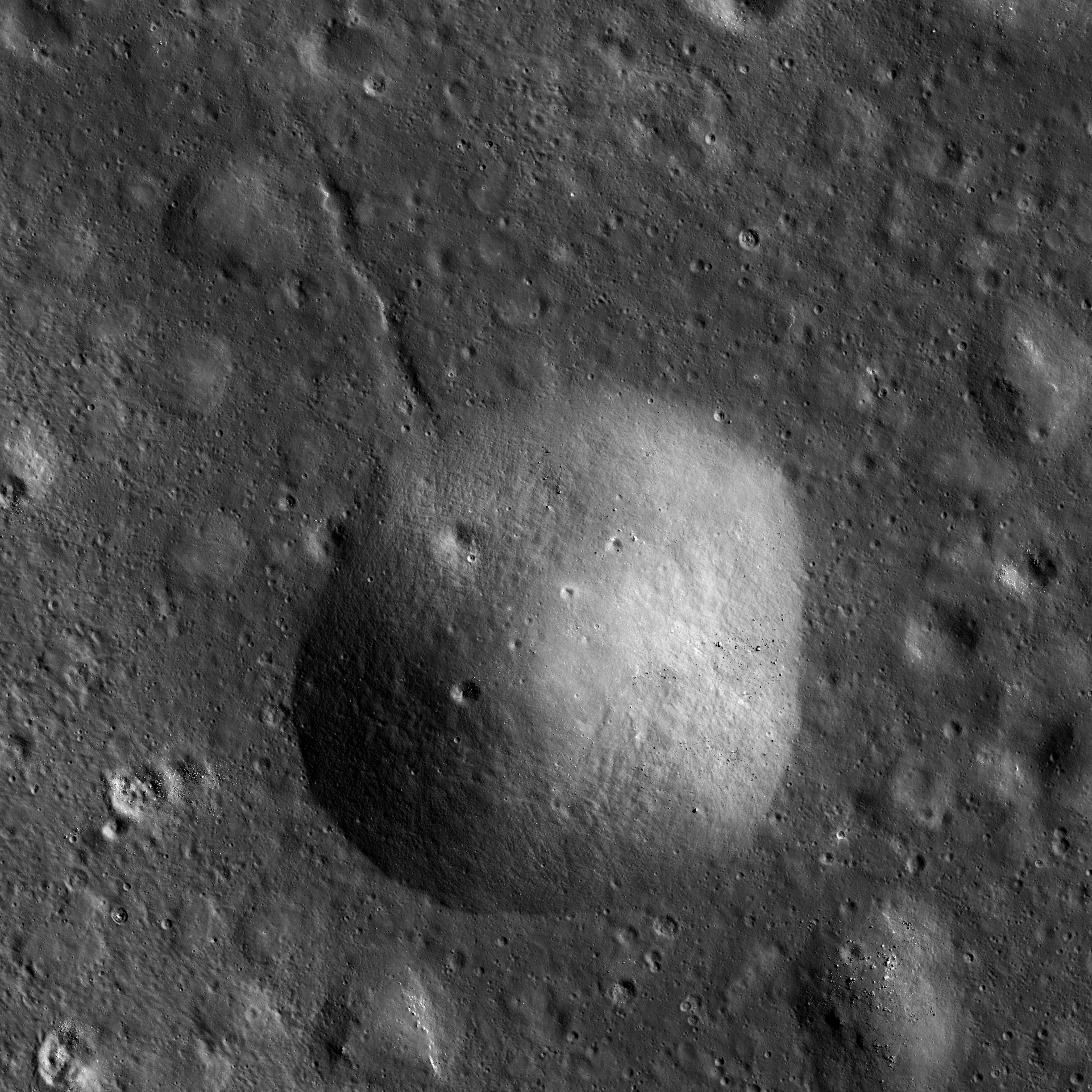
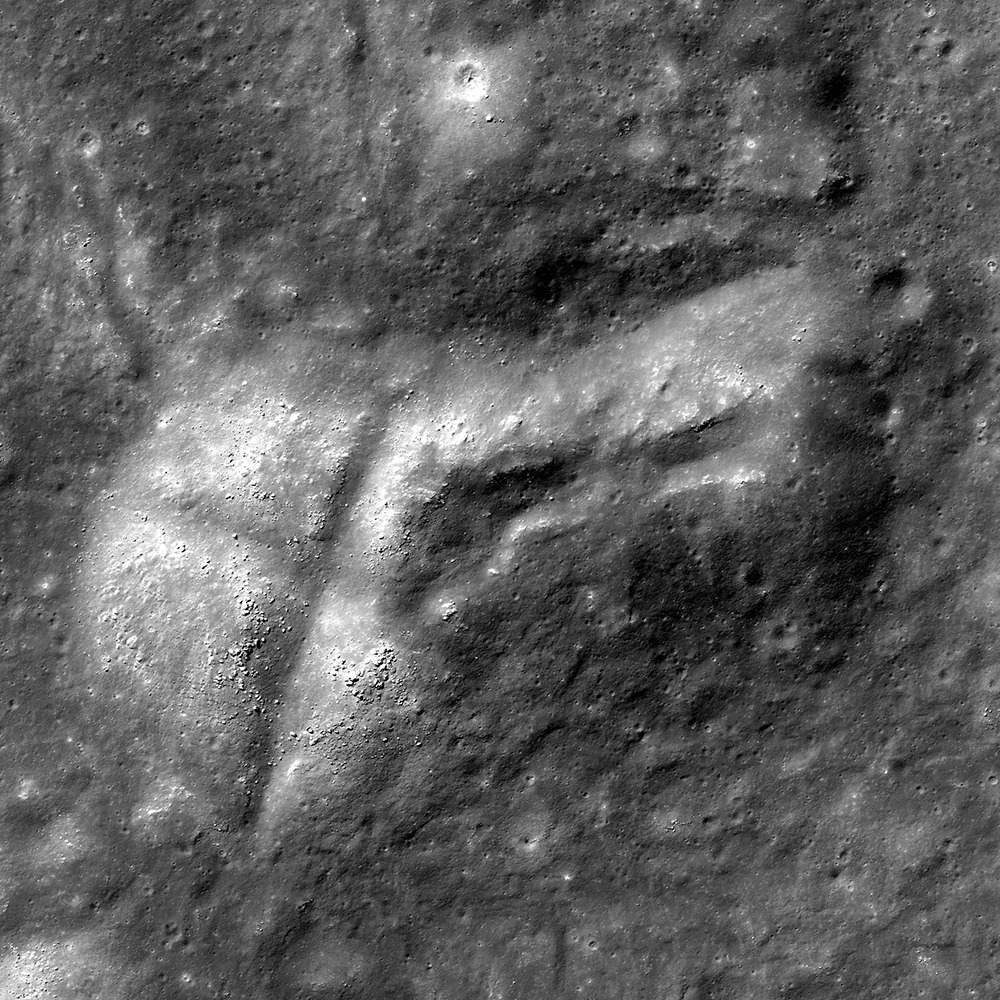
Fractured mound, approximately 3 km in width, on the northeastern floor of Stevinus crater (71.54 km; 32.490°S, 54.137°E) LROC Narrow Angle Camera observation M1131495601R, LRO orbit 18872, August 18, 2013; resolution 78 cm per pixel [NASA/GSFC/Arizona State University].
Raquel Nuno
LROC News System

Today’s Featured Image is an LROC NAC image of an elongated mound (positive relief feature) located on the floor of Stevinus crater [32.49°S, 54.14°E]. The mound has a central fracture along its length, which intersects another perpendicular fracture, forming an "X".

Many mounds of various shapes and sizes are found on the floor of Stevinus crater, but most of them do not have fractures. How did the cracks form on this mound? Perhaps the mound was caused by the upwelling of impact melt beneath a thin solidified crust, as a hardened crust was pushed up it fractured forming the X. Similar morphologies are commonly observed on pahoehoe lava surfaces on the Earth and are known as tumuli.
LO-V-040_M_USGSAS-nodash-580x620
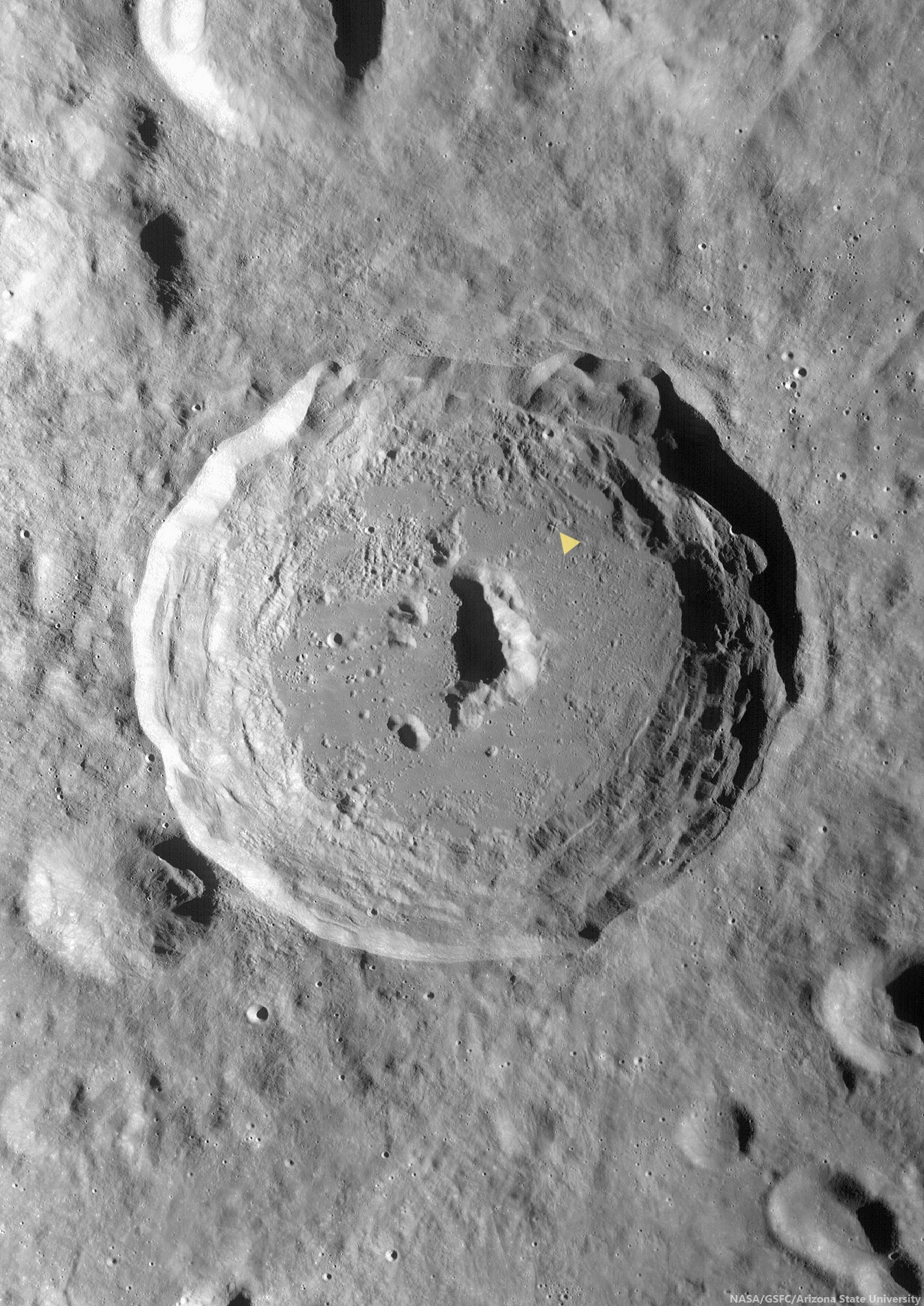
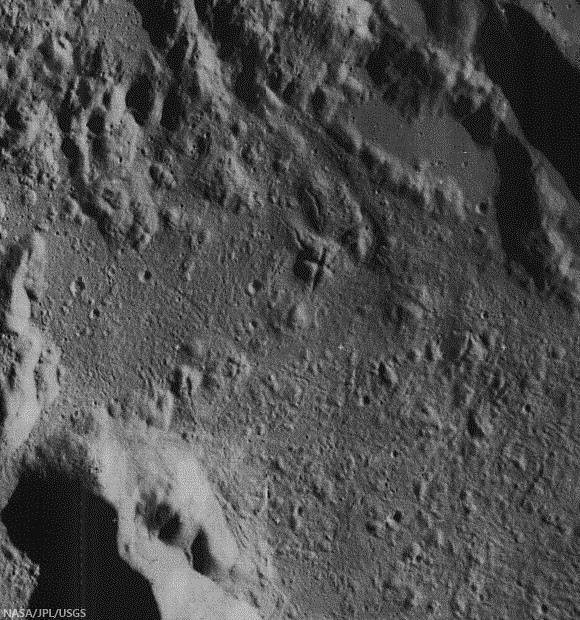
Context for the 3 km fractured mound on the northeastern interior of Stevinus, and near center of this full-resolution crop from medium resolution Lunar Orbiter frame 5040, processed by the United State Geological Service. Lunar Orbiter V, from 163.74 km; 73.37° incidence angle [NASA/JPL/USGS/LPI].
M177278416CE_604nm
Detail northeastern interior Stevinus, centered on the 3 km fractured mound, from LROC Wide Angle Camera (WAC) observation M177278416CE (604 nm), LRO orbit 11261, November 11, 2011; 69.71° incidence, resolution 67.7 meters from 49.6 km [NASA/GSFC/Arizona State University].
Tumuli form when a slow moving lava beneath a brittle crust flows upward, due to an obstruction or a topographical discontinuity, causing the crust to fracture. In our FI, instead of lava, the molten material was impact melt.  Another difference between these lunar mounds and terrestrial tumuli is their size.  On Earth, tumuli are from 2 to 10 meters high; this lunar mound reaches a height of over 160 meters. This is probably due to the lower gravity on the Moon.

M177278416-85207-91969-CE_604nm_stitch-5882-1345x1901
Stevinus and vicinity, arrow marks the fractured mound. LROC WAC observation M177278416CE (604 nm) in mosaic with three subsequent WAC observations from orbits 11262 and 11263, November 11, 2011. View the full-resolution mosaic HERE [NASA/GSFC/Arizona State University].
The rest of this spectacular processed LROC NAC observation can be seen HERE. Can you think of another formation mechanism?

Related LROC Posts:
Pancakes in a melt pond
The Domes of Stevinus Crater
Impact melt channel

Tuesday, April 23, 2013

The peculiar domes of Stevinus

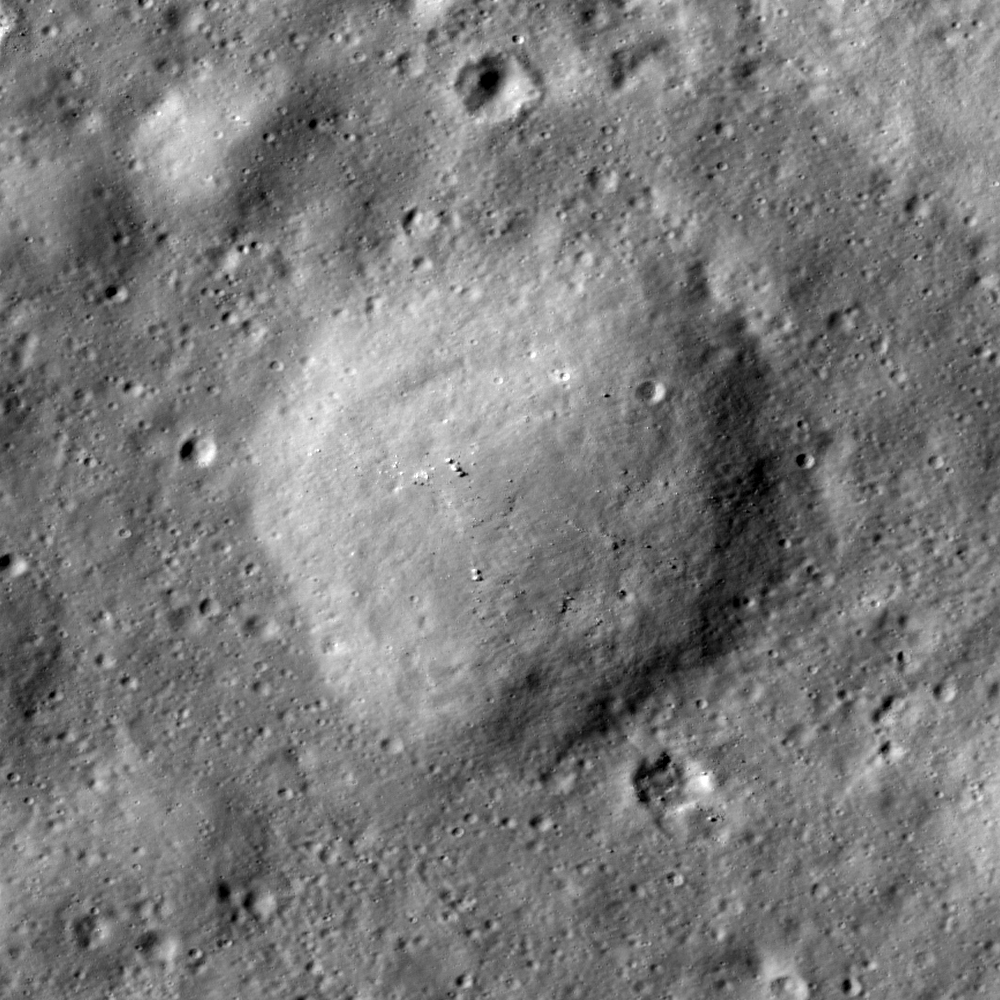
A distinctive positive-relief feature on the floor of Stevinus crater (32.760°S; 53.739°E). LROC Narrow Angle Camera (NAC) frame M113603383L, spacecraft orbit 1875, illumination is from the east, angle of incidence 57.67° field of view 1.9 km at 58 cm resolution from 55.68 km [NASA/GSFC/Arizona State University].

James Ashley
LROC News System

Today's image explores a portion of the Stevinus crater floor (southern hemisphere, nearside highlands). Here we see a topographic feature that can be found by the dozens throughout the area in many shapes and sizes. These mounded forms show positive relief upon a flat surface of ponded impact melt deposits (now solid).

Some are circular, while others show more irregular outlines. Some occur in clusters that appear to have coalesced, and others superpose one another. Some have smooth upper surfaces and others appear deflated with depressed central portions. The featured dome likely superposes an extension crack, indicating that it occurred after the crack formed.

What caused these peculiar mounds on the floor of Stevinus crater?

Some perspective on the peculiar dome of interest near center of this LROC Wide Angle Camera (WAC) monochrome (643nm) mosaic of three observations gathered in sequential orbits, November 20, 2011. Field of view roughly 40 km across. Angle of incidence 69.83° at 70 meters resolution from 50.66 km [NASA/GSFC/Arizona State University].
While not entirely clear without a better understanding of melt pond dynamics for still-molten deposits, we note that moderately viscous materials can behave in odd ways. The isolated occurrence of individual domes suggests molten behavior with each dome forming in-situ from a local source just beneath its position. Since the phenomenon is occurring in impact melt, we would be wrong to call this behavior volcanic. But something similar to volcanism in the sense that molten rock is locally "erupting" from an accumulated, still-hot deposit, might be appropriate for conceptual purposes. Perhaps isostatic readjustment of the crater floor "squeezes up" these blobs through holes or cracks in crust as the melt mass cools and thickens. This mechanism might explain why today's mound is centered over a fracture.

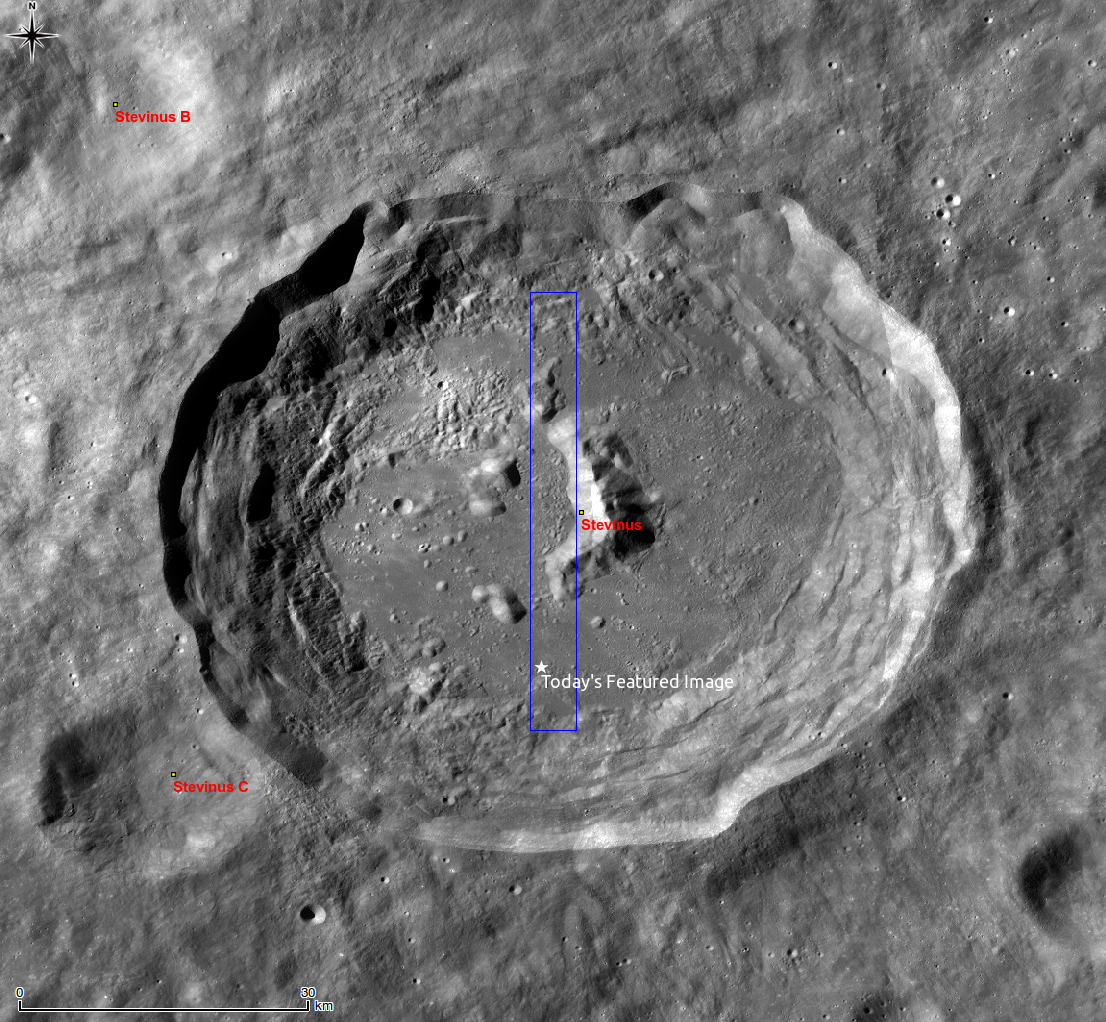
Reduced view of the LROC WAC mosaic from which the image immediately above it was taken shows the entirety of 71 km-wide Stevinus [NAXA/GSFC/Arizona State University].
Perhaps experiments with analog melts would be a good way to study impact melt behavior. Of course collecting samples is always recommended for any geologic study. What kinds of samples would be helpful for determining the solution to this mystery? Where should they be collected from and why?

Click HERE to see the full NAC frame. Other examples of odd features in impact melt deposits can be found with the Melt Fractures in Jackson Crater, Rippled Pond, and Anomalous Mounds on the King Crater Floor LROC Featured Image posts.

Thursday, May 12, 2011

Pancakes in a melt pond


Pancake-like mound in Stevinus crater (33.03°S, 54.07°E). LROC Narrow Angle Camera observation M104162457R, LRO orbit 512, August 6, 2009; solar incidence 62°, field of view about 870 meters [NASA/GSFC/Arizona StLinkate University].

Hiroyuki Sato
LROC News System

The central peak of Stevinus crater is surrounded by a very flat and smooth floor. Small hummocks, fractures, and wrinkled textures all suggest that the flat and smooth floor is a frozen impact melt pond. However, small details in the floor show that the impact melt is not perfectly smooth. Just after the impact event, molten rocks and fragmented breccias were mixed together within the forming crater cavity. Think of a huge frying pan with this mix of molten and solid materials sloshing about. Slowly the melt solidified by surface cooling. If you look carefully you will find numerous pancake-like mounds on the smooth floor. What are they? Pancake mounds were likely created during the impact event, but the actual process is unknown. Did half solid, half molten rock lumps fall into the pond? Perhaps magma moving under the crust tried to push up and out of the crust as the crater floor readjusted? Or what if the pancake-like mounds were formed by slumping caused by small impacts over time?


LROC Wide Angle Camera Global 100 meter resolution monochrome mosaic of 77 km Stevinus. The blue rectangle and star indicate the location of entire NAC frame and the LROC Featured Image released May 11, 2011, respectively. View the full-sized LROC WAC context image HERE [NASA/GSFC/Arizona State University].

Explore the boundary of mare basalts by viewing the full NAC frame!

Related posts:
Mounds in a melt pond
Impact melt features in Tycho crater's floor
Anomalous mounds on the King crater floor


Simulated view courtesy of Google Moon showing the view, looking north from near the location of the LROC Featured Image of the Pancake Mound, south of Stevinus central peak. The north inner wall beyond towers nearly 5 kilometers higher in elevation above the crater's floor, 50 kilometers away.