

During orbit 7152, January 11, 2011, as LRO slewed to obliquely view Aitken crater (Featured Image, January 17), the northern edge of Vertregt J was serendipitously captured by the Narrow Angle Camera. North is to the left and the image field of view is about 6 kilometers [NASA/GSFC/Arizona State University].
Mark Robinson
Principal Investigator
Lunar Reconnaissance Orbiter Camera
Arizona State University
 Extreme oblique views are a luxury with the LRO mission, since most instruments (including LROC) need to be pointed nadir (straight down) most of the time. Also, thermal concerns limit when LRO can look off to the side. The LROC targeting team closely monitors when opportunities arise to target extreme slews and acquire spectacular views (Bhabha crater).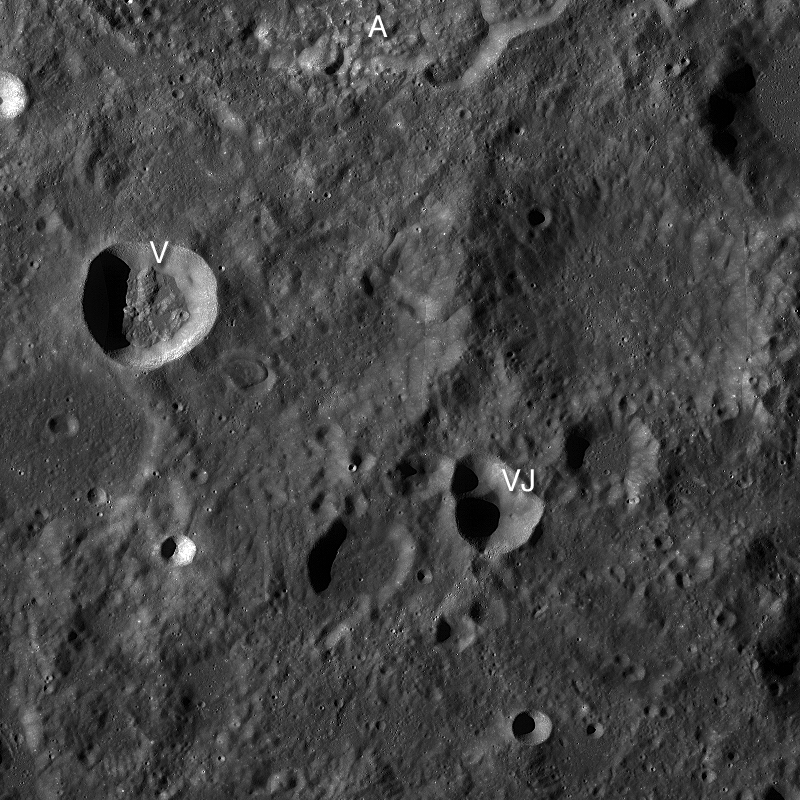
LROC Wide Angle Camera mosaic, centered on the Vertreg J (21.5°S, 174.3°E) oblique NAC featured image, January 19, 2011. Image field of view is 80 kilometers; A = bottom of Aitken crater, V = Vertregt K & VJ = Vertregt J [NASA/GSFC/Arizona State University].
Sometimes LROC obtains images while the spacecraft is slewing to a steady off-nadir position, which takes about ten minutes, in order to acquire oblique views. When possible the LROC targeting team will squeeze in a short NAC image just as the spacecraft is nearing the slew position - when this type of targeting works we sometimes obtain spectacular views such as today's featured image.
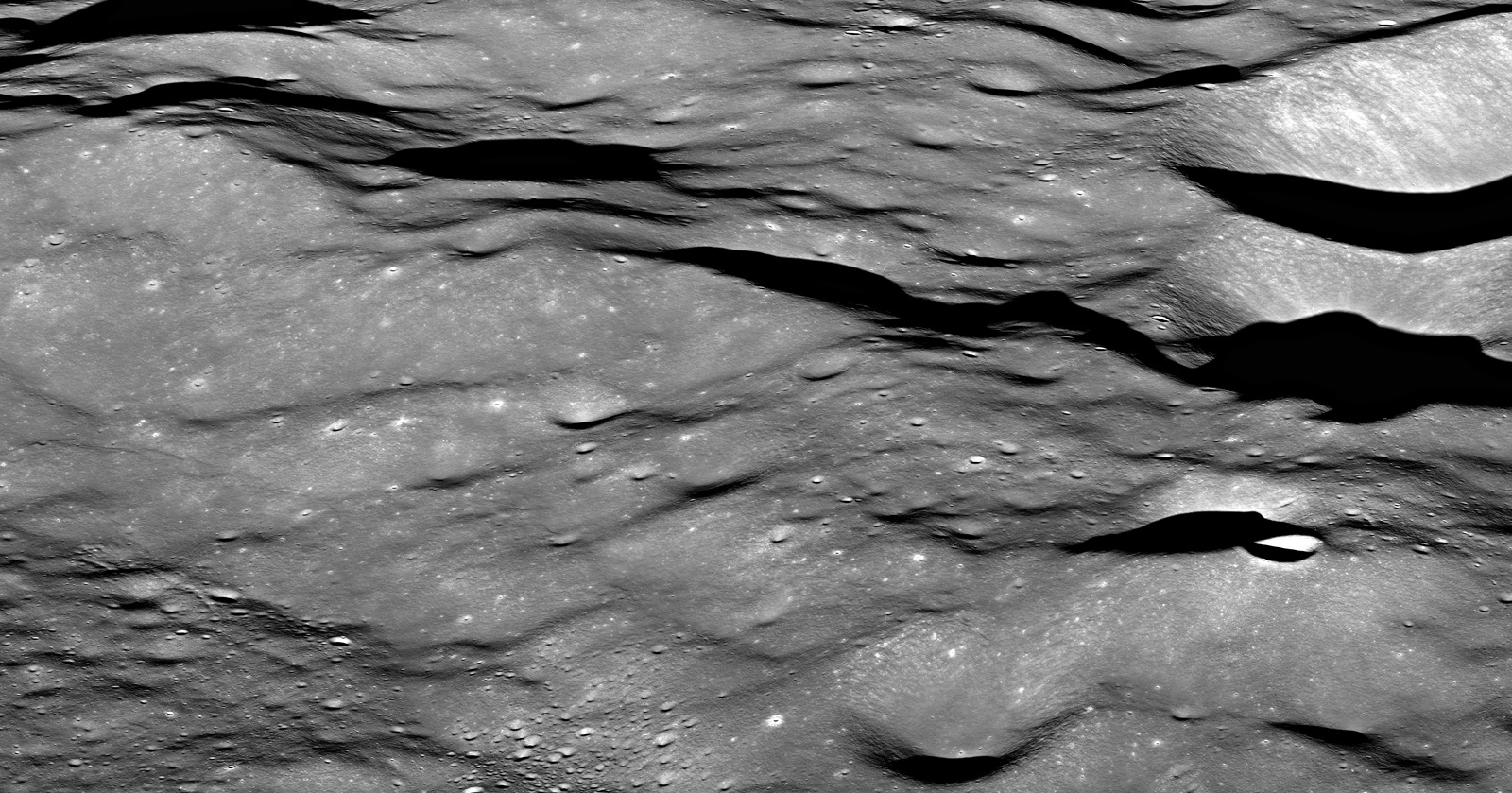
The full Narrow Angle Camera oblique view, with the double crater Vertregt J partially seen in the southeast background (right). The full scene is about 30 kilometers wide, LROC NAC M149411489 [NASA/GSFC/Arizona State University].
The region around Vertregt J (21.46°S, 174.32°E) is typical of the highlands - hilly and rugged. About seventy percent of the Moon is mapped as highlands, yet this most common terrain type is only poorly sampled. Only one Apollo mission explored a true highland target: Apollo 16.
As it turns out, results from the Clementine and Lunar Prospector missions showed lunar scientists that the chemistry of Apollo 16 rocks differs significantly from most the highlands. Murphy's law at work!
Lunar scientists need samples from other highland targets, especially inside the South Pole Aitken Basin (SPA) basin, to get a better handle on the origin of the lunar crust and the history of asteroid bombardment early in our solar system's history.
Explore at full resolution the Vertregt J oblique view.
As it turns out, results from the Clementine and Lunar Prospector missions showed lunar scientists that the chemistry of Apollo 16 rocks differs significantly from most the highlands. Murphy's law at work!
Lunar scientists need samples from other highland targets, especially inside the South Pole Aitken Basin (SPA) basin, to get a better handle on the origin of the lunar crust and the history of asteroid bombardment early in our solar system's history.
Explore at full resolution the Vertregt J oblique view.
Also visit the oblique view taken a few minutes later across the center of Aitken crater.
Explanation of "lettered craters" on the Moon.
Explanation of "lettered craters" on the Moon.


