Showing posts with label EPOXI. Show all posts

Monday, April 8, 2013

The Mystery of Shackleton Crater

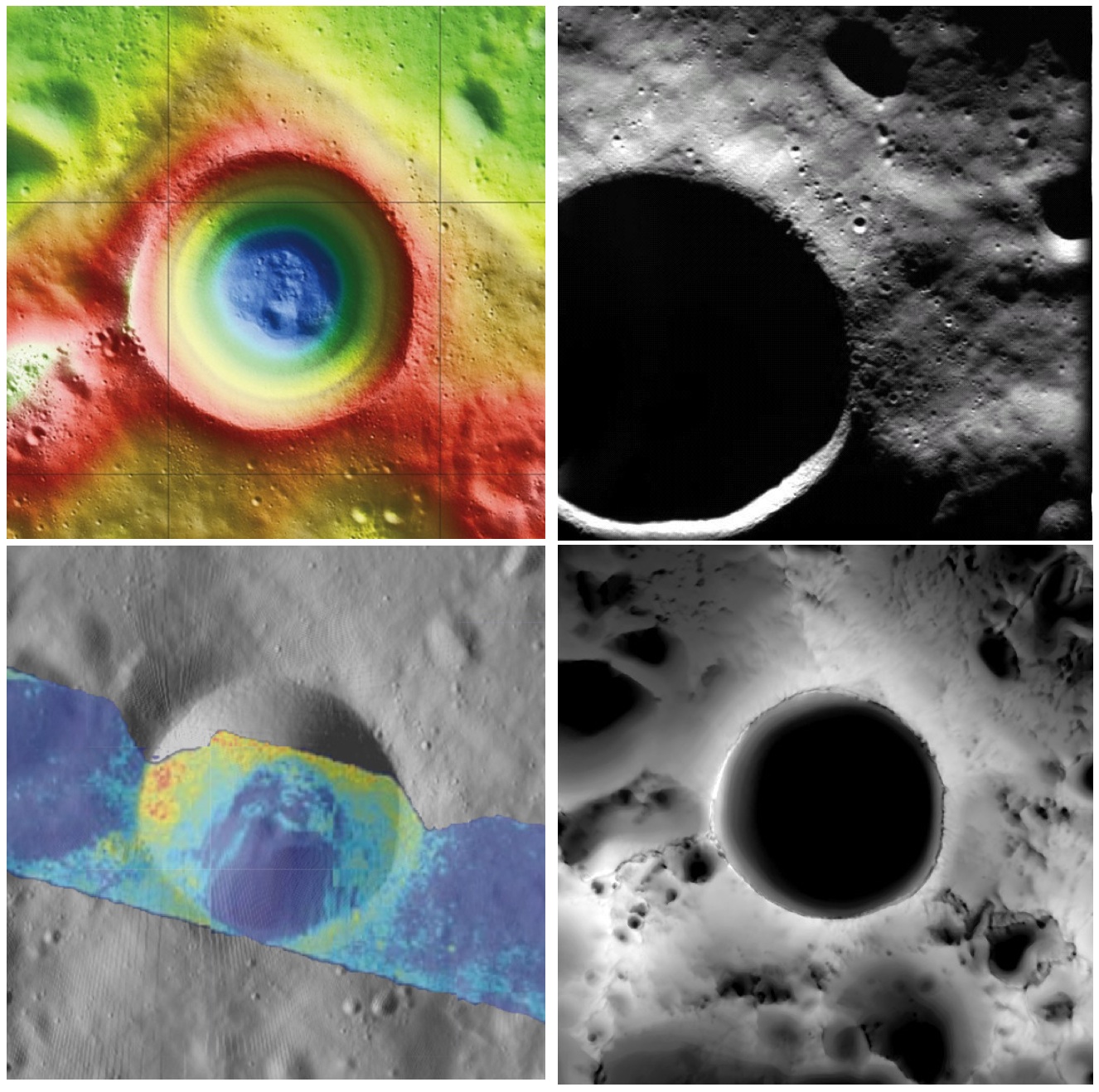
Shackleton crater, Earth's Moon. Clockwise from top left: topography from (LOLA) laser altimetry, photography from ESA SMART-1 mission, lighting map (relative isolation - brighter indicates longer periods of illumination) from LROC data, Mini-RF Circular Polarization Ratio (CPR) image draped over shaded relief. The crater is about 20 km across.
Paul D. Spudis
The Once and Future Moon
Smithsonian Air & Space


Though unremarkable in appearance compared to the roughly 4,000 craters on the Moon in its size range, the 20 km diameter crater Shackleton has been the source of relentless scientific controversy for the past 20 years.  Shackleton is located at the south pole of the Moon; indeed, its near side rim is the precise location of the geographic pole itself.   Its location makes observation by Earth-based telescopes difficult and it was not well photographed by the Lunar Orbiter series (our principal source of lunar images) of the 1960s.  That all changed in 1994 with the flight of the joint DoD-NASA mission to the Moon, Clementine.

Clementine carried cameras that globally imaged the Moon in eleven visible and near-infrared wavelengths.  In addition, it mapped the surface and lighting of the poles of the Moon at uniform resolution over the course of almost three lunar days (74 Earth days).  When the Science Team first saw the south polar mosaic, the extent of darkness in the map was striking.  Because the Moon’s spin axis is close to perpendicular to the ecliptic plane, the Sun is always at the horizon at the lunar poles.  Instead of rising and setting, the Sun circles around the poles at or near the horizon.  Because of this grazing incidence, an area in a topographic depression may be in permanent shadow.  And so it appeared for Shackleton crater in the Clementine data, setting off bells in the heads of the Science Team.

Intuitive selection from HDTV still frame captured by Japan's lunar orbiter SELENE-1 (Kaguya) in 2008 shows Shackleton, with the Moon's south pole on its rim (upper left) in relation to Earth and Malapert Massif, part of the nearside rim of the ancient South Pole-Aitken impact basin, along the line of sight. Shackleton's interior and the craters between it and Malapert, are permanently shadowed interiors (PSR), unmapped before the 21st century [JAXA/NHK/SELENE].
A key controversy of the post-Apollo era was whether the lunar poles might contain water or not.  Although the Apollo samples had been studied and found to be “bone-dry,” we had not been to the poles on any Apollo mission.  We knew that any shadowed areas had to be extremely cold as well as permanently dark.  As water-bearing debris in the form of asteroids and comets constantly strike the Moon, it was thought that some of that water might get into a polar “cold trap” and would be kept there (essentially) forever – billions of years of impacting cosmic “debris” can add up.

Clementine was not configured to measure the presence of water, but a cleverly improvised experiment used the spacecraft’s data transmitter to beam radio waves into the dark regions near the poles and listen to their reflected echoes on the enormous (70 m) dish antenna of NASA’s Deep Space Network.  Interestingly, the reflections indicated an enhancement of “same sense” polarization within the (very large) resolution cell that contained Shackleton crater.  A collect of data from a nearby sunlit area (taken as an experimental control) did not show this peak.  The Clementine team interpreted the RF peak as evidence for the presence of a few percent water ice within the dark, cold interior of Shackleton crater.  The media quickly spread the startling news about water on our “bone-dry” Moon.

Shackleton, as seen in a joint 70 mm radar experiment collected by radio telescopes at Greenbank and Arecebo during a favorable libration opportunity in 2006.
Such a controversial conclusion did not go unchallenged.  Some in the radar community argued that abundant wavelength-sized rocks on the surface were the source of the enhanced same sense reflection.  Since the lunar surface is indeed rocky, this interpretation could not be ruled out.

Then a few years later, the Lunar Prospector (LP) mission found an enhancement of hydrogen concentration at both poles of the Moon; as hydrogen is a major constituent of water, the idea ice exists in the dark areas gained credence and has lead to a decade-long scientific search (using a variety of techniques) for lunar polar ice.  Though many areas near the poles were studied in detail, attention continued to be drawn back to Shackleton and the area near the south pole.

From studying Clementine images, we discovered that part of the rim crest of Shackleton is one of the most sunlit areas on the Moon.  Now we had a double-attraction: constant sunlight with water ice nearby.  At a press briefing in 1996, I called this area of water and sunlight “the most valuable piece of real estate in the Solar System.” Nothing found subsequently has changed my mind on that judgment.

So what have we learned about Shackleton lately?  Many different, new sensors have flown to the Moon in the last few years, including radar, ultraviolet (UV) imaging, laser reflections, and low-light level imaging.  And yet again, Shackleton crater continues to confound us with contradictory evidence, both for and against the presence of water ice in its interior.

In 2009, the question regarding the presence of water ice somewhere near the lunar south pole was answered when the LCROSS impactor threw up a cloud of water vapor and ice particles during its collision with the floor of the nearby crater Cabaeus.  Spectral mapping instruments on three different spacecraft (Chandrayaan-1, Cassini, and EPOXI) documented the presence of adsorbed water on the lunar surface, increasing in concentration with latitude toward both poles.  A small impact probe flown by India (MIP) passed through a water vapor zone in the exosphere just above the lunar south pole.  And radar images from Mini-RF, our radar imaging experiment on both Chandrayaan-1 and Lunar Reconnaissance Orbiter (LRO), found evidence of high same sense reflections (just as Clementine had suggested in 1994) within the interior of Shackleton crater.

LRO Mini-RF instrument radar data indicate the walls of Shackleton crater may, indeed, hold ice, confirming exacting measurements of laser altimeter (LOLA) point brightness studies revealed in June. Actual observations (CPR) are compared to calculated radar values for 0.5% to 10% ice. Illustration to post "Mini-RF adds to evidence of ice on Shackleton walls," September 1, 2012 [NASA ].
These new lines of supporting evidence were countered by Japanese researchers, whose Kaguya spacecraft imaged the interior of the crater and found morphology similar to other lunar craters in the same size-class.  But no one had ever claimed that the interior of Shackleton was a skating rink of pure ice – the lunar polar ice is partly covered by waterless dust and mixed with an unknown amount of dry regolith.

Interpretation of the new data continues to vex us.  The LOLA (laser altimeter) team on LRO recently published a paper that documents the high reflectivity (at 1 micron wavelength) of the walls of Shackleton.  Although the team’s favored interpretation is that this is caused by a constant exposure of fresh material on a steep slope, they also note that it is consistent with the presence of water ice on the walls of the crater.

In addition, a team analyzing neutron spectrometer data from both LP and LRO found evidence in the fast neutron data (never before analyzed) that water in the interior of Shackleton is a possible explanation for its signal.  Detailed analysis of the Mini-RF data for Shackleton corrected for its steep wall slopes and found that the presence of 5-10 wt.% water there provides the best model fit to the observed data.  Newly obtained UV images from LRO show the existence of water frost in the interiors of the craters Haworth and Shackleton, and the neutron detector on LRO shows enhanced hydrogen within both Shoemaker and Shackleton craters.  The Japanese team from Kaguya continue to insist that the no-ice interpretation is the correct one.

So we are left with a mystery.  Some evidence is pro-ice and some is contra-ice.  I find it interesting that for most of the investigators, new data does not necessarily change any minds, but tends to be interpreted in a way most favorable to their previously published ideas.  This should not be terribly surprising; the people who have argued for some specific interpretation presumably did so for good reasons and desire hard and clear-cut evidence to the contrary before abandoning a previously held position, one no doubt reached after much thought and soul-searching.

Less so, but still-mysterious Shackleton, "twice as deep as the Grand Canyon," from "Tour of the Moon," a 2:30 video prepared by the Science Visualization Studio (SVS) at Goddard Space Flight Center in 2012 [NASA/GSFC/SVS].
The way to unravel the water-ice mystery is to go to the surface of the lunar south pole (or both poles) and measure the composition of the surfaces in question.  Getting a definitive answer about the nature of lunar water would be game changing.   Some say the bigger mystery is:  Why hasn’t the United States sent a rover to the south pole of the Moon to take a closer look?

Originally published April 8, 2013 at his Smithsonian Air & Space blog The Once and Future Moon, Dr. Spudis is a senior staff scientist at the Lunar and Planetary Institute. The opinions expressed are those of the author but are better informed than average.

Related Posts:
Mini-RF adds to evidence of ice on Shackleton walls (September 1, 2012)
Shackleton harbors ice after all (June 12, 2012)
1000 Day Anniversary of LROC Imaging (March 27, 2012)
Shackleton on a Summer's Day (March 26, 2012)
Shadowed fluffy lunar frost detected in starlight (January 14, 2012)
Shackleton: Out of the Shadows (September 17, 2009)

Monday, May 3, 2010

The Four Flavors of Lunar Water

From Lunar Pioneer
Earth over the watery north polar regions of the Moon, as viewed from NASA/DOD platform Clementine (1994) [USGS].

Paul D. Spudis
The Once and Future Moon
Smithsonian Air & Space Blogs


The Moon is constantly bombarded by the solid debris of the Solar System. Comets, asteroids and interplanetary dust, all containing varying amounts of water, have pounded the lunar surface for billions of years. Yet until recently, the Moon was considered to be barren and bone-dry. Rock and soil samples returned by the Apollo missions lacked any hydrous mineral phases or water-bearing weathering products. Since water is not stable on the Moon under ordinary conditions, what happens to it?

New studies of lunar samples, along with results from several missions in recent years, have given us a revolutionary new picture of water on the Moon. Study of volcanic glass from the Apollo 15 landing site in 2008 demonstrated that tiny amounts of water (about 50 parts per million) are present in the interiors of these glasses, suggesting that the lunar mantle (whence they came) contains about ten times this amount. This was a startling result, considering the extreme dryness of other lunar samples.

Because the Moon’s spin axis is nearly perpendicular (1.5° from vertical) to the ecliptic plane, the Sun is always on the horizon at the poles, keeping the floors of deep craters in permanent shadow. These dark areas only receive heat from the interior of the Moon and are extremely cold; recent measurements by the DIVINER instrument on the Lunar Reconnaissance Orbiter (LRO) spacecraft indicate temperatures as cold as 25-35° C above absolute zero. Water molecules are trapped by the cold as soon as they find their way into these craters. Over the more than 4.5 billion years of lunar history, significant amounts of water could accumulate in many of these crater “cold traps” at the Moon’s poles.

"The Moon is on the critical path to human expansion into the Solar System."
The first hint of water ice in these polar cold traps came from a radio experiment aboard the 1994 Clementine mapping mission orbiting the Moon. The polarization characteristics of echoes from the south pole were consistent with the presence of ice in the crater Shackleton. Four years later, the Lunar Prospector (LP) spacecraft carried an instrument designed to measure the amount and energy of neutrons given off the Moon’s surface. Hydrogen absorbs neutrons, so when LP investigators saw a decrease in the flux of medium-energy neutrons near the lunar poles, they concluded that excess amounts of hydrogen were present there. Although this observation is consistent with the presence of polar ice, neutron data alone do not tell us what form the hydrogen is in, and it was alternatively postulated that this enhancement was caused by excess solar wind hydrogen.

The Moon Mineralogy Mapper (M3) instrument on the 2008-09 Indian Chandrayaan-1 mission collected reflectance spectra for most of the Moon. It found both water (H2O) and hydroxyl (OH) molecules, present either as a monolayer on lunar dust grains or bound into the mineral structures in surface materials, poleward of about 65° latitude at both poles. Moreover, the abundance of this surface water varies with time, being present in greater quantity in both local early morning and late evening and it increases in abundance with increasing latitude. These results were verified by observations from the Cassini and EPOXI spacecraft during separate flybys of the Moon. The new observations indicate significant quantities of water moving towards areas with lower mean surface temperatures and increasing in abundance with latitude. Taken all together, the results mean that water is being deposited (e.g., by comet impact) and/or created (e.g., by reduction of metal oxides in the surface by solar wind protons) and then transported to the poles. By this process, significant quantities of water ice could accumulate at the poles over geological time.

Last October, the companion satellite to LRO, LCROSS, slammed the upper stage of its launch vehicle into the Moon’s south pole and observed the ejected material. Results show that both water vapor and ice particles were ejected from the LCROSS impact crater; initial analyses indicate that water is present at about the 5-10 wt.% level. The LCROSS impact site exhibits no anomalous radar behavior, suggesting that such an amount of water ice cannot be detected by radar. However, the results do indicate that significant amounts of lunar polar water may be present even in the absence of specific radar evidence for it. Spectra from this impact event show evidence for other volatile substances, including ammonia and simple carbon compounds. The presence of such material may indicate a cometary source for these volatile materials.

Both poles were covered by radar images from the Mini-SAR instrument on Chandrayaan-1. Much of the north polar region displays backscattering properties typical for the ordinary Moon, but one group of craters in the region show elevated polarization enhancements in their interiors, but not in deposits exterior to their rims. Almost all of these anomalous craters are in permanent sun shadow and correlate with proposed locations of ice modeled on the basis of the Lunar Prospector neutron data. These relations suggest that the interiors of these craters contain nearly pure water ice, with approximately 600 million metric tonnes of ice present in over 40 small craters within 10 degrees of the pole. The south polar region shows similar relations, except that it has fewer anomalous craters than the north pole. Small areas of polarization enhancement are found in some craters, notably Shoemaker, Haworth and Faustini; these areas might be deposits of water ice.

So water on the Moon is present in large quantity in at least four different “flavors.” Water was in the deep lunar interior 3.3 billion years ago, at concentration levels of a few hundred parts per million. This water would have been released during the eruption of lunar magma and could have made its way into the polar cold traps. Water is either being made or being deposited nearly continuously by impact all over the Moon. Most of this water is subsequently lost to space (e.g., by sputtering, ionization or thermal escape) but some is retained on the Moon. Any water arriving at a cold trap near the pole will be captured. Water, once in the polar areas, is stable as ice in the permanent darkness or where sublimation is prevented when buried by a thin layer of soil. Significant quantities of water may accumulate there; the LCROSS results suggest several to tens of weight percent water ice may exist in the polar soils. Finally, some of this migrating water apparently collects at rates high enough so that significant soil cannot mix with it during normal impact bombardment, as shown by the presence of relatively “pure” water ice deposits in selected lunar craters imaged by radar.

A significant amount of water at the poles of the Moon is present, with many billions of metric tonnes at each pole (detailed estimates of the water reserves are in progress). Such an amount is more than enough to support both permanent, sustainable human presence on the Moon and for export to cislunar space. Water is useful as rocket fuel and energy storage (hydrogen and oxygen are the two most powerful chemical propellants known) and for life support (water and oxygen) in space. These new discoveries fundamentally alter our understanding of the Moon’s processes and history and highlight both it’s scientific value and utilization potential. The Moon is on the critical path to human expansion into the Solar System.

Addendum. In Comments, below Dr. Spudis original post, Pradeep Mohandas reminded the author of the findings of the Moon Impact Probe, released from Chandrayaan-1, which discovered water vapor in very small concentrations in the space just above the Moon during its descent to the south pole. "This exospheric water (i.e., water in extremely small concentrations) may be related to the time-variable water seen in the spectral data from M3, Cassini, and EPOXI — in other words, it may represent water molecules in motion, migrating toward the poles. Work on the nature and processes of the lunar hydrosphere continues, and I will keep you up to date on the latest research results on this new and exciting subtopic of lunar science."

Thursday, September 24, 2009

Deep Impact identifies water on the surface

Since successfully carrying out its spectacular impact experiment at comet Tempel 1 on July 4, 2005, the Deep Impact spacecraft has been on an extended mission, called Epoxi, which culminates in a flyby of comet Hartley 2 on November 4, 2010. En route to the second comet, the spacecraft observed the moon for calibration purposes on several occasions. In June 2009, the northern polar regions were observed and detailed measurements of light from the regions, called spectra, were collected (blue and cyan). These data unambiguously show the signature of water and hydroxyl (hashed regions). The water signature varies in strength; in particular, data acquired over the warm equator in December 2007 have a distinct but weaker signature (purple). [NASA/JPL-Caltech/University of Maryland]

Lunar Weather: many miles wide, 2 mm deep

Chart highlighting the calibration observations by Deep Impact of the northern polar regions of the moon on June 9. At left is a reference albedo map from Clementine while the other images are different representations of Deep Impact data, including measurements of brightness, temperature, and the strength of a signature for water and hydroxyl. The water signature varies significantly across the lunar surface but, while the strength of the water signature is not correlated with any terrain type it is highly dependent on temperature. Since successfully carrying out a spectacular impact experiment on comet Tempel 1 July 4, 2005, Deep Impact spacecraft has been on an extended mission, called "EPOXI," which will culminate in a flyby of comet Hartley 2 on November 4 2010. The spacecraft observed the moon for calibration purposes on several occasions en route to its second cometary encounter. [NASA/JPL-Caltech/University of Maryland]

Short-range 'lunar hydrology'

Observations from NASA's Deep Impact mission of the moon's north pole June 2 and 9, 2009 revealed changes in the amounts of water and hydroxyl. In the week between these datasets, the moon rotated 90 degrees. A volcanic mare terrain (labeled 'M') is observed in the morning on June 2 and at local noon by June 9 and a highland unit ('H') begins at noon and rotates to evening by June 9. Deep Impact observed a significant change in the strength of a water and hydroxyl signature as the moon rotated around. The highland unit has a weaker signal near noon (red) and a stronger signal by evening (blue). Taken together the data show a "systematic" change in water loss from morning to noon, recovery in the afternoon and return to "steady state" by evening. This daytime cycle suggests that hydrogen ions in the solar wind may be a source for re-hydration. [NASA/JPL-Caltech/University of Maryland]

The Solar Wind Theory illustrated

Schematic shows daylight cycle of hydration, loss and re-hydration on the lunar surface, as indicated by calibration images collected by EPOXI during as close as 8 million km encounters with the Moon in 2007 and again, on two separate days in June 2008. In the morning, when the moon is cold, it contains water and hydroxyl molecules. The Solar Wind Theory holds the water and hydroxyl are, in part, formed from hydrogen ions in Solar Wind. By local noon, when the moon is at its hotest, some water and hydroxyl are lost. By evening, the surface has cooled again, and is returning to a state equal to that seen in morning.

Regardless of location or terrain type the entire surface of the moon is hydrated during some part of the lunar day. [University of Maryland/McREL. ]

NASA instruments reveal water molecules in lunar surface

Minerally-bound water in the ejecta blanket of a fresh crater (less than 100 million years old) as detected in 1,000 gigabytes of data collected by NASA's 3M spectrograph as it flew aboard the Indian Space Research Organisation (ISRO) lunar orbiter Chandrayaan-1. A simular image was built showing hydroxels that was not spread from the point of impact in all direction, as is the water-bearing materials, showing that the hydroxel-bearing minerals were likely to have been excavated from some depth.

"The moon continues to surprise us," said Dr. Carle Peiters, principle investigator for the American-made 3M experiment on-board India's Chandrayaan lunar orbier. "Widespread water has been detected on the surface of the Moon."

Instruments aboard three spacecraft reveal water molecules in amounts greater than predicted.
Hydroxyl (OH) - molecules consisting of one oxygen and one hydrogen atom was also was found in the lunar soil, in greater abundance. The findings were published in Thursday's edition of the journal Science.

NASA's Moon Mineralogy Mapper, or "M3," instrument reported the observations. M3 was carried into space on Oct. 22, 2008 aboard the Indian Space Research Organization (ISRO) Chandrayaan-1 lunar orbiter. A more robust but very similar instrument, the Mini-RF mapper, is now operating on NASA's Lunar Reconnaissance Orbiter (LRO).

Data from the Visual and Infrared Mapping Spectrometer (VIMS) on Cassini spacecraft and the High-Resolution Infrared Imaging Spectrometer on NASA's EPOXI (AKA "Deep Impact") contributed to confirmation of the findings.

"Water ice on the moon has been something of a holy grail for lunar scientists for a very long time," said Jim Green, director of the Planetary Science Division at NASA Headquarters in Washington.

From lunar orbit M3's state-of-the-art spectrometer measured light reflecting off the moon's surface at IR wavelengths and revealed "a new level of detail in surface composition," according to NASA.

"When the M3 science team analyzed data from the instrument, they found the wavelengths of light being absorbed were consistent with the absorption patterns for water molecules and hydroxyl.

"For silicate bodies, such features are typically attributed to water and hydroxyl-bearing materials," said Carle Pieters, M3's principal investigator from Brown University. "When we say 'water on the moon,' we mean molecules of water and hydroxyl that interact with molecules of rock and dust specifically in the top couple of millimeters of the moon's surface. "

Whether this water is a result of solar wind interaction, out-gassing, cometary impacts, a combination of all of these and other lunar exospheric dynamics is not yet understood.

The M3 team found water molecules and hydroxyl at diverse areas of the sunlit region of the moon's surface, but the water signature appeared stronger at the moon's higher latitudes. Water molecules and hydroxyl previously were suspected in data from a Cassini flyby of the moon in 1999, but the findings were not published until now.

Roger Clark of the USGS, and a member also of the Cassini and 3M teams said the finding was not detected previously because removal of spurious detections of water is very much a part of the calibration process. Cassini was switched on during its fly-by of the Moon in November 1999 as calibration began and was immediately switched off until the vehicle approached Saturn. in 2004. Detection of a lunar water signature in the Cassini data was not apparent until 2008, after four years in Saturnian orbit.

"The data from Cassini's VIMS instrument and M3 closely agree," said Clark. "We see both water and hydroxyl." While the abundances and ratios are not precisely known, as much as 1,000 parts per million could be in the lunar soil. "To put that into perspective, if you harvested one ton of the top layer of the moon's surface, you could get as much as 32 ounces of water."

For additional confirmation, scientists turned to the "EPOXI" mission (AKA 'Deep Impact") and calibration data collected while it flew as close as 8 million kms from the moon in 2008 and June 2009 (on its way to a November 2010 encounter with comet Hartley 2).

That spacecraft confirmed the VIMS and M3 findings and expanded on them. "With our extended spectral range and views over the north pole, we were able to explore the distribution of both water and hydroxyl as a function of temperature, latitude, composition, and time of day," said Jessica Sunshine of the University of Maryland.

Sunshine is EPOXI's deputy principal investigator and also a scientist on the M3 team. "Our analysis unequivocally confirms the presence of these molecules on the moon's surface and reveals that the entire surface appears to be hydrated during at least some portion of the lunar day."

Because the EPOXI data in June 2008 were collected on two occassions, several days apart, Sunshine said, it was possible to see a stronger water signature at sunrise that dissipated at Noon and reaccumulated in the afternoon, before local sunset.

Meanwhile, ahead of the LCROSS impact on October 9, NASA is excited by the possibility of understanding lunar hydrology as a function of depth, as the impactor excavates as much as a meter deep into Cabeus A.

Confirming a damp Moon

The lunar surface as swept up by Cassini during its accelerating fly-by returning through the Earth-Moon system on the way to Saturn in 1999 showed regions of trace surface water (blue) and hydroxyl (orange and green) in daylight and at equatorial latitudes. [Science] On Aug. 19, 1999 the observations show water and hydroxyl at all latitudes on the surface, even areas exposed to direct sunlight. The Visual and Infrared Mapping Spectrometer (VIMS) view was slightly south of the lunar equator. The yellow cross indicates a latitude and longitude of zero. The picture at top left shows infrared light reflected off the moon as seen by VIMS. The top right picture shows the moon as seen by Cassini's Imaging Science Sub-system (ISS) during the flyby. The image at bottom left shows temperatures of the moon derived from VIMS data. Temperatures near the equator are hotter than boiling water on Earth. The bottom center picture shows a VIMS map of water associated with minerals. At bottom right is a VIMS map of hydroxyl-bearing minerals, created by chemical reactions with minerals and glasses in the lunar soil. [NASA/JPL-Caltech/USGS]

Kenneth Chang
New York Times

There appears to be, to the surprise of planetary scientists, water, water everywhere on the Moon, although how many drops future astronauts might be able to drink is not clear.

Data from three spacecraft indicate the widespread presence of water or hydroxyl, a molecule consisting of one hydrogen atom and one oxygen atom as opposed to the two hydrogen and one oxygen atoms that make up a water molecule. The discoveries are being published Thursday on the Web site of the journal Science.

“It’s so startling because it’s so pervasive,” said Lawrence A. Taylor of the University of Tennessee, Knoxville, a co-author of one of the papers that analyzed data from a National Aeronautics and Space Administration instrument aboard India’s Chandrayyan-1 satellite. “It’s like somebody painted the globe.”

For decades, the Moon has been regarded as a completely dry place. The dark side is more than ice cold, but when it passes into sunlight, any ice should have long ago been baked away. The possible exceptions are permanently shadowed craters near the Moon’s poles, and data announced this month by NASA verified the presence of hydrogen in those areas, which would most likely be in the form of water.

If water is somehow more widespread, that could make future settlement of the Moon easier, especially if significant water could be extracted just by heating the soil. Oxygen would also be a key component for breathable air for astronauts, and hydrogen and oxygen can also be used for rocket fuel or power generation.

Samples of lunar soil brought back from NASA’s Apollo missions about four decades ago actually did show signs of water, but most scientists working with the samples, including Dr. Taylor, dismissed the readings as contamination from humid Houston air that seeped in before the rocks were analyzed at NASA’s Johnson Space Center.

“I was one of the ones back in the Apollo days that was firmly against lunar water,” Dr. Taylor said.

Now he is convinced he was wrong. “I’ve eaten my shorts,” he said.

The Chandrayyan-1 data looked at sunlight reflected off the Moon’s surface and found a dip at a wavelength where water and hydroxyl absorb infrared light. Dr. Taylor estimated the concentration at about one quart of water per cubic yard of lunar soil and rock.

Meanwhile, Roger N. Clark of the United States Geological Survey analyzed decade-old data from NASA’s Cassini spacecraft when it passed the Moon en route to Saturn. He, too, found signs of water or hydroxyl, mostly at the poles, but also at lower latitudes.

Scientists working with the Deep Impact spacecraft, which later studied the Comet Tempel 1, also found infrared absorption at the water and hydroxyl wavelengths. More interesting, the amount of absorption — and thus the quantity of water — varied over time.

That suggests the water is being created when protons from the solar wind slam into the lunar surface. The collisions may free oxygen atoms in the minerals and allow them to recombine with protons and electrons to form water.

Lori M. Feaga, a research scientist at the University of Maryland who is a member of the team that analyzed the Deep Impact data, said this process would work only to about one millimeter into the lunar surface. If correct, that would not give future astronauts much to drink.

“You would have to scrape the area of a baseball field or a football field to get one quart of water,” she said.

Data from three spacecraft indicate that a thin film of water coats the surface of the soil in at least some spots, a discovery that raises the possibility of colonization.

John Johnson, Jr.
Los Angeles Times

Space scientists have found the strongest evidence yet that water exists on the moon, a discovery that helps complete a picture of a water-rich solar system and that could make colonizing our nearest neighbor in space much easier than previously thought.

Using data from three spacecraft that have made close flybys of the moon in recent years, research teams in the United States have found proof that a thin film of water coats the surface of the soil in at least some places on the moon.

"Within the context of lunar science, this is a major discovery," said Paul G. Lucey, a planetary scientist with the University of Hawaii, who was not involved in the current research. "There was zero accepted evidence that there was any water at the lunar surface, [but] now it is shown to be easily detectable, though by extremely sensitive methods. As a lunar scientist, when I read about this I was completely blown away."

The discovery "will forever change how we look at the moon," added Roger Clark, a scientist with the U.S. Geological Survey in Denver and the author of one of three papers -- each dealing with data from a different spacecraft -- appearing in this week's edition of Science magazine.

For decades, the moon had been considered a dead and uninteresting world by scientists. The Apollo missions of the 1960s and '70s brought back some rocks that contained tiny amounts of trapped water, but scientists at the time decided they had been contaminated by water from Earth.

Proponents of human space travel hope this new discovery could put pressure on the White House to follow through with the Bush administration's plans to return to the moon by 2020 and to construct Earth's first off-world colony there.

At the very least, the discovery lends weight to a new view of a friendlier solar system, where water, the lifeblood of biology on Earth, suddenly seems to be everywhere. Last year's Phoenix mission to Mars' polar region found ice just beneath its struts. Ice has been found on Saturn's moon Titan and it covers Jupiter's moon Europa.

Research teams from Brown University, the University of Maryland and the U.S. Geological Survey used spectroscopic measurements taken of the lunar surface by NASA's Cassini and Deep Impact spacecraft, as well as India's Chandrayaan 1 satellite. The instruments on all three spacecraft detected the signature of the OH chemical bond (oxygen and hydrogen) at many places on the lunar surface, including areas subject to daytime temperatures that reach the boiling point of water. The greatest concentrations were found in the coldest regions, however, near the two poles.

Detecting the OH bond is not a sure indicator of water. The instruments could be picking up hydroxyl, which is composed of one oxygen and one hydrogen atom. Water has two hydrogen atoms and one oxygen.

But one of the papers, by research scientists Lori Feaga and Jessica Sunshine of the University of Maryland, found clear evidence for both hydroxyl and water in measurements taken by the Deep Impact spectrometer on June 2 and June 9. "We saw both species," Feaga said.

The amount of water in any one place is tiny. Clark estimated it at about a quart per ton of soil.

The moon "is almost as wet as a bone," Lucey said in an e-mail interview with The Times. "It is in the form of an imperceptible film on soil grains, perhaps several molecules thick."

Unless science makes some technological breakthrough, it would be extremely difficult for future moon colonists to harvest such tiny amounts of water. The research indicates, however, that the water migrates toward the poles -- by literally lifting off the soil particles and drifting north and south -- when the temperature rises during the lunar day. When the water molecules land in a colder area near the poles, they are trapped there in higher concentrations, "perhaps high enough to use," Lucey said.

The question of how much water might have accumulated at the poles could be answered on Oct. 9, when NASA's Lunar Crater Observation and Sensing Satellite, known as LCROSS, is set to steer a rocket into a south pole crater called Cabeus A. The resulting collision, which will send up a dust cloud two miles above the surface of the moon, will be observed and sampled by satellites and observatories on Earth for evidence of water. Cabeus A was chosen because it is in a perpetual shadow, so any water stored there in the form of ice would not melt.

"The results of the present studies lend credence to the lunar polar water hypothesis by providing a proven source of water on the surface of the moon," Lucey said.

If there is water on the moon, where did it come from? One possibility, according to the research teams, is that the water was deposited by one or more comets colliding with the moon. Another is that meteorites colliding with the moon might have unearthed underground sources of water.

Finally, the solar wind, a stream of charged particles flowing outward from the sun, which is mostly made up of hydrogen and helium, could play a role. The solar wind could supply hydrogen to bind with oxygen in lunar soils.

Perhaps ironically, given how many spacecraft have orbited and landed on the moon in the last five decades, two of the spacecraft that made this discovery had other missions besides observing the moon. Cassini's primary mission was to observe Saturn and its major moons, including the bizarre smog-choked Titan. The measurements of the moon were taken in 1999 as Cassini was on its way to Saturn.

Deep Impact shot a rocket into the comet Tempel 1 in 2005 to find out what a comet is made of, but has since been given other jobs, including rendezvousing with another comet. Chandrayaan 1, India's first moon-orbiting satellite, was launched in October 2008.

All three spacecraft carried spectrometers, which operate by breaking down the light reflected off the surface of the moon. Because every chemical molecule has a different light wavelength signature, scientists analyzing the spectrograph can tell what the surface is made of. The reason the Deep Impact instrument was able to see both water and hydroxyl, Feaga said, was because it has a larger bandwidth than the instruments carried by Cassini and Chandrayaan.

"It is astounding to find water at all latitudes on the moon and in places where the temperature is hotter than boiling water on Earth," Clark said.

The discovery comes at a pivotal time for America's space program. Former President George W. Bush set NASA on an ambitious course to return to the moon by 2020 and then travel on to Mars. But a presidential commission recently found that without a significant increase in its budget, NASA won't be able to reach either goal.

It's unclear how this new discovery will affect the debate in Washington over NASA's future, but the presence of water on the moon would presumably make colonization much easier. Water would not only be valuable for drinking, but it could also be used to make oxygen for breathing and to make rocket fuel for trips to and from Earth.

"Perhaps the most valuable result of these new observations is that they prompt a critical reexamination of the notion that the moon is dry," Lucey said. "It is not."

Wednesday, September 23, 2009

Significant water, everywhere on the Moon

Keith Cowing
SpaceRef.com

Three articles will appear in Science Magazine tomorrow - one paper each describing results on lunar observations from three spacecraft: Deep Impact aka EPOXI, Cassini, and Chandrayaan-1. Three different spacecraft - three different instruments - all saying the same thing about the presence of water and other materials on the Moon.

The EPOXI paper says that water has been "unequivocally" confirmed and that "the entire lunar surface is hydrated during at least some portions of the lunar day".

In another paper, previously unreleased 1999 flyby data from Cassini shows hydroxyl concentrations on "the sunlit face of the Moon". Water was detected in concentrations as high as "10 to 1,000 parts per million" and according to the paper "Regardless of its origin, water is found on the lunar surface in areas previously thought to have been depleted in volatiles."

The Chandrayaan-1 paper says "data suggests that the formation and retention of OH and H2O is an ongoing surficial process. OH/H2O production processes may feed polar cold traps and make the lunar regolith a candidate source of volatiles for human exploration."

Why has NASA waited, Cowling asks, HERE.