Showing posts with label Clavius. Show all posts

Thursday, October 18, 2012

Debris flow at Clavius E: How Recent?

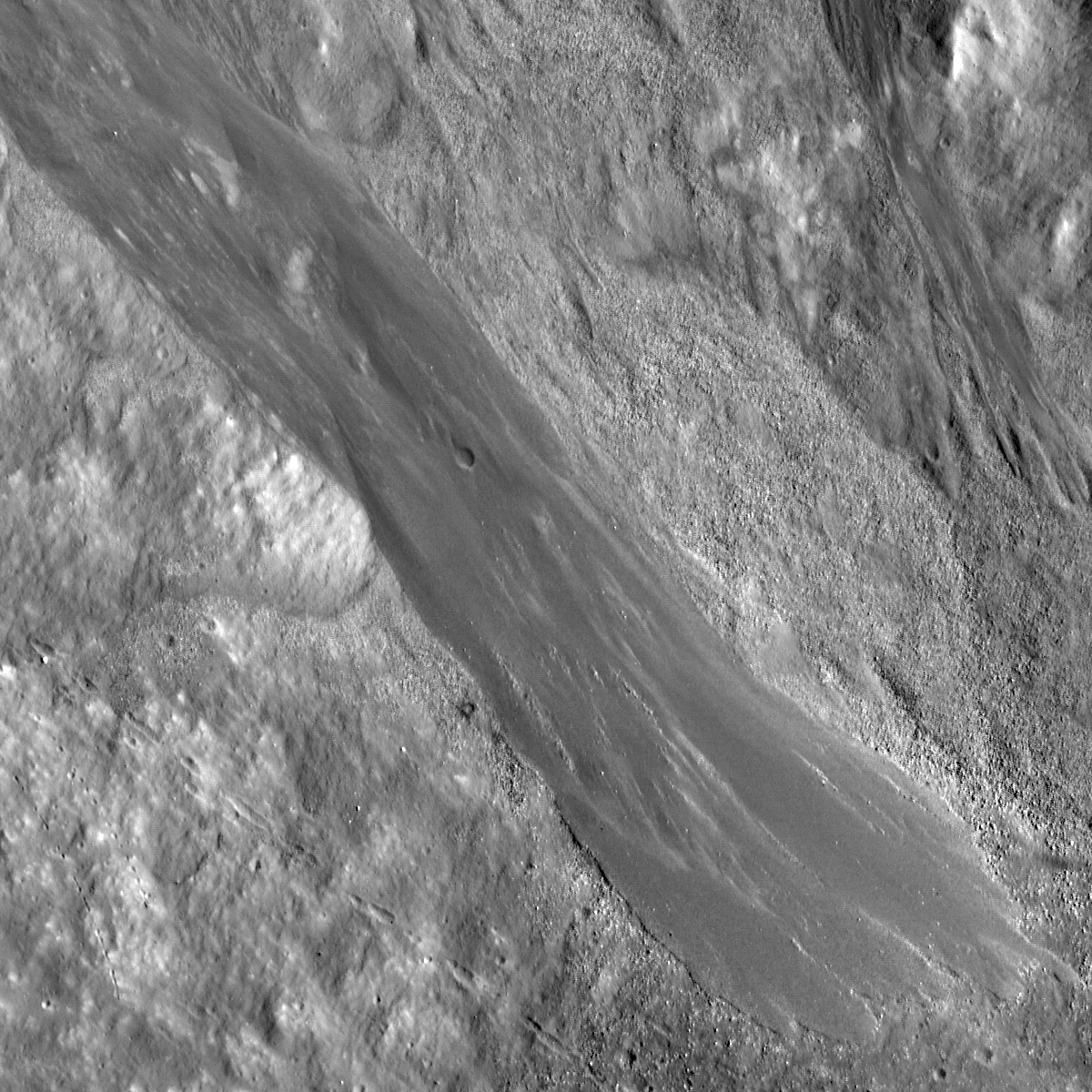
Granular debris flows cascade down the wall of a young crater. Geologically these are young features - but how young? Approximately a 696 meter-wide field of view from LROC Narrow Angle Camera (NAC) frame M185961505L (downslope to lower right, north is down), spacecraft orbit 12483, March 9, 2012; resolution 60 centimeters per pixel from 57.29 kilometers, angle of incidence 53.52° [NASA/GSFC/Arizona State University].
Lillian Ostrach
LROC News System

Granular debris flows are found in many young impact craters and are the products of mass-wasting. Over time, material from the crater rim and walls erodes into successively finer particles, and when the influence of gravity becomes too much this material moves downhill. Observations of mass-wasted material are prevalent in the LROC NAC images, and the detailed morphology of the flows are striking. Examples are composed of low-reflectance material when compared to the crater walls, fine-grained fingers superposing coarser-grained flows, as well as meandering flows interweaved with one another. Although debris flows on the Moon exhibit many spectacular morphologies and features, the presence of the flows represents relatively recent activity of a geologic process that is still active today.

Two kilometer-wide field of view, resampled to 12 percent of original NAC frame, with north at top, shows the granular flow in context with the southeastern rim, wall and floor of Clavius E. Boulder trails, shown at much greater visibility through the LROC Image Browser, abound [NASA/GSFC/Arizona State University].

Some debris flows show evidence of multiple formation events in the form of superposed lobes of material or braided channels, and today's Featured Image is no exception. The debris flow descending across the center of the image (51.725°S, 347.058°E) has braided, meandering channels at the upper left (uphill) that gradually disappear downslope into larger lobes of material. The lobes are most easily distinguished at the lower right corner of the image (downhill) where the flow terminates, and there are at least three individual flow units (and thus separate depositional events) that can be distinguished by a faint outline of higher-reflectance material. However, what makes today's flow special is the ~13 m diameter impact crater superposed on the flow because both of these features are geologically young. The presence of an impact crater on a debris flow suggests that the flow may not be geologically active at present and may not have been geologically active for some time (although constraining that time period is difficult).

Simulated view north over Clavius E (51.509°S, 347.278°E, ~15 km diameter), from a perspective originating 130 km over Clavius proper, south of Tycho. LOLA elevation model under LROC 100 meter Global WAC mosaic, ILIADS application from NASA Lunar Mapping and Modeling Project (LMMP).
Because the debris flows form in the young, least-degraded craters and do not often exhibit degradational features (such as superposed impact craters), determining the absolute age of the flow is impossible because the flow may have formed 100 million years ago or yesterday. However, the presence of a superposed impact crater on a debris flows constrains the relative age of the flow because the crater must have formed after the flow was deposited. Crater counting techniques are frequently used by lunar scientists to estimate an absolute age-date for a surface, but there have to be craters to count! For the moment, we must be satisfied knowing that enough geologic time has passed for the flow pictured above to accumulate one crater. Alternatively, LROC could target this debris flow (or others like it) and acquire additional observations over time in an attempt to understand the geologic history of these spectacular features. Because who knows - maybe a seismic event (moonquake, impact) will dislodge material upslope to flow downhill that erases the crater!

Can you find additional impact craters superposed on the debris flows in the full LROC NAC, HERE?

Hint: there is at least one other crater superposed on a debris flow in the opening image.

Related Posts:
Debris Channels
Lunar landslides!
Dawes
Granular Flow

Wednesday, October 17, 2012

A Beautiful Bench Crater

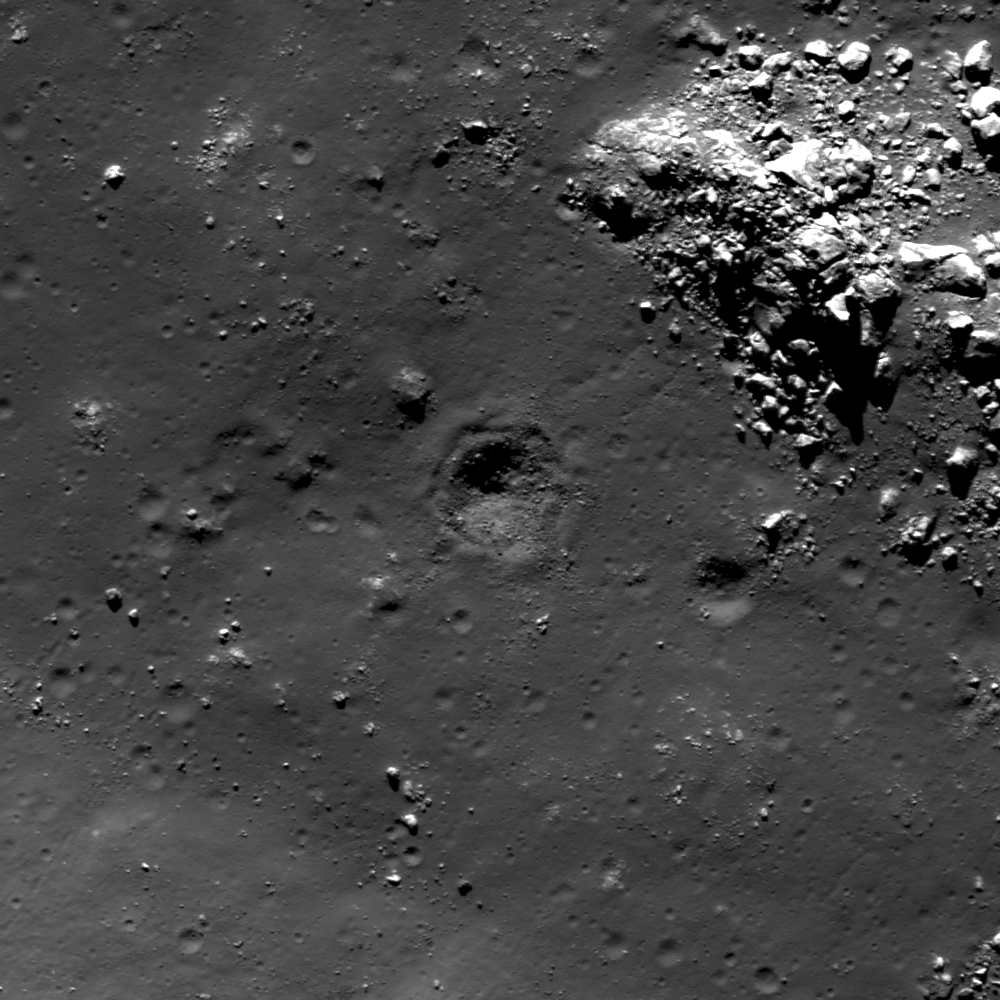
A beautiful bench crater, formed in melt trapped on a western wall terrace of Rutherfurd crater, south of Clavius on the lunar near side. A 300 meter-wide field of view from LROC Narrow Angle Camera (NAC) observation M185961318R, spacecraft orbit 12483, March 9, 2012; resolution 0.52 meters from 51.29 km [NASA/GSFC/Arizona State University].
Lillian Ostrach
LROC News System

Regolith covers the lunar surface, and the thickness of regolith on the surface is related to the age of the surface. Older surfaces have thicker regolith layers than younger surfaces, and observations of crater morphologies are used to learn about the regolith for a specific area. Bench craters form in layered targets when there are variations in strength between the layers because different strength targets require different amounts of energy during the excavation phase of impact cratering. On the Moon, bench crater formation is usually interpreted to result when a bolide punches through an unconsolidated regolith layer to excavate a more cohesive layer such as mare basalt bedrock. The 75 m diameter bench crater in the opening image (61.504°S, 346.728°E) is a prime example of a bench crater that formed in an impact melt pond that is covered by a thin layer of regolith. However, observations of LROC NAC images show some bench craters like the one above to be self secondary craters, formed during the last stages of the impact process. It may be that the bench crater above was one of the last secondary craters formed during the Rutherfurd impact event, soon after the melt was emplaced, but without further study, we cannot be certain.

LROC WAC monochrome 64 meter resolution mosaic of Rutherfurd crater (61.186°S, 347.683°E, ~47 km diameter), from LROC QuickMap. Featured Image field of view noted by plot point on the southwestern crater wall [NASA/GSFC/Arizona State University].

The smoothed, softened texture of the pond surface, absence of cracks and fractures in the melt, and presence of superposed impact craters of various sizes and degradational states provide evidence of a layer of regolith in this area. If the 75 m diameter bench crater is not a self secondary crater, the projectile that formed the crater likely excavated roughly 7-8 m into the melt rock. Meter-sized boulders distributed within and around the eastern portion of the bench crater support an impact into a consolidated target and the formation of these boulders during excavation of the crater. Besides confirming the results of experiments conducted in the 1960s with layered targets, today's bench crater might be used to help constrain the depth of the impact melt pond. If there are other craters of similar degradational state in the pond, the morphology of these craters could be studied to help constrain not only the regolith thickness but also perhaps the thickness of the melt pond in this region. Unfortunately, it looks like the ~40 m diameter crater to the right of the bench crater may too degraded or affected by the boulders outcropping toward the upper right of the image. Additionally, finding these craters may prove difficult because the Featured Image may be the location of the only small melt pond with a bench crater in this portion of the Rutherfurd crater wall and any bench craters occurring elsewhere may reflect the strength contrast between the impact melt veneer on Rutherfurd's wall and the crater wall material.

How many bench craters can you find in the full LROC NAC frame? Are the bench craters located in small melt ponds or in the impact melt veneer on Rutherfurd's wall? If you find bench craters in the melt veneer, what two layers do you think might be responsible for forming the bench (hint: think about what the melt veneer covered) if the craters are not self secondaries?

Related Posts:
Not so Simple!
Fresh Bench Crater in Oceanus Procellarum
Bench Crater in Plato

Saturday, July 4, 2009

LRO LROC commissioning Clavius


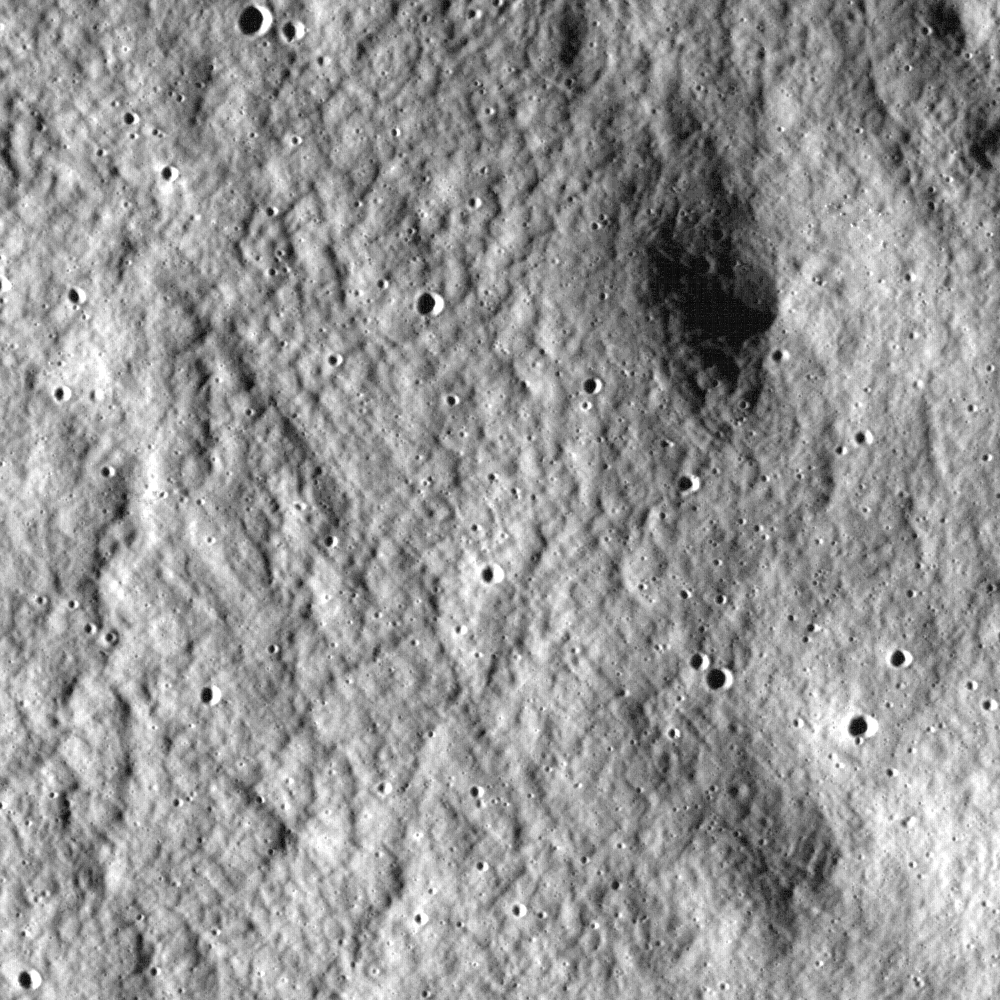
Close-up view of the lunar highlands, southeast of Clavius
[NASA/GSFC/Arizona State University]
Larger view, click on Image.

Arizona State-NASA Goddard - Tuesday's Lunar Reconnaissance Orbiter Camera (LROC) images were purely engineering tests, and this particular frame was part of a sequence specifically designed to check one of the NAC's settings.

The engineering frames were acquired with only one-tenth the number of lines of a standard 52,224-line NAC frame to allow the full sequence to be acquired in one orbit. As an added bonus we captured this spectacular view of the lunar highlands southeast of Clavius crater.

From 56 km altitude, small features such as fresh craters and boulders can be readily identified. Many hills in the in highlands exhibit the so-called "tree bark" or "elephant skin" texture, which really stands out in this picture. "Tree bark" was first identified by lunar scientists analyzing Apollo-era photography during the 1970s, and its origin remains a mystery. As NAC images accumulate and more examples are revealed, scientists will delve into the processes that form this distinctive surface texture. - Samuel Lawrence

LP Ed. NOTE: The "Elephant Skin" or "tree bark" texture seen in the lunar highland anorthosite, blanketed with dust, has a curious similarity with the larger scale structure seen in the cross-hatched kilometer-high rolling hills of the Descartes Formation.