Showing posts with label Carnegie Institution. Show all posts

Tuesday, August 21, 2012

NASA awards funding for sub-surface exploration by Astrobotics, among 28 needed innovation studies

Close-ups of the Tranquillitatis pit crater (8.337°N, 33.219°E), LROC Narrow Angle Camera (NAC) observation M155016845R, LRO orbit 7979, March 17, 2011. The interior is seen under a high Sun (incidence angles around 10.58°) and at resolutions close to 47.4 centimeters per pixel, from 39.67 kilometers. LROC QuickMap link [NASA/GSFC/Arizona State University].
Astrobotic Technologies has announced a contract with NASA to develop technologies for exploring caves on the Moon, Mars, and beyond. Astrobotic was one of ten teams to be selected for phase II awards from NASA's Innovative Advanced Concepts (NIAC) program.

NASA also announced funding for 28 innovative programs under the NIAC label.

Planetary caverns and tunnels can provide shelter from micrometeorites, radiation, and thermal extremes for human and robotic explorers. They may be the best hope for habitation on the Moon. They could be the best place on Mars to find life. They can provide a window into a planet's past geology, climate, and even biology. Recently discovered skylights, formed by partial cave ceiling collapse, provide access to sub-surface voids. In a phase I study for NASA's NIAC program, Astrobotic developed several mission concepts and investigated key technologies for exploring these exciting planetary destinations.

In phase II, Astrobotic will detail a mission concept for entering a planetary cave through a skylight, and exploring and modeling the interior. "Skylights are gateways to wonders of exploration, science and resources that await beneath planetary surfaces", said Red Whittaker, Astrobotic CEO. "Robots are our access to those new worlds." Robotic technologies will be developed to explore the extreme terrains of skylights and caves. This is very different from surface exploration, as has been achieved on the Moon and Mars. Technologies will be developed to descend into the holes, negotiate the blocky floors, and thread into the tunnels. The company will also roadmap technology for future planetary cave exploration missions. Astrobotic will collaborate with experts in subterranean robotics at Carnegie Mellon University on this contract.

Friday, March 18, 2011

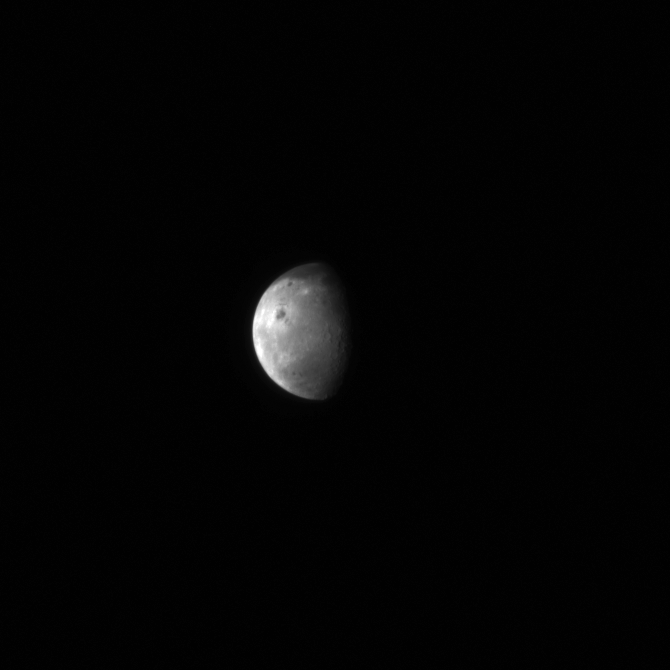
Earth's Moon from MESSENGER


Image of Earth's moon from MESSENGER's Wide Angle Camera. The Moon's south pole, farside highlands, west Oceanus Procellarum and Mare Orientale are prominent [NASA/Johns Hopkins University Applied Physics Laboratory/Carnegie Institution of Washington].

Sarah Braden

LROC News System

The MErcury Surface, Space ENvironment, GEochemistry, and Ranging (MESSENGER) spacecraft became the first spacecraft ever to enter Mercury's orbit! The insertion burn occurred 18 March 2011 at 12:45 am UTC (17 March, 8:45 EDT). The MESSENGER spacecraft traveled about 4.9 billion miles to reach the point for orbital insertion. Read more about the successful MESSENGER orbital insertion!

Today's Featured Image is the Moon as seen from the MESSENGER spacecraft on July 31, 2005, less than a year after the spacecraft's launch from Cape Canaveral. The lunar image was taken by the MESSENGER Wide Angle Camera (WAC), which is part of the Mercury Dual Imaging System (MDIS). At the time when the image was taken, the spacecraft was about 992,814 kilometers (616,906 miles) from the Earth.

This image was not taken simply because the Moon is beautiful and inspiring; it serves to help the MESSENGER team calibrate the camera and spectrometer. The Moon is a good calibration standard because its reflectance and color have been measured with many instruments, so it is useful to make comparisons between instruments with different characteristics. In other words, it is a check on the quality of the Earth-based calibration.

LROC is an important new contributor to our understanding of how light interacts with the lunar surface especially in ultraviolet wavelengths. In particular, the new WAC color images will help to calibrate the MESSENGER MASCS spectrometer, which measured the Moon at the same time the MDIS camera snapped this picture.

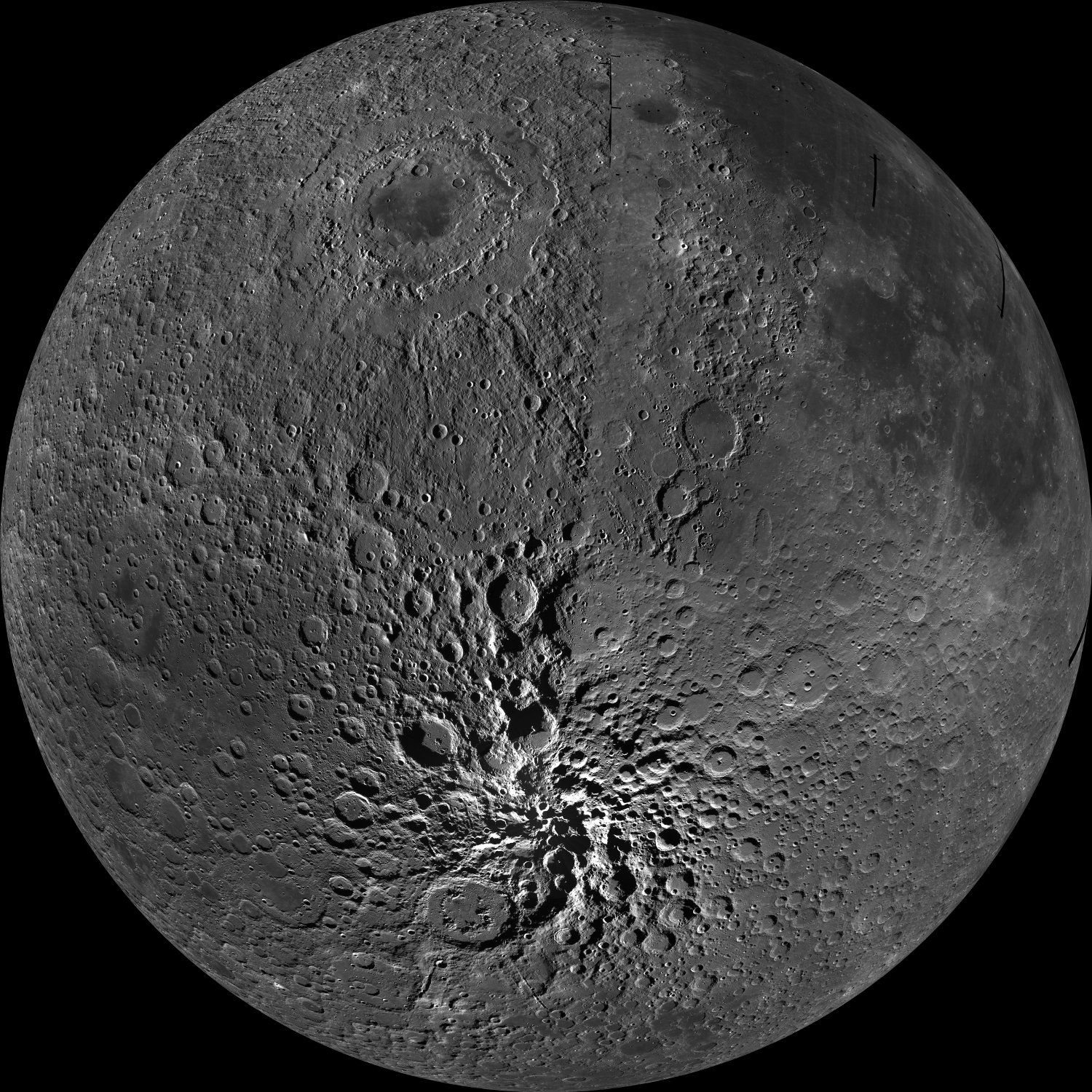
The MESSENGER MDIS view of the Moon is centered about -60°, 280°. Mare Orientale is the the small dark spot in the upper left. For a closeup of Orientale see the recent LROC Featured Image. The same viewpoint as the MESSENGER image was used to create a higher resolution view from the LROC WAC.


LROC Wide Angle Camera 400 meter/pixel orthographic projection, similar to the field of view captured from MESSENGER, July 31, 2005. View the full-sized contextual LROC WAC mosaic HERE [NASA/GSFC/Arizona State University].

After the orbital insertion, scientists will test the spacecraft systems to make sure that all the instruments are in good working order. It is important to verify that all the instruments operate well in the harsh thermal environment around Mercury (currently Mercury is only about 0.3 AU from the Sun!). On April 4, 2011, the science phase of the MESSENGER mission will begin and the orbital science data from Mercury will be returned to Earth almost every day for at least a year! For more news about the MESSENGER mission, visit the NASA news page.

Congratulations to the awesome MESSENGER spacecraft operations team at APL!

Check out the MESSENGER website to learn more about the mission goals!

Monday, July 5, 2010

Graphite found in Apollo 17 sample

A. Light microscopy image of 72255,89. (B) Higher magnification image of transition from light to dark material in area shown in (A). (C) Raman spectra of three types of graphite analyzed in the sample [A. Steele, et al].

Nancy Atkinson
Universe Today

Long-held secrets continue to be unlocked from the Moon. Researchers taking a new look at a rock brought back by the Apollo 17 mission have discovered graphite in the form of tiny whiskers within the lunar sample. Just like the recent finding of water on the Moon, it was previously thought that any carbon present in the Apollo rocks came from terrestrial contamination from the way the lunar samples were collected, processed or stored. Andrew Steele, who led a team from the Carnegie Institution's Geophysical Laboratory said the graphite could have come from carbonaceous impactors that struck both the Moon and Earth during the Late Heavy Bombardment, approximately 4.1 to 3.8 billion years ago, and if so, could provide a new and important source of information about this period in the solar system's early history.

"We were really surprised at the discovery of graphite and graphite whiskers," Steele said. "We were not expecting to see anything like this."

The tiny graphite whiskers or needles were found in multiple spots within a specific area of lunar sample 722255 from the Mare Serenitatis impact crater in the Taurus-Littrow region, indicating that the minerals are in fact from the Moon and not just contamination.

Read the article, HERE.

Monday, June 14, 2010

Moon's 'apatite' for water


Figure 1. (McCubbin, et.al.) Back-scattered electron images of Apollo high-Aluminum basalt sample 14053, 16. Phase abbreviations are as follows, apatite; Met, Fe-metal; b Si, intergrown Fe-metal and silica; Kfs b Si, intergrown K-rich feldspar and silica; Pyx, pyroxene; Ox, Fe-Ti oxide; Pl, plagioclase; Si, silica; Ol, olivine. (A) BSE image showing one of the apatite granes analyzed by SIMS. The black circle with the white number indicates the analysis spot and its corresponding analysis number. The reduction texture of fayalite breaking down to Fe-metal b silica is also captured in this image. (B) BSE image showing the apatite analyzed by SIMS. The black circle with the white numbers indicate analysis spots and their corresponding analysis numbers.

Carnegie Institution of Washington/Geophysical Laboratory - For years it was believed that the Moon is 'bone dry'. A new paper reports a higher water content of the Moon compared to previous work based on direct measurements upon lunar samples of the phosphate mineral apatite. Video press release.

Francis McCubbin, Andrew Steele, Erik Hauri and Russell Hemley, from Carnegie along with Hanna Nekvasil from Stony Brook University and Shigeru Yamashita from Okayama University find 100’s to 1000’s parts per million (ppm) water in the apatite using a technique known as secondary ion mass spectrometry. The results indicate a minimum water content of the source of the Moon’s magmas that is more than two orders of magnitude greater than the previous estimates of less than 1 parts per billion (ppb) for the lunar interior.

Water is an important component in igneous systems, and its presence in planets affects the nature of these bodies as a whole. The lower limit of water inferred for the Moon in this study is still low in comparison to the interior water contents of the Earth and Mars. The work shows, however, that the 40 year old notion that the Moon now appears to contain significantly more water than previously thought not only needs to be reassessed, it can also be quantified. For additional information see: Moon Whets Appetite for Water.

The article can be found at: F. McCubbin et al. Proc. Nat. Acad. Sci. 10.1073, 1006677107 (2010).

The thumbnail image is a crystal structure of apatite Ca5(PO4)3(F,OH,Cl).